 Saltar para o conteúdo
Plunge Routers vs. Fixed Routers
Routers come in two base designs: fixed and plunge. You need to understand the differences to purchase tools smartly. Both plunge and fixed routers have some advantages at particular routing tasks that affect the quality of production.

Source: bosch
What Is a Fixed-Base Router?
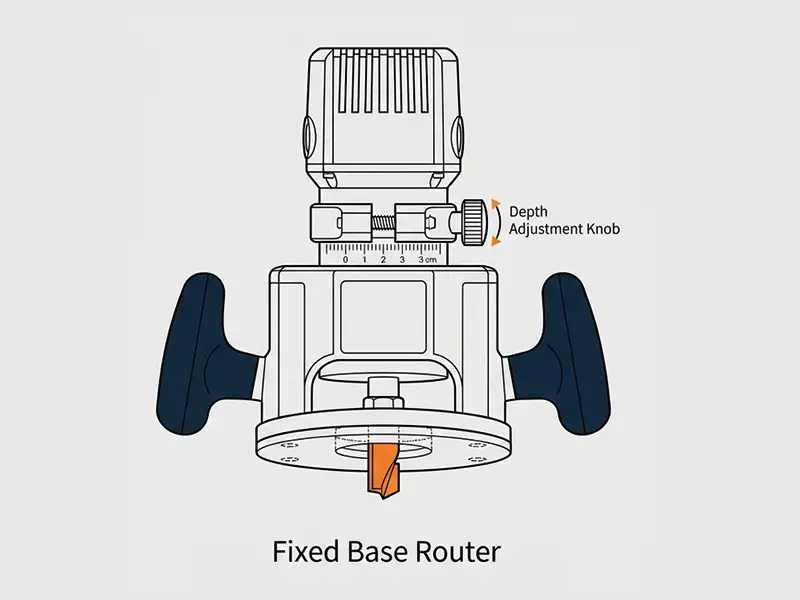
A fixed-base router holds the bit at a locked position. You set the cutting depth before starting work. The broca de tupia extends a fixed distance from the base. It stays at that height until you adjust it. Most models have micro adjustment dials for precision. The design is compact and lightweight. So you generally use fixed-base routers to profile edges. They work best when mounted in router tables.
What Is a Plunge Router?
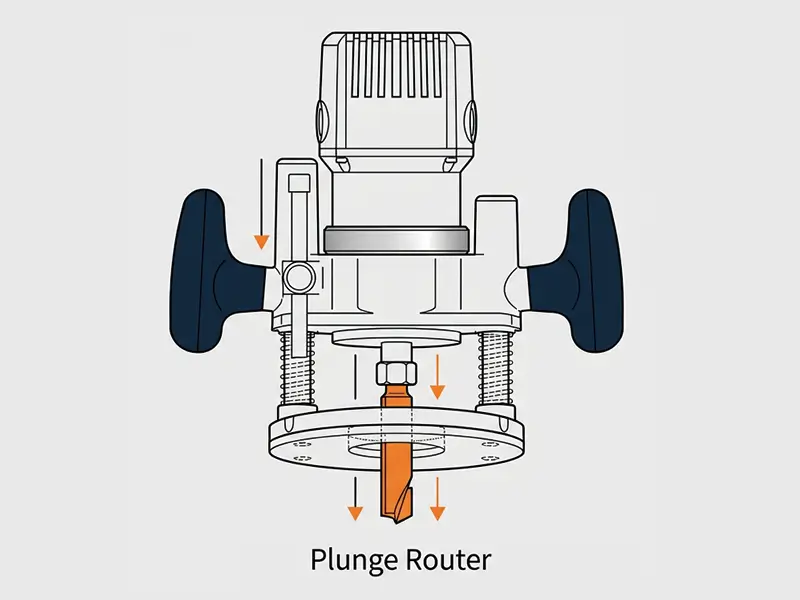
A plunge router allows vertical bit movement during operation. The motor rides on spring-loaded arms. You can lower the bit into material while the router runs. A lock lever controls the plunge action. Depth stops preset how far the bit plunges. The springs automatically lift the bit when you release the lock. You need plunge routers for mortises and stopped cuts. They start cuts anywhere on the workpiece surface.
How Does Fixed and Plunge Router Work?
Fixed-Base Operation
You adjust the base to your desired cut depth first. Then you lock it at that height. The bit remains at constant extension throughout the entire cut. You must start all cuts from the edge of your workpiece. You turn on the router, guide it along the material, then turn it off. An important thing here is that the bit position never changes during operation.
Plunge Router Operation
You position the router over your work with the bit raised above the surface. Next, turn on the motor first. Then you push down on the handles to plunge the bit into the material. The bit reaches your preset depth stop. You lock the plunge mechanism at that depth. You make your cut, then release the lock. The springs lift the bit automatically. You can start cuts anywhere on the board surface.
When to Use a Fixed-Base Router

Router Table Applications
Fixed-base routers work ideally in router tables. You can adjust bit height easily without removing the router. There is no spring tension to overcome during adjustments. The bit position stays stable and consistent. You use table-mounted routers for panel raising and edge profiles. You also cut joinery like tongue-and-groove connections. Most router lifts are designed specifically for fixed-base motors.
Edge Profiling and Decorative Work
Bearing-guided bits are used in conjunction with fixed-base routers. It is easier to use with one hand due to its lightweight. It is easier when using board edges. You get cleaner on the chamfer and round over. Fixed bases are better suited to ogee and cove profiles. The small size allows you to view your cut line.
Production Runs with Consistent Depth
You establish the depth once and cut several pieces in the same direction. No chance of making a mistake and altering depth in the middle of production. The plunge mechanism is not needed to speed up the operation. You just follow the router in each piece. It is most effective for high-volume, repetitive tasks. As an example, 50 drawer fronts can be profiled without depth adjustment.
When to Use a Plunge Router
Mortising and Joinery
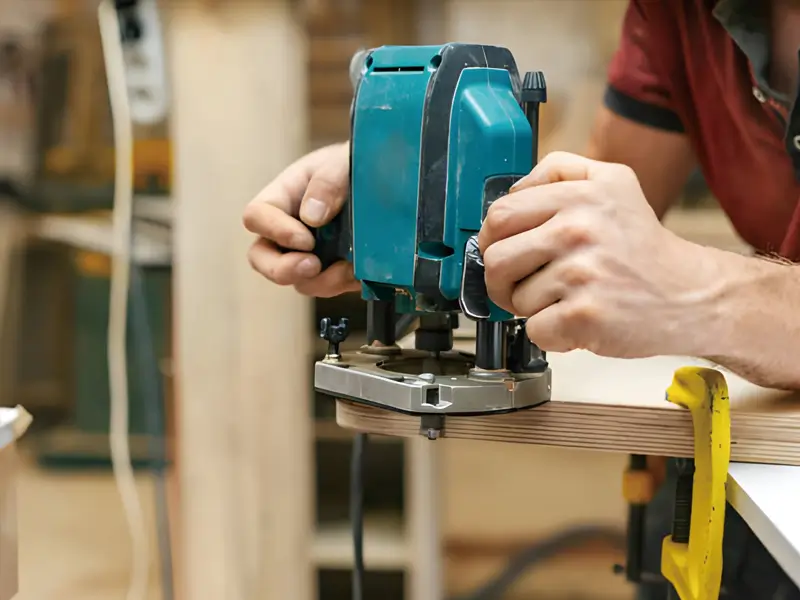
Board centers require plunge routers to cut mortises. Fixed-base routers are not safe to initiate these cuts. You have depth stops to use in cutting in steps. You can say, for example, 1/4 inch each pass on deep mortises. This eliminates bit breakage and motor strain. You have accurate depth control in fitting tenons. The procedure is less risky and more precise as compared to fixed-base options.
Template and Pattern Routing
Guide bushings are compatible with plunge action. You put the trim router, and then cut to the start. You break and retract on template boundaries without leaving any residue. Damage to templates through tipping in is eliminated. Dovetail jigs can only be operated with plunge routers. Complex joinery jigs rely on controlled plunge.
Inlay Work and Decorative Routing
You require a free entry and exit of captured inlays. This control is offered by default on plunge routers. You get the exact depth for stringing and banding. Decorative flutes, stopped cuts, cut clean. As an example, rout flutes can be used to prevent 2 inches beneath the bottom of the leg. You are at a better level with sensitive decorative work.
Stopped Grooves and Dadoes
Certain grooves should not run along the edge. You require suspended shelf supports in the form of dadoes. Stopped cuts are needed in columns of flutes and legs of furniture. These operations cannot be safely performed on fixed-base routers. The plunge mechanism is vital in the initiation and halting of mid-board.
Why Manufacturing Operations Need Both Router Types
Production Efficiency Through Specialization
You should dedicate a fixed-base router to your router table permanently. You keep a plunge router for handheld operations. This eliminates base swapping delays between tasks. Tool changeover time drops significantly. You optimize workflow by matching the right tool bit to each task. For example, production runs stay at the router table while custom joinery uses the plunge router.
Expanded Capability Range
Fixed-base routers handle 70 to 80 percent of special routing tasks. Plunge routers are essential for the remaining 20 to 30 percent. Together they provide complete routing capability. You eliminate the need to outsource specialized routing operations. Some projects absolutely require plunge capability. You cannot compromise on mortising and stop cuts.
Quality and Consistency
Fixed-base routers deliver superior accuracy for repetitive operations. Plunge routers provide precision for complex joinery. Each type comes with benefits for special applications. You get better results than compromising with a single router type. Quality improves when you use the right tool for each task.
Tool Investment Strategy
Combo kits provide both bases for one motor investment. Your total cost is lower than buying two separate routers. You simplify maintenance with shared motor components. Spare parts inventory is more efficient. This approach works best for shops building routing capability. You invest approximately $250 to $300 for complete routing functionality.
Combo Router Kits
What Combo Kits Include
One motor unit is included in a general combo kit. The majority have 2 to 2.3 horsepower midsize motors. Bases are both fixed and plunge. Base swapping can be done quickly using quick-release mechanisms. Both bases are compatible with accessories, such as edge guides and dust ports. You buy a whole routing solution at a time.
Advantages of Combo Kits
You save money compared to separate routers. Combo kits cost $200 to $350 versus $400 or more for two routers. You get consistent power and performance across both bases. The learning curve is simpler with one motor and two bases. Maintenance and spare parts are less complex. You stock parts for one motor instead of two.
Leading Combo Kit Options
The industry standard is the Bosch 1617EVSPK. It provides 2.25 horsepower electronic variable speed. The DW618PK by DeWalt is constructed heavily. It has a soft-start system to ensure a smooth operation. The Makita RT0701CX7 is a small router package. It is effective in light routing. Test new designs as manufacturers periodically upgrade product lines.
Conclusão
Fixed-base routers are good at router table work and edge profiling with superior accuracy. Plunge routers handle mortising, stopped cuts, and template work that fixed bases cannot do. You should invest in combo kits for complete capability at the lowest cost.
FAQs
Can you use a plunge router in a router table?
Plunge router springs add friction during height adjustments. Most router lifts are designed for fixed-base motors. The springs resist the lift mechanism operation.
Which router is better for beginners?
Fixed-base routers are simpler to operate and more forgiving. They have fewer moving parts and lighter weight. You should start with a fixed base, then add plunge capability as skills develop.
Do I need both a plunge and fixed-base router?
You need both for complete routing capability. Fixed bases handle 70-80% of tasks but cannot do mortises or stopped cuts. Combo kits provide both bases affordably with one shared motor.
Are plunge routers heavier than fixed-base routers?
Plunge routers weigh 30-50% more due to steel arms, springs, and telescoping mechanisms. A general fixed base weighs 6-8 pounds while comparable plunge routers weigh 9-12 pounds.


 Portuguese
  English
  Russian
  German
  Spanish
  French