 Skip to content
What Is MDF? Complete Guide for Beginners
MDF is an engineered wood product. It is made from wood fibers, resin, and wax pressed into uniform panels. You need to understand this material for affordable alternatives to solid wood and plywood that are important for manufacturing operation.
What Is MDF?
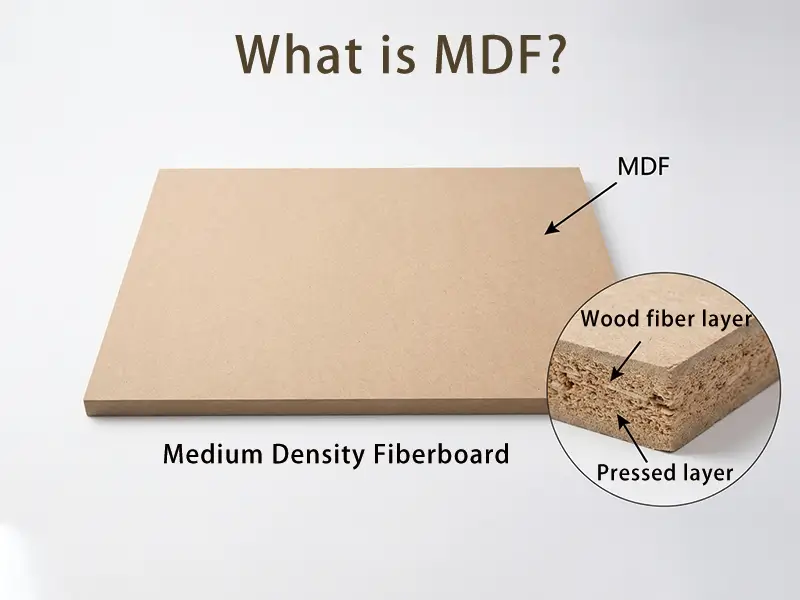
MDF stands for Medium Density Fiberboard. It is an engineered wood material that consists of 80 to 85 percent wood fibers. Moreover, MDF is combined with 8 to 10 percent resin binder and wax. The full form describes the material’s density range of 600 to 800 kilograms per cubic meter. It falls between low density particleboard and high density hardboard.
You will not find visible grain patterns or knots in MDF, as you see in solid wood or plywood. Instead, MDF gives a smooth, consistent surface on all sides and edges. This uniformity makes MDF material ideal for applications requiring painted finishes.
How Is MDF Made?
- Logs Chipping
The MDF production process begins when logs arrive at the mill. Workers debark the logs and feed them through chippers that reduce the wood into small pieces. You can take these wood chips from softwoods, hardwoods, or even recycled wood from manufacturing waste.
- Defibrating
Next, the chips go into a defibrator where high-pressure steam and mechanical action cut them into separate wood fibers. This step distinguishes MDF from particleboard, which uses larger wood particles. The finer fibers in MDF make a denser, more uniform material.
- Wax Injection
Then, the manufacturing process injects wax into the fiber stream. This wax coats each fiber and provides some moisture resistance in the finished product.
- Fiber Distribution
After that, the coated fibers drop onto a forming belt where they distribute into a uniform mat. The thickness of this mat determines the final panel thickness. Workers can create MDF thicknesses from 1/8 inch up to 1-1/2 inches.
- Hot Pressing and Resin Bonding
The fiber mat then moves into a hot press where temperatures reach 300 to 400 degrees Fahrenheit and pressure exceeds 1,000 pounds per square inch. This combination activates the resin and bonds the fibers together permanently. The pressing method creates the characteristic density and strength of MDF.
- Cooling, Trimming, and Sanding
Finally, the pressed panels cool gradually to prevent internal stress. Workers trim the edges to standard MDF sizes like 4×8 feet or 5×12 feet sheets, then sand the surfaces smooth. Some manufacturers add primer to make primed MDF sheets ready for immediate painting.
MDF vs. Plywood
Difference in Structure
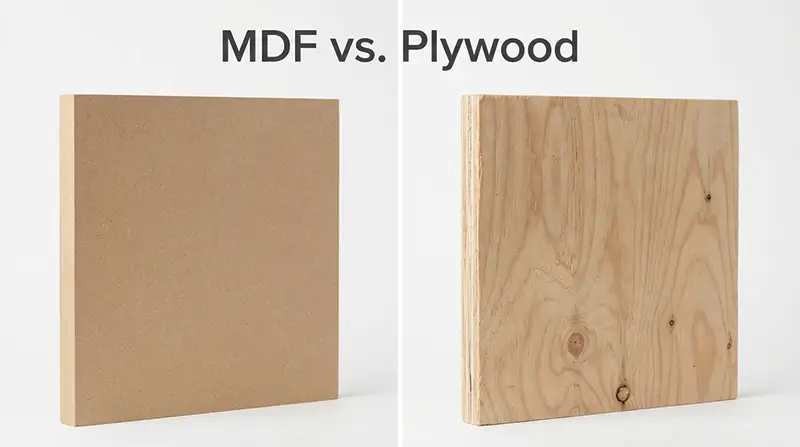
Plywood consists of thin wood veneers stacked in layers with alternating grain directions. This is a cross-grain construction. It provides strength in multiple directions. In contrast, MDF boards contain randomly oriented wood fibers with no grain direction at all.
The difference in structure affects how each material behaves. Plywood resists splitting along grain lines because the cross-layers prevent cracks from propagating. MDF gives uniform strength in all directions but generally lower overall strength than comparable plywood grades.
Performance Comparison
Strength
You will find plywood stronger than MDF for structural applications. The layered construction of plywood creates a good bending strength and impact resistance. When you need load-bearing shelves and cabinet boxes that support heavy weight, plywood performs better.
Surface Finishing
However, MDF excels for surface quality. The smooth, void-free face accepts paint without grain telegraphing through the finish. You can also create complex profiles and molding details that would splinter in plywood. Furthermore, MDF edges the machine cleanly for decorative routing.
Moisture Resistance
Plywood is good at moisture resistance in many applications. Standard MDF swells permanently when exposed to water, while plywood maintains its structure better. You must specify a moisture resistant MDF or HMR MDF board when humidity exposure is likely. Even these upgraded grades do not match plywood’s moisture performance.
Weight
Weight is a significant disadvantage for MDF. For example, a 4×8 sheet of 3/4-inch MDF weighs approximately 95 to 100 pounds. Simultaneously, comparable plywood weighs 60 to 65 pounds. This 50 to 75 percent weight difference increases shipping costs and complicates handling.
The cost of MDF sheets is generally 30 to 50 percent less than similar plywood. Similarly, standard MDF price falls between $26 to $32 per 4×8 sheet, while plywood costs $45 to $65. However, the price also depends on grade and species.
MDF vs. Solid Wood
Solid Wood
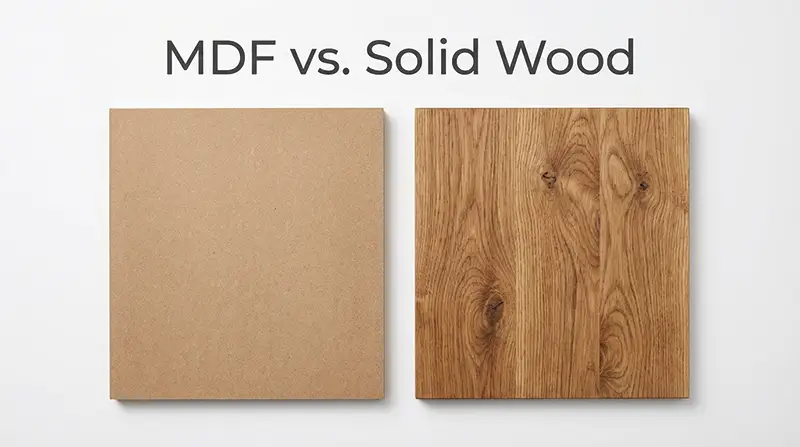
Solid wood gives a natural beauty with visible grain patterns, color variations, and unique character that MDF cannot adopt. When you need aesthetic appeal and are low on budget, solid wood gives a good appearance. However, solid wood also moves seasonally. For example, it expands in humidity and contracts in dry conditions.
MDF
MDF maintains dimensional stability regardless of humidity changes in controlled environments. You will not experience the warping issues, cupping, or twisting common with solid wood. This predictability simplifies manufacturing and reduces defect rates.
Cost Comparison
Moreover, MDF costs 50 to 70 percent less than most hardwoods. You can produce painted furniture and cabinets at significantly lower material costs using MDF instead of maple, oak, or cherry. The cost advantage becomes even greater for wide panels where solid wood requires edge-gluing multiple boards.
Strength
Solid wood gives good strength for high-impact applications. MDF dents and crushes more easily than hardwood when struck. Furthermore, solid wood furniture can be refinished multiple times. On the other hand, MDF accepts only limited sanding before exposing the core material.
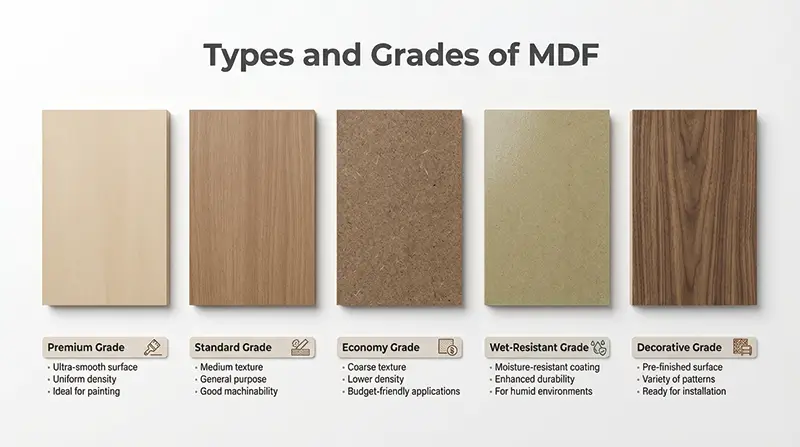
Types and Grades of MDF
Standard MDF is good for general interior applications at the lowest cost. Moisture resistant MDF includes special additives and is suitable for humid environments but not direct water contact. Subsequently, fire retardant MDF meets building code requirements for commercial construction.
Ultra light MDF reduces weight by 20 to 30 percent for applications where handling matters. High-density MDF gives enhanced strength for demanding uses. Flex MDF bends around curves for specialty applications like column wraps and curved moldings.
Formaldehyde emission standards include E2, E1, and E0. CARB Phase 2 compliant materials meet California’s strict emission limits. You should specify low- emission grades for any indoor application.
How to Select the Right MDF for Your Application
Assess Environmental Conditions
Use standard MDF only in dry interior locations with controlled climate. You should highlight moisture resistant MDF or HMR MDF for closets, and laundry rooms. Moreover, you should choose fire retardant MDF when building codes require it for commercial construction.
Evaluate Requirements for Structure
You should not choose MDF for heavy loads. MDF is good at decorative parts, drawer fronts, and door panels. Select plywood for cabinet boxes, and shelving that supports significant weight.
Match Finish Requirements
MDF is also good for painting. You can use it whenever you need paint-grade finish. Furthermore, you can select solid wood or plywood for stained finishes that show natural grain. MDF also works as an excellent substrate for wood veneer. It is important when you need a natural appearance with MDF.
Conclusion
MDF is best at cost savings and better painted finishes for manufacturing. You can easily produce furniture, cabinets, and millwork. Select MDF when you need smooth surfaces and your budget is tight. However, you should choose plywood or solid wood to resist moisture, and structural loads.
Sundi provides a variety of cutting tools for MDF processing, including router bits, planer blades, and saw blades. Get in touch with us today to find the right solution for your needs and improve your machining performance.
FAQs
Is MDF as strong as plywood?
No because Plywood has layered construction. It provides you with a good bending strength and impact resistance. Subsequently, MDF gives uniform strength but lower overall structural capacity.
Can MDF be used outdoors?
Standard MDF is not good for outdoor purposes. Even moisture resistant MDF is not suitable for exterior use. You need marine plywood or you can use treated lumber for outdoor applications.
How do you prevent MDF from swelling when wet?
You should seal all edges and surfaces with paint, primer, or specialized edge sealers before moisture exposure. However, even regular water and moisture is not good for sealed MDF.
What is the difference between MDF and particleboard?
MDF uses finer wood fibers creating denser, stronger, smoother material. Particleboard uses larger wood chips resulting in lower density, rougher surface, and less strength but lower cost.
Is MDF toxic or safe for indoor use?
MDF releases formaldehyde from resin binders. Choose E0 or E1-rated material with low emissions for safe indoor use. Proper ventilation and dust collection protect workers during fabrication.
Can you stain MDF like real wood?
No. MDF absorbs stain unevenly creating blotchy appearance. The material works only for painted finishes or as a substrate for wood veneer when natural appearance is desired.
How much does MDF weigh compared to plywood?
MDF weighs 50 to 75 percent more than plywood. A 3/4-inch 4×8 sheet of MDF weighs 95-100 pounds while similar plywood weighs 60-65 pounds.


 English
  Russian
  German
  Spanish
  French
  Portuguese