 Skip to content
What is a Thickness Planer?
A thickness planer changes rough lumber into precision dimensioned boards. It makes all your boards the exact same thickness. A thickness planer ensures the top and bottom surfaces are smooth and parallel to each other. You need it when you are making products where the wood has to be precisely the right size and of high quality.
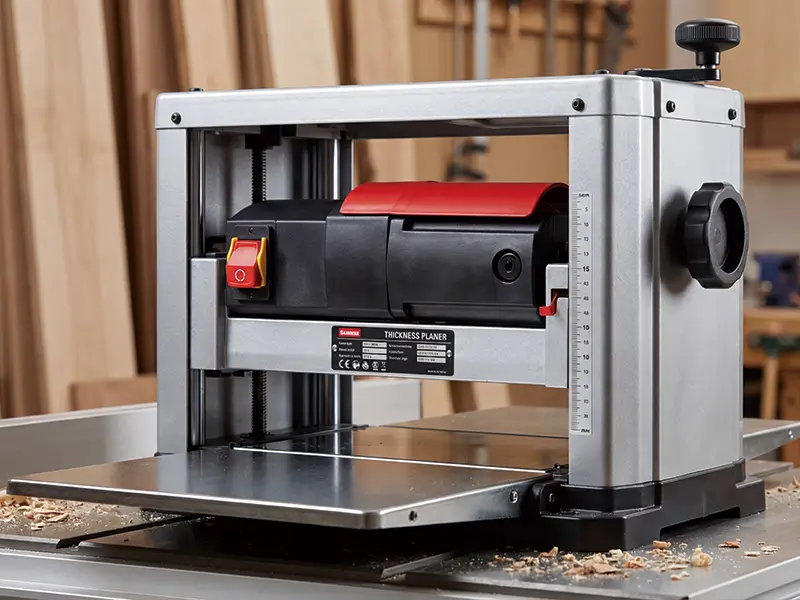
What is a Thickness Planer?
A thickness planer is a woodworking machine. It reduces boards to a consistent thickness throughout their entire length. In the United Kingdom and Australia, manufacturers call this machine a thicknesser. The machine uses rotating cutterhead blades to remove thin layers of material from the top surface while the bottom face rides on a flat reference table.
The primary function focuses on making boards with two perfectly parallel faces. However, you must understand an important limitation: the planer does not flatten warped wood. The machine only makes surfaces parallel to each other. You need a flat reference face on the bottom before you can achieve accurate results.
How Does a Thickness Planer Work?
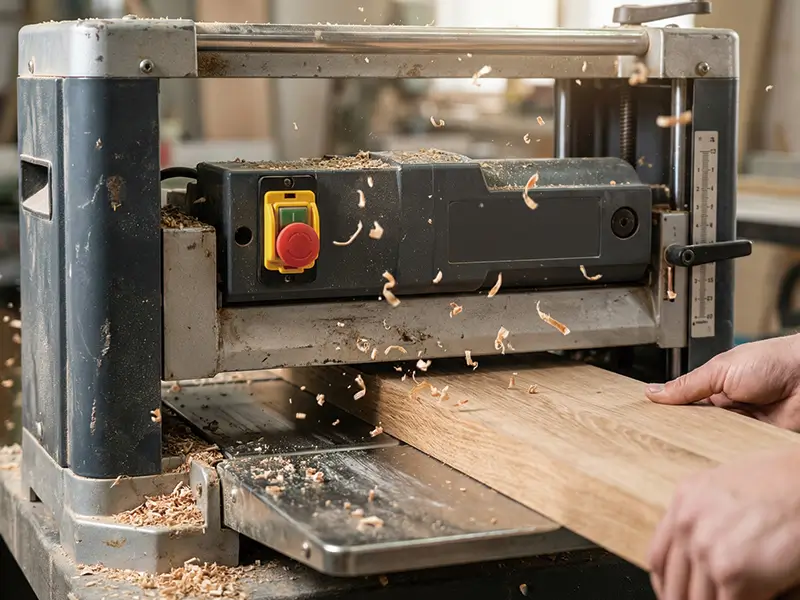
Important Parts
The thickness planer consists of four important systems.
First, the feed table provides the flat reference surface that you can adjust to control material removal. Second, the in-feed and out-feed rollers grip and move boards through the machine at a consistent speed. Third, the cutterhead holds the planer cutting blades. It rotates at 8,000 to 10,000 RPM. Finally, the depth adjustment mechanism controls the distance between the cutterhead and the table. It allows adjustments as small as 1/64 inch.
Operating Process
You begin by setting the table height so the cutterhead contacts the board’s top surface. Then, you push the board into the in-feed roller. It automatically feeds it through. The rotating cutterhead shaves material from the top as the bottom face slides along the flat table. Most operators remove material in passes of 1/16 inch or less. The purpose is to prevent motor overload and wood tearing.
One requirement deserves emphasis: you must have one flat reference face before planning. If you feed a warped board through the planer, the machine simply copies that defect to the opposite face.
Thickness Planer vs. Jointer
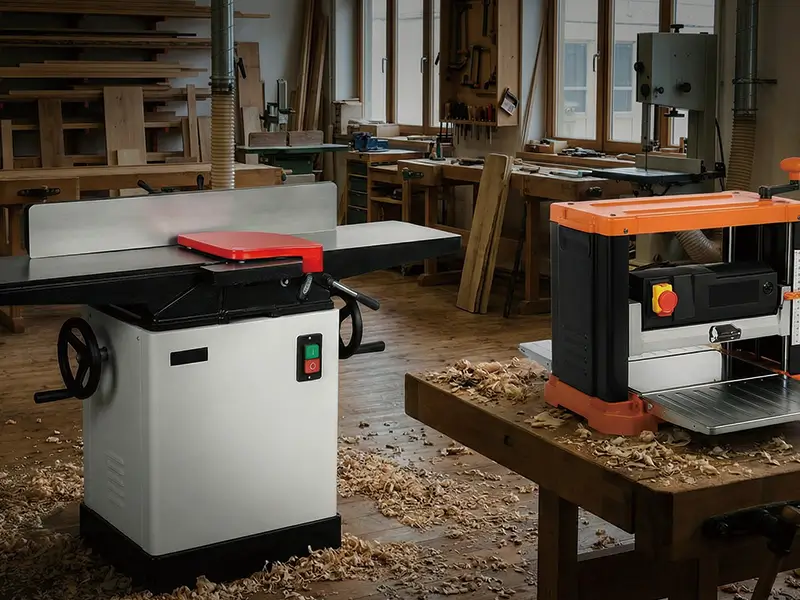
The jointer flattens one face and squares one edge of rough lumber. You push boards across the jointer’s flat table past a rotating cutterhead that removes high spots.
The planer makes both faces parallel and reduces boards to a consistent thickness. You cannot create a flat surface from warped lumber using only a planer.
Both tools work together in proper lumber milling. First, you flatten one face on the jointer. Second, you square one edge on the jointer. Third, you run the board through the planer with the flat face down. This makes the second flat face parallel to the first.
Types of Thickness Planers
Manual Hand Planers
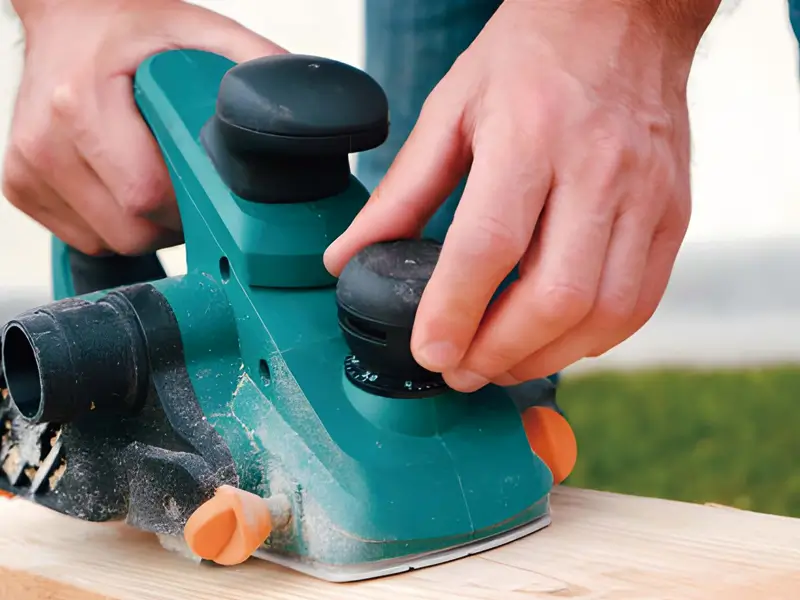
Manual hand planers give maximum portability, and electricity costs are zero. These tools are good for small jobs and edge work where you only need to remove a very little material. However, you should be skillful to maintain consistent thickness and require significant physical effort for large volumes.
Benchtop Planers
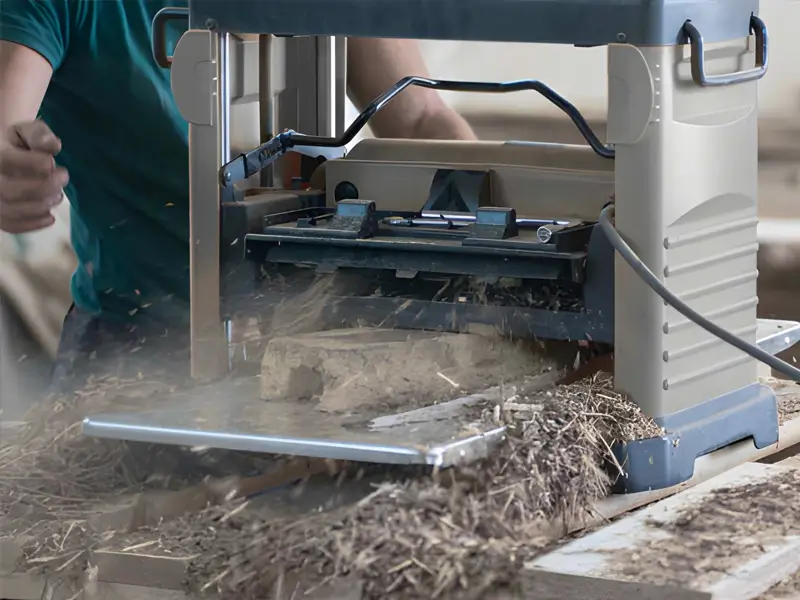
Benchtop planers dominate small-to-medium manufacturing operations. These portable machines handle boards 12 to 13 inches wide and up to 6 inches thick. The machines weigh 60 to 100 pounds and generally incorporate 15 amp motors running on standard 120 volt circuits.
Stationary/Industrial Planers
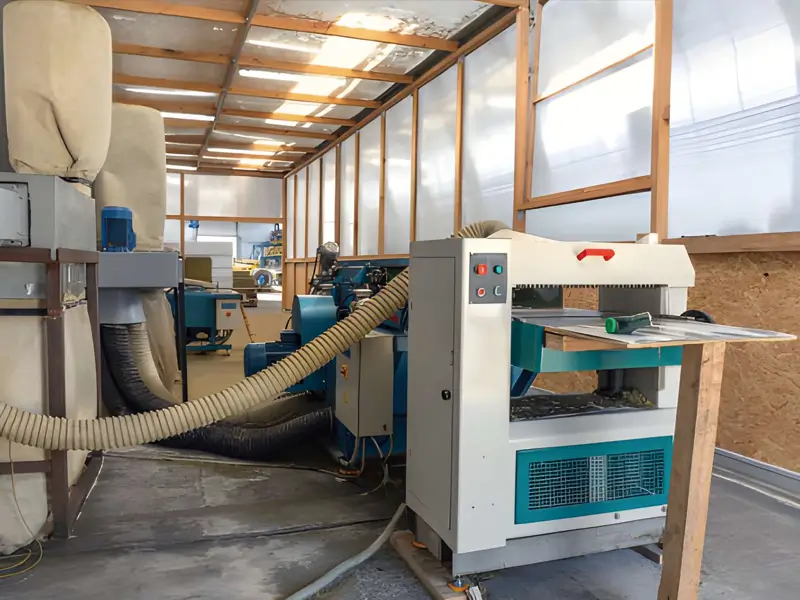
Stationary planers give maximum capacity for high volume manufacturing. These are floor standing machines. They can handle boards 15 to 20 inches wide with heavy cast iron construction weighing 400 to 800 pounds. Industrial planers use powerful 3 to 5 horsepower induction motors designed for continuous operation. However, the main disadvantages involve cost starting around $2,000.
How to select a Thickness Planer?
Cutterhead Technology
Straight blade cutterheads use two or three planer knives spanning full width. They cost less initially but produce more noise. Subsequently, it tears the figured wood, and requires complete blade replacement when damaged.
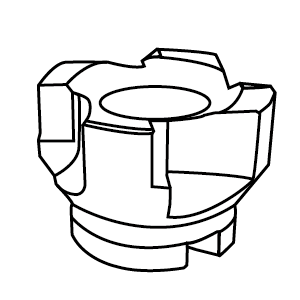
Spiral cutterheads arrange small square carbide inserts in staggered patterns. Each insert has four cutting edges that you can rotate when dulled. This dramatically reduces operating costs because you only replace individual inserts. Furthermore, spiral cutterheads produce less noise and reduce tear-out.
Helical cutterheads position carbide inserts at an angle for shearing action that produces the finest surface finish. However, they command premium prices of $300 to $800 more than straight-blade models.
Capacity Specifications
Match planer capacity to your typical material dimensions. Benchtop planers handle 12 to 13 inches wide, while stationary planers range from 15 to 20 inches. Most planers accept boards up to 6 inches thick. In addition, consider feed rate—premium models offer two-speed operation with slower rates that reduce tear-out in figured hardwoods.
Motor Power and Performance
Benchtop planers use 15-amp universal motors on 120-volt circuits. These provide adequate power for most applications but may require lighter cuts in dense hardwoods. Stationary planers use 3 to 5 horsepower induction motors on 220 or 240-volt circuits that handle heavy cuts and continuous operation without overheating.
Snipe Reduction Technology
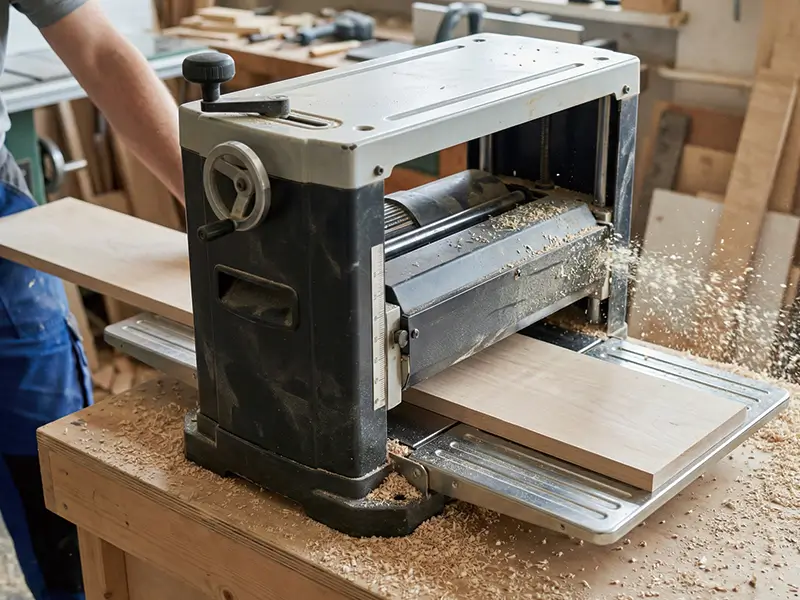
Snipe refers to deeper cuts at board ends caused by tilting when not fully supported by both rollers. Advanced planers use 4-lead screw systems combined with head lock mechanisms to reduce snipe from 1/4 millimeter to 0.13 millimeters or less—essentially invisible. This eliminates material waste and secondary sanding operations.
Dust Collection Integration
Thickness planers generate enormous chip volumes during operation. Most planers include a dust port connecting to shop vacuum systems. Premium planers include built-in chip blowers that actively eject material, performing better than passive ports relying on suction alone.
Conclusion
A thickness planer gives precise dimensional control and significant cost savings for manufacturing operations. Match your planner capacity to production requirements. Moreover, prioritize carbide insert technology for durability. Your investment pays for itself through reduced material costs and improved quality control.
FAQs
What are common applications for thickness planers?
Planers process reclaimed wood, flatten glue-up panels for countertops, size baseboard quickly, and salvage usable material from pallet lumber and scrap hardwood pieces.
Can a thickness planer flatten warped wood?
No. The planer only creates parallel surfaces. You need a jointer to flatten one face first, or build a planer sled with shims.
What is a plan snipe and how do you prevent it?
Snipe is a deeper cut at board ends. Use machines with head lock mechanisms, add support tables, and take lighter cuts to reduce it.
What is the difference between portable and industrial planers?
Benchtop planers weigh 60-100 pounds, handle 13-inch width, and cost $250-$800. Industrial planers weigh 400-800 pounds, handle 15-20 inches, and cost $2,000-$10,000.
How do you maintain a thickness planer?
Keep cutterheads sharp, wax the table monthly, check roller pressure, clean dust ports, inspect belts, and verify alignment for consistent thickness.

 English
  Russian
  German
  Spanish
  French
  Portuguese