Skip to content
What is M-Code: A Detailed Insight Into M-Code in CNC Machining
At the core of modern manufacturing is computer numerical control (CNC) programming. In recent times, machines have become more sophisticated and advanced, they have been designed to run entirely on programmed instructions.
For this reason, it has become crucial for engineers, operators, and programmers to possess a well-informed understanding of the codes that relay these instructions.
What is M-Code?
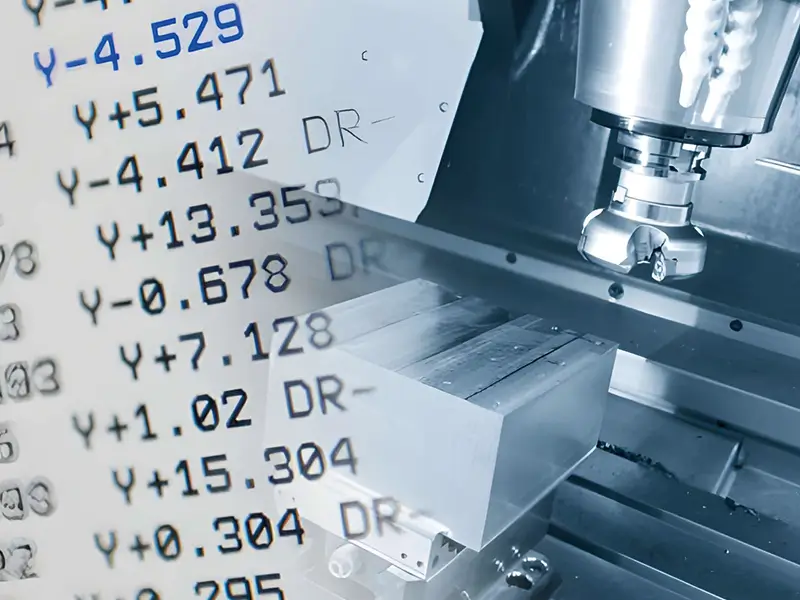
M-codes, also known as miscellaneous function codes, are commands used in CNC (computer numerical control) programming to drive the non-motion functions of a machine. These miscellaneous function codes are typically integrated with what we call G-codes, needed for control the movement of the machine, thereby creating a complete CNC program.
M-code is the programming language that controls the overall program of the machine,directing its actions. While M-Code stands for ‘miscellaneous codes,’ it is not unusual to call it ‘machine code,’ because they directly control the operating functions of the machine.
For applications where M-Codes are not deployed, you can still direct your tools to carry out certain set tasks like moving in a line or arc. However, attempts to give these tools more direct commands beyond the 3 basic G-codes will prove futile.
Examples of these direct commands include:
- Start or stop the spindle
- Change a tool
- Turn on the coolant
- Stop the program.
Navigating the world of CNC machining can be quite complex, especially in the aspect of programming languages. In this article, we will delve into everything you need to know about M-code, giving you a detailed insight into this fundamental component that drives manufacturing excellence, and transforms a digital design into a practical and physical part
How Does an M-Code Work?
As a CNC programmer, engineer, or even machine operator, it is critical that you understand the sequence of operations, and how these things work. After a M-Code has been deployed, it is no longer just a mere software command, it translates into an action and triggers a process.
Every M-code is a signal that directs the machine controller to perform a specific operation, a predefined task. The process of direction and execution follows a precise feedback loop, just as detailed below:
- Code Parsing
The CNC controller reads the blocks of code, line by line, identifying the M-code instruction in each one.
- Signal to PLC
The controller then sends a signal to the machine’s Programmable Logic Controller (PLC). The PLC is the link between the physical hardware of the machine and its digital program.
- Hardware Activation
The PLC activates the corresponding hardware component in the machine. For an M08 (Coolant On) command, it activates the coolant pump relay. For an M06 (Tool Change) command, the entire machining sequence is kick-started.
- Action Confirmation
Once the action is complete, the machine’s sensors give feedback to the PLC. For instance, a sensor confirms that the new cutting tool has been locked, or a pressure switch confirms that coolant is flowing.
- Program Continuation
As soon as the PLC receives feedback or the “done” signal from the sensors, it will in turn relay this information to the CNC controller. The CNC controller then proceeds to execute the next block of code.
With this well structured process, crashes and system failures are prevented, as every action is completed before the next one begins.
What is the Structure of an M-Code?
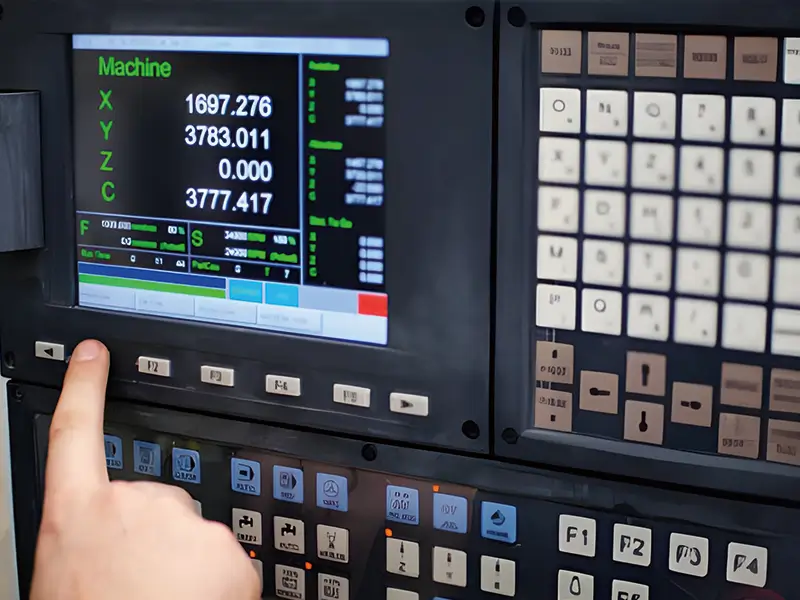
Despite its outstanding functions, the structure of an M-code is surprisingly simple and standardized. You can easily recognize an M-Code as broken down below:
- Each code starts with the letter ‘M,’ followed by two or three digits (for example, M03 and M08).
- A majority of modern CNC controllers recognize leading zeros. What this means is that the M8 code will be ideally interpreted the same way M08 would.
- In most CNC programming, only one M-code can be commanded per block of code. This rule is very essential.
- M-Codes are usually placed at the end of the block. For example, G01 X2.5 Y1.0 F15.0 M08. This is a block of code where the machine will progress linearly (G01) to the coordinates X2.5 Y1.0 at 15 inches per minute (F15.0) feed rate. During this movement, the M08 will switch the flood coolant on.
The Importance of M-Code in CNC Machining
M-codes are an essential part of CNC machining, their importance can not be exaggerated. This set of codes allows for improved automation in machines and gives more room for efficiency in the manufacturing process. Below are a few notable reasons why M-Code is crucial to CNC machining:
- Optimization of CNC Operations
Critical functions in machines are automated by M-Code. For example, the spindle stop for inspection (M05), tool changeover (M06), and automatic coolant activation (M08), ensure that you don’t need to manually intervene machine operations. These automatic functions help to reduce cycle times to a significant extent, also minimizing any risks of human error.
- Enabling Complex Operations
CNC machining as we know it today would be impossible without M-Codes. In modern machining, M-Code makes it possible for a single program to carry out several operations. It can do this with multiple tools, at different speeds and conditions, without interruption or need for your intervention.
- Synergy with G-Code
M-Code doesn’t work in isolation, it partners with G-Code. Together, they form a complete set of instructions that covers every essential aspect of the CNC machining process. From precise geometric movements to the machine actions that support them, these sets of codes work hand-in-hand to give you an absolutely seamless operation.
How M-Code Differs from G-Code
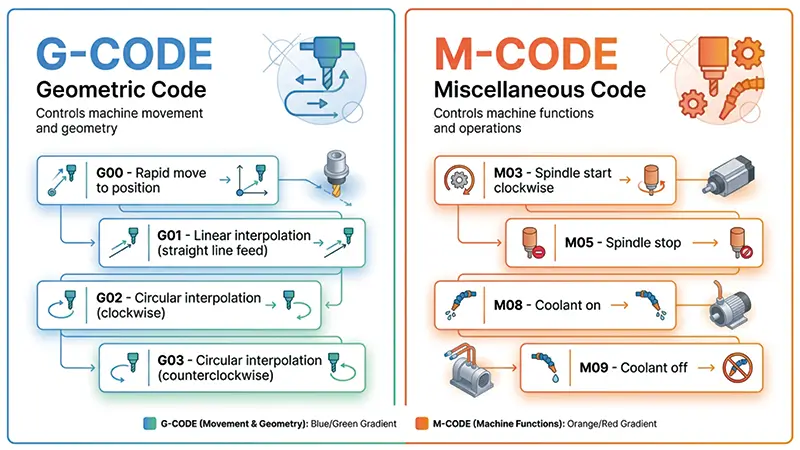
Despite working hand-in-hand, the roles of G-codes and M-codes are fundamentally different. G-codes are “geometric codes” that commands the position and movement of the tool. M-codes, on the other hand, are “miscellaneous codes” that control the hardware and functions of the machine.
While G-codes controls the toolpath geometry (where to move and how to move), M-codes directs the machine hardware to perform specific, unique actions
Below is a table of detailed comparison we have prepared to make it easier for you to understand the differences between M-Code and G-Code.
Feature | M-Code | G-Code |
Primary Function | It controls non-geometric functions and hardware of the machine. | Controls the movement and position of the machine’s tools. |
Focus | Focuses on the machine’s actions. That is, what to do and when to do it. | Concerned with just the geometric toolpath- where to move, how to move. |
Examples | M03 (Spindle On), M06 (Tool Change), and M08 (Coolant On). | G00 (Rapid Move), G01 (Linear Feed), and G02 (Circular Move). |
Execution | Non-modal. An M-code is typically active and executed once per command. | Modal. The command of a G-code remains active until it is replaced by another G-code in the same group. |
Analogy | An instance of how M-Code works is like the control of a car. It tells the car to turn the engine on, switch on the headlights, or activate the windshield wipers. | The G-Code comes into action in directions, telling the car where to turn and how fast it should go. |
Commonly Used M-Codes in CNC Machining
There are many M-Codes used in CNC machining, some are specific to certain manufacturers, and at the same time, some M-Codes are a standard used almost universally. In this section, we will be taking a look at the latter, that is, the most commonly used M-Codes in CNC machining.
1. Program Control Codes
- M00 (Program Stop): It pauses the program unconditionally. The operator must press a button to resume it.
- M01 (Optional Stop): Pauses the program only when you enable the “Optional Stop” function on the control panel.
- M02 (End of Program): This code puts an end to the program. It is often used interchangeably with M30.
- M30 (Program End and Reset): Ends the program and resets the code back to the beginning, ready for the next part.
2. Spindle Control Codes
- M03 (Spindle On – Clockwise): Starts the spindle rotating in the standard forward/clockwise (CW) direction.
- M04 (Spindle On – Counter-Clockwise): Starts the spindle in the reverse/counter-clockwise (CCW) direction, often used for tapping.
- M05 (Spindle Stop): Stops the spindle’s rotation.
3. Tool and Coolant Control Codes
- M06 (Tool Change): Initiates an automatic tool change with the tool previously specified by a ‘T’ code.
- M08 (Flood Coolant On): Activates the primary coolant system.
- M09 (Coolant Off): Deactivates all coolant systems.
What Machines Use M-Code?
M-code is the universal language for controlling machine functions on virtually all types of CNC equipment. The application possibilities of M-Code in machines are endless, but here are some common practical use cases:
- CNC Milling Machines and Machining Centers
M-codes control spindle rotation (M03), tool changes from the carousel (M06), and flood/through-spindle coolant (M08).
- CNC Lathes & Turning Centers
M-codes manage the chuck (clamp/unclamp), tailstock, and turret indexing, in addition to standard spindle and coolant control.
- Plasma & Laser Cutters
M-codes are used to turn the plasma torch or laser beam on and off (M03/M05 are often used for this) and control cutting gas pressure.
- Water Jet Cutters
Specific M-codes control the high-pressure water pump and abrasive supply system, turning the abrasive on or off as needed for different tag types.
- Electric Discharge Machines (EDMs)
M-codes control the flushing of dielectric fluid, wire cutting, and power settings for the electrical discharge.
Why You Should Partner with Us
At Sundi Precision Tools, we know that M-code is the language that brings our tools to life. An M08 (Coolant On) command is only as useful as the tool it’s cooling. Our cobalt drills are made with geometries that enhance coolant flow to the cutting edge, allowing them to withstand the intense heat of drilling stainless steel.
An M06 (Tool Change) command is only valid if the loaded tool is valid. Filling your machine’s carousel with our precision-ground solid carbide end mills, ensure that every tool change delivers consistent accuracy and superior surface finishes.
We don’t just sell tools; we provide the important components that translate your programming expertise into substantial, profitable results. As industry leaders, we understand the entire production process, from the code on the screen to the cutting-edge chip. We make sure you, our esteemed customer, attain incomparable precision and durability.
Conclusion
Understanding M-code is important for functional, safe, and correct CNC machining. These simple instructions are essential in automation, as it allows machines to perform hard tasks with minimal human interaction. Whether you are an operator or programmers, efficient M-Code integration makes your workflow better, enhances security, and ensures that every component you produce meets their exact requirements.
In the end, a perfect written program is not always enough. True value can only be achieved when M-codes commands are executed by reliable, precise and powerful tools.
Ready to equip your operations with tools that can execute your commands flawlessly? Explore the Sundi Precision Tools catalog or contact our team of experts today, to find the perfect cutting solutions for your project.
FAQs
Is M-Code a programming language?
Yes, M-code is a programming language. It is one many programming languages that software engineers use to issue instructions and commands to machines.
What do the M-Codes do in CNC Machining?
M-code handles instructions relating to turning the spindle on or off, coolant control, tool change, and program stops.
What does M in M-Code stand for?
The M in M-Code stands for Machine. However, in certain contexts, it also stands for Miscellaneous functions.
Can M-Codes Control External Automation Systems?
Yes, M-codes can control external automation systems when connected to the controller. This connection uses signals from specific codes to control external components like conveyor belts or measuring tools.