 Skip to content
Full Edge CBN Turning Inserts
Standard tipped CBN inserts restrict your depth of cut and only offer single-sided use. Solid CBN is brittle. You need a solution that offers the best of both worlds.
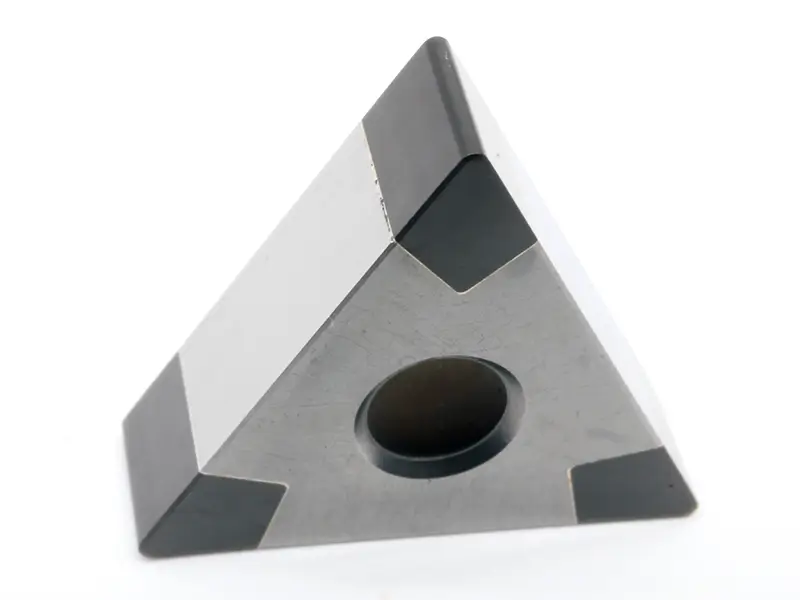
Sundi Full Edge CBN Inserts feature a thick layer of Cubic Boron Nitride brazed along the entire vertical flank of a tough carbide core. This unique “Full Face” construction allows the insert to be flipped and used on both sides, giving you double the cutting edges while maintaining the shock resistance of a carbide backbone.
Heavy Duty Applications
Sundi Full Edge CBN is the cost-effective workhorse for removing heavy stock from hard materials.
Roll Turning: Roughing and finishing High-Chrome Iron rolls where deep cuts are required.
Large Brake Drums: Removing heat checks and scale from heavy-duty cast iron drums.
Mining Crushers: Turning high-manganese steel wear parts with heavy interruptions.
Mill Rolls: Resurfacing worn rolls in steel mills.
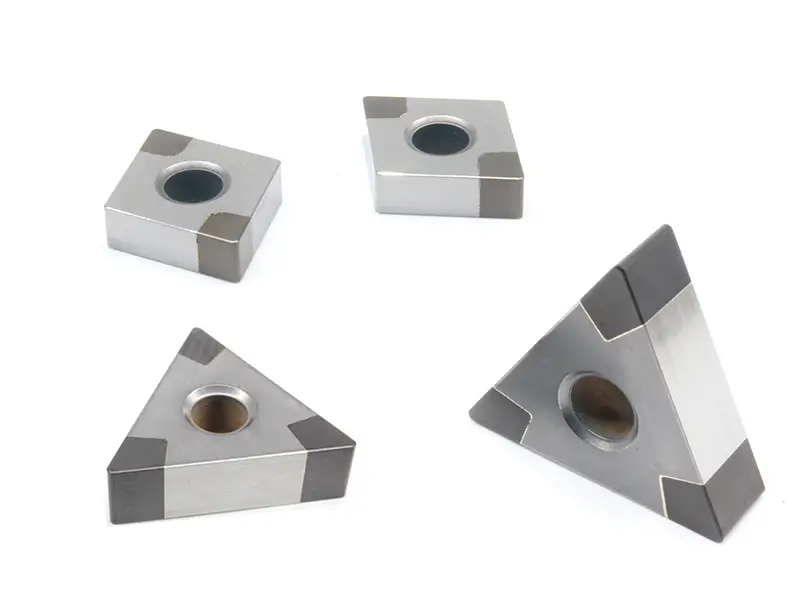
Ideal Materials for Full Edge CBN
Engineered for roughing large, hard ferrous components.
High-Chrome Iron: HRC 45-60 abrasive castings.
Chilled Cast Iron: Deep depth-of-cut roughing.
Hardened Steel: Large shafts requiring heavy stock removal.
Ni-Hard (White Iron): Interrupted cuts on pump parts.
- High wear resistance
- Reduce the machine time
- Stable Performance
- Easy to use
Why Choose Sundi Full Edge CBN?
Designed for Roll Turning and heavy roughing where cost-per-edge and toughness are critical.
-
1. Double-Sided = Double Value
Unlike standard "tipped" inserts that can only be used on one side, our Full Edge design covers the entire side of the insert. This means once the top edge is worn, you can simply flip the insert to use the bottom edge. You get twice the tool life per insert compared to standard brazed tools.
-
2. Unlimited Depth of Cut (DOC)
The CBN layer extends across the full height of the insert flank. This removes the "braze line" limitation found in small-tipped tools. You can take massive roughing cuts (e.g., up to the full edge length) to remove heavy scale and skin without worrying about undercutting the diamond layer.
-
3. Tough Carbide Core (Shock Resistance)
While pure solid CBN can be brittle, Sundi Full Edge inserts rely on a Carbide Substrate to absorb the mechanical shock of interrupted cuts. This brazed structure provides superior fracture resistance when roughing uneven cast iron surfaces or turning over cracks.
Technical Specifications
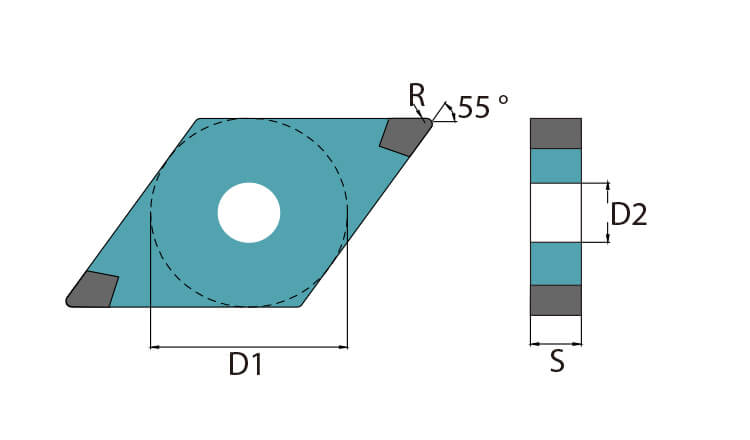
| Tech Data | |
|---|---|
| Type | ISO Indexable CBN inserts |
| Angle | Positive/ negative |
| CBN Grade | CBN 850/ CBN 010/PCD 025/CBN302 |
| Tolerance | G/M |
| Work piece material | Aluminum and aluminum alloys Copper, brass and bronze alloys Carbon Fiber Graphite composites Reinforced plastics Ceramic Wood Fiberglass Composites Fiber Reinforced Plastics (FRP) Tungsten Carbide |
| Shape | Designation | D1 [mm] | D2 [mm] | S [mm] | R [mm] |
|---|---|---|---|---|---|
 | CNGA120404 | 12.7 | 5.16 | 4.76 | 0.4 |
| CNGA120416 | 12.7 | 5.16 | 4.76 | 1.6 | |
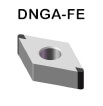 | DNGA150404 | 12.7 | 5.16 | 4.76 | 0.4 |
| DNGA150616 | 12.7 | 5.16 | 4.76 | 1.6 | |
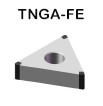 | TNGA160404 | 9.525 | 3.81 | 4.76 | 0.4 |
| TNGA220412 | 12.7 | 5.16 | 4.76 | 1.2 | |
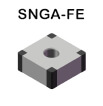 | SNGA120404 | 12.7 | 5.16 | 4.76 | 0.4 |
| SNGA120412 | 12.7 | 5.16 | 4.76 | 1.2 |
Double Your Heavy Turning Efficiency
Get the deep-cutting power of Full Edge CBN with the economy of a double-sided tool. Switch to Sundi Full Edge CBN Inserts today.
FAQ
Most frequent questions and answers
A: Toughness and Cost. Solid CBN is very hard but can shatter under heavy shock. Sundi Full Edge Brazed inserts have a tungsten carbide core that absorbs impact, making them tougher in interrupted cuts. Plus, the brazed design is often more cost-effective while still offering the double-sided benefit of solid tools.
A: Yes, but it excels at Roughing. The “Full Edge” capability is designed to handle variable depths of cut (like removing an uneven casting skin). For light precision finishing with very tight tolerances, a standard “Tipped” CBN insert might be a cheaper option if the depth of cut is small.
A: It depends on the shape. For a Square insert (SNGA), you get 8 cutting edges (4 Top + 4 Bottom). For a Rhombic insert (CNGA), you get 4 cutting edges (2 Top + 2 Bottom). This is double what you get with a standard single-sided tipped insert.