


What is 3,4, and 5-Axis CNC Machining?
CNC is widely used across the manufacturing industries for fabricating complex metal parts. CNC machining has varied axis capabilities, i.e., 3, 4, 5, 7, or 9. More axes means the ability to create complex parts.
In this article, we provide comprehensive information about 3-axis, 4-axis, and 5-axis machining. You’ll get to know their advantages, limitations, and factors to consider when choosing one technique.
Contents
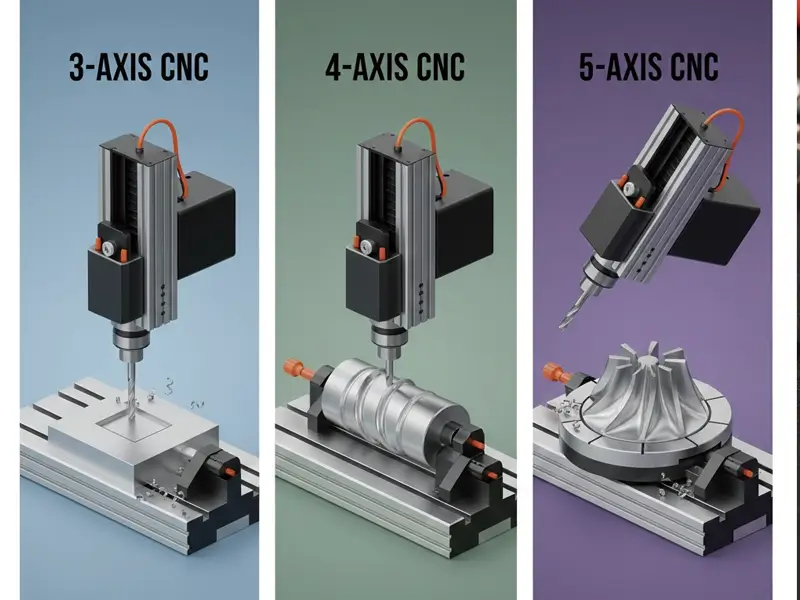
What is 3, 4, and 5 Axes in Machining?
An axis is a controlled linear or rotary degree of motion. More axes can expand tool access, but axis count alone does not specify simultaneous machining capability, accuracy, or part complexity. Typical milling axes are:
- Linear Axis: Linear axis means straight line motion. There are 3 linear axes:
- X-axis: one linear direction; left to right on a typical vertical mill.
- Y-axis: a second perpendicular linear direction; front to back on a typical vertical mill.
- Z-axis: the linear direction parallel to the main spindle axis; vertical on a typical vertical mill.
- Rotatory Axis: The rotatory axis allows rotational movement. The rotatory axis moves in degrees. Here are its types:
- A-axis: Rotates around X-axis
- B-axis: Rotates around Y-axis
- C-axis: Rotates around Z-axis
What is 3-Axis Machining?
In 3-axis milling, relative motion between the cutting tool and workpiece is controlled along X, Y, and Z while tool-axis orientation remains fixed. The spindle need not be vertical. Suitable toolpaths can machine complex 3D surfaces as well as flat features.
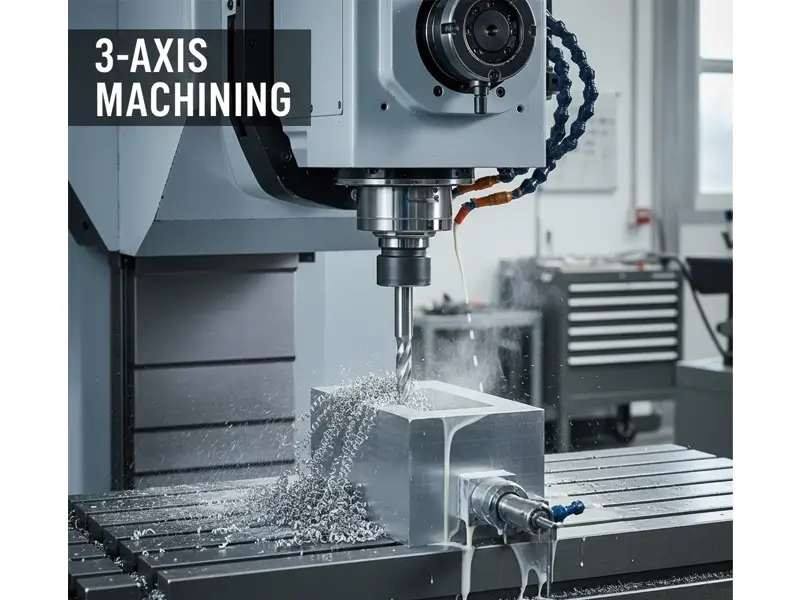
Advantages of 3-Axis Machining
3-axis machines offer several benefits for manufacturers:
Cost reduction: Compared with multi-axis machines, the total cost of acquisition and
maintenance of 3-axis machining is low. It makes them affordable for small/medium-sized businesses.
Ease of programming: Basic 3-axis jobs can be simpler to program, but complex surfaces and safe operation still require appropriate training.
Speed of setup: Setup time depends on the part and fixtures. Three-axis machines still need correct alignment, offsets, and calibration; multiple-sided work may need additional setups.
Availability: Most machine shops employ 3-axis machines. It’s easy to find service providers or replacement parts is easy.
Reliability: Since 3-axis machines have fewer components than multi-axis machines, the potential for failure is less. if maintained regularly, they can provide reliable and consistent service for multiple years.
Limitations of 3-Axis Machining
Here are some limitations of 3-axis machining:
- Fixed tool orientation limits access, but 3-axis machines can cut shaped surfaces and some undercuts with suitable tooling and clearance.
- Deep or angled features may require special tools, angled fixtures, attachments, or another setup, depending on access.
- Features on different sides may require repositioning, adding time and potential setup error rather than inevitably reducing accuracy.
Applications of 3-Axis Machining
Here are some applications of 3-axis machining:
- Flat metal plates
- Metal enclosures and housing components
- Gears
- Flanges
- Heat sinks
- Simple molds for plastic injection molding
- Nameplates and engraved identification tags
- PCB boards (printed circuit boards)
- Spacers and washers with precise dimensions
What is 4-Axis Machining?
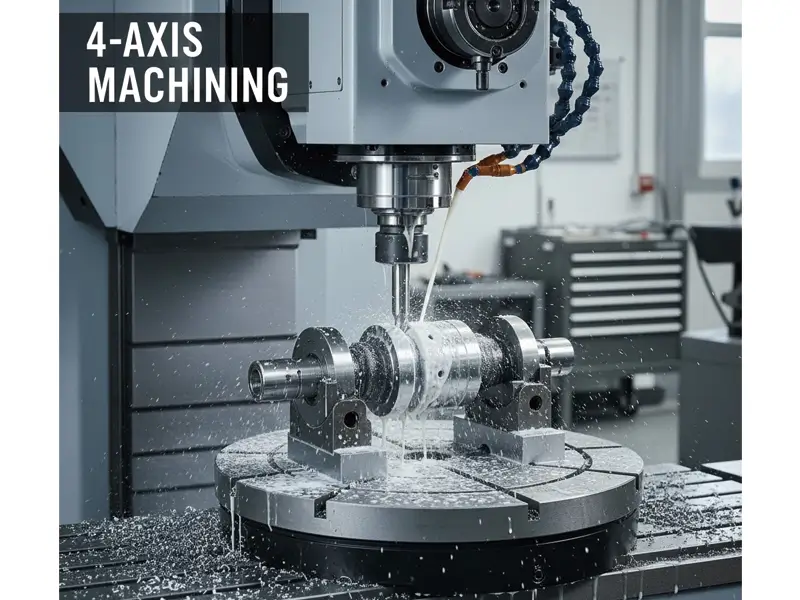
Four-axis milling adds a rotary axis to X, Y, and Z, often A about X. Indexed 3+1 machining rotates between cuts; simultaneous four-axis machining coordinates rotary and linear motion during cutting when supported.
Advantages of 4-Axis Machining
Let’s look at some advantages of 4-axis machining:
Less Time-consuming Setup: A rotary fixture can expose several faces without manual remounting, reducing handling for suitable parts; it does not guarantee a fixed time saving or simultaneous cutting of several faces.
Machining Curved Surfaces: Coordinated rotary machining can produce suitable cylindrical contours and continuous engraving when the controller and CAM support simultaneous four-axis motion.
Increased Tool Life: Better access may permit a more favorable tool setup, but tool life depends on material, cutting conditions, rigidity, and tool selection rather than axis count alone.
Faster Production Times: Because of the reduced handling time between each work process, you will finish jobs much faster.
Limitations of 4-Axis Machining
4-axis systems have the following limitations:
- The cost associated with acquiring 4-axis machinery is higher than that of 3-axis machinery.
- If your part is complex and contains multiple angles, you may experience difficulty accessing those areas.
- Rotary toolpath programming requires suitable CAM, a verified postprocessor, and knowledge of machine kinematics, not simply learning a CAD program.
Applications of 4-Axis Machining
Applications of 4-axis machining include:
- Crankshafts with curved profiles
- Shaft used in turbines in the production of electrical power
- Cylinder-shaped custom engraved products (i.e., custom pen and tube)
- Helical gears
- Pump impellers with curved blades
- Medical screws
- Custom rifle barrels
- Cylindrical molds to manufacture bottles
- Couplings and connectors
What is 5-Axis Machining?
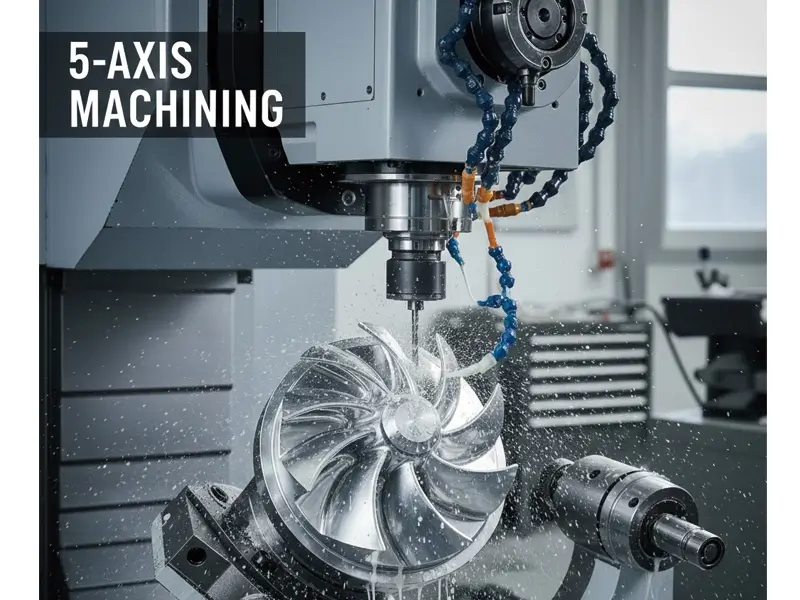
Typical five-axis milling combines three linear axes with two rotary axes. Rotation may occur in the table, head, or both; tool access remains limited by machine travel, tooling, and fixtures.
Five-axis machining can reduce setups for complex parts, but clamped or inaccessible features may still need repositioning or another process.
Here’s how the 5-axis capability is used:
- 3+2 Axis (Positional) Machining: In positional machining, the rotatory axes are used to orient the tool or part to a fixed angle. Then, the cutting is performed using the linear axes. The rotary axes remain stationary during the cutting process.
- Simultaneous 5-Axis Machining: The control can coordinate all five axes during a cut; each axis need not move continuously in every segment. This supports changing tool orientation for accessible freeform surfaces, not guaranteed access to every side.
Advantages of 5-Axis Machining
5-axis machining has unique advantages over other methods:
One Setup: Many accessible faces can be machined in one setup, but clamped surfaces and inaccessible features may require another setup.
Superior Surface Finish: Suitable tool orientation can improve contact and finish, but the result depends on toolpaths, cutting conditions, rigidity, and machine accuracy.
Precision: The ability to tilt the head gives you the ability to use shorter and more rigid tools. This decreases tool vibrations and deflections, allowing you to achieve a higher level of precision when machining deep features.
Faster Machining: Reduced handling and favorable tooling can shorten production for suitable parts; total time must include programming, setup, and the actual machining strategy.
Limitations of 5-Axis Machining
The 5-axis machining capabilities have certain drawbacks, including:
- The original 3 to 5 times cost comparison is not a universal purchasing rule; machine size, configuration, options, and supplier quotations determine the difference.
- A 5-axis machine requires highly skilled computer-aided manufacturing (CAM) programmers to program. Hiring experienced CAM programmers or training in-house programmers will incur high additional costs.
- The more 5-axis moving parts increase the possibility of a tool or tool head colliding with a fixture or workpiece. Therefore, 5-axis Machinists must take care to simulate the program before running it.
- For simple parts, compare total setup, programming, handling, and cycle costs; five-axis equipment is not automatically inefficient.
Applications of 5-Axis Machining
Here are some applications of 5-axis machining:
- Titanium medical implants
- Aerospace turbine blades
- Automotive body panel molds
- Prosthetic components
- Prototype engine components with accessible machined features; enclosed curved internal cooling channels may require additional manufacturing processes.
- Marine propellers
- Compound angle tool and die components
- Military aircraft structure components with weight-reducing pockets.
Key Differences Between 3, 4, 5-Axis Machining
In the following section, we have discussed the key differences between 3, 4, and 5-axis machining:
Part Complexity
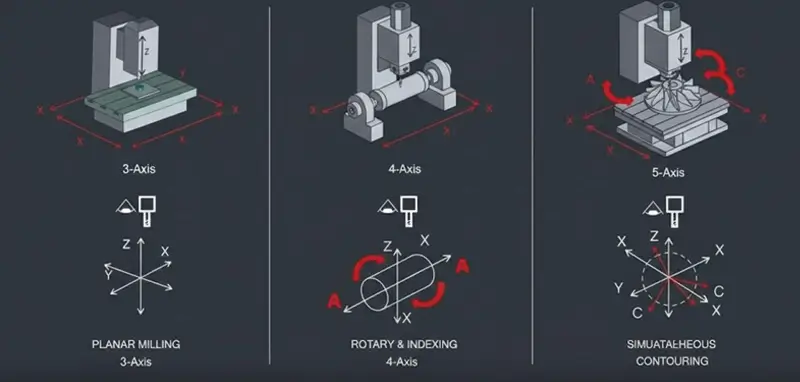
- 3-Axis Machining: Supports flat features and complex 3D surfaces with fixed tool orientation; undercuts and angled features depend on tooling and access.
- 4-Axis Machining: With 4-axis machining, you can make cylindrical parts/circular-shaped parts with curvature, and parts with features on multiple sides.
- 5-Axis Machining: With 5-axis machining, changing tool orientation improves access to suitable compound angles and freeform surfaces, but does not guarantee a complete part in one setup.
Cost
- 3-Axis Machining The original $20k purchase cost example has no stated basis and should not be treated as a typical value or guarantee. Obtain a current quotation for the required configuration.
- 4-Axis Machining: The original $75k-$250k purchase cost example has no stated basis and should not be treated as a typical value or guarantee. Obtain a current quotation for the required configuration.
- 5-Axis Machining: The original $200k to $1M+ purchase cost example has no stated basis and should not be treated as a typical value or guarantee. Obtain a current quotation for the required configuration.
Time Taken
- 3-Axis Machining: Is capable of making simple, fairly quick-turnaround parts. However, making more complicated parts requires multiple setups that can affect your overall schedule.
- 4-Axis Machining: Rotary positioning can reduce remounting and handling time; it does not eliminate all downtime.
- 5-Axis Machining: Can reduce setups and cycle time for suitable complex parts, but is not always fastest and may still require repositioning.
Programming Requirements
- 3-Axis Machining: The original 2-3 weeks training duration example has no stated basis and should not be treated as a typical value or guarantee. Requirements depend on the job, equipment, process, and operator experience.
- 4-Axis Machining: The original a few months training duration example has no stated basis and should not be treated as a typical value or guarantee. Requirements depend on the job, equipment, process, and operator experience.
- 5-Axis Machining: Requires highly skilled personnel with advanced CAM programming and collision avoidance skills.
Setup Time
- 3-Axis Machining: The original 15 minutes to 30 minutes setup time example has no stated basis and should not be treated as a typical value or guarantee. Requirements depend on the job, equipment, process, and operator experience.
- 4-Axis Machining: The original 30 to 60 minutes setup time example has no stated basis and should not be treated as a typical value or guarantee. Requirements depend on the job, equipment, process, and operator experience.
- 5-Axis Machining: The original 1 hour to 3 hours setup time example has no stated basis and should not be treated as a typical value or guarantee. Requirements depend on the job, equipment, process, and operator experience.
Accuracy
- 3-Axis Machining: The original ±0.005 inch machining tolerance example has no stated basis and should not be treated as a typical value or guarantee. Requirements depend on the job, equipment, process, and operator experience.
- 4-Axis Machining: The original ±0.002 inch machining tolerance example has no stated basis and should not be treated as a typical value or guarantee. Requirements depend on the job, equipment, process, and operator experience.
- 5-Axis Machining: The original ±0.0005 inch machining tolerance example has no stated basis and should not be treated as a typical value or guarantee. Requirements depend on the job, equipment, process, and operator experience.
Surface Finish Quality
- 3-Axis Machining: Suitable tools and toolpaths can produce good finishes on flat and curved surfaces; visible marks are not determined by axis count alone.
- 4-Axis Machining: Coordinated rotary motion can help finish cylindrical surfaces, depending on the toolpath, setup, and cutting conditions.
- 5-Axis Machining: Tool orientation can improve finish on suitable features, but does not guarantee the best finish in every application.
Conclusion
Understanding about 3-, 4-, and 5 Axis CNC machining helps people in manufacturing select the correct technology for them. Having a greater number of axes will allow for more movement and flexibility. It also allows for the use of more complex geometries and fewer setups. However, those machines with more than three axes will cost more money and require more skill in programming.
FAQs
What is the difference between 3/4 and 5-axis machining?
Typical three-axis milling controls X, Y, and Z simultaneously and can follow curved paths. Four-axis milling adds one rotary axis; five-axis milling adds two. Indexed positioning and simultaneous cutting are different capabilities.
Is there a 6-axis CNC machine?
Yes, six-axis machines have been specifically designed to provide additional flexibility. However, these machines are used for specialized applications, such as those involving the pairing of robotic machining with additive manufacturing processes.
How much does CNC machining cost per hour?
The original hourly examples of $40-$75 for three axes, $75-$150 for four, and $150-$300 for five have no stated date, location, or quotation basis. They are not current benchmark rates; request a quote for the actual part, volume, setup, and inspection requirements.
How expensive is a 5-axis CNC machine?
The original figures of $200,000 to more than $1,000,000 for industrial machines and at least $50,000 for desktop machines have no stated model or date. They are not universal ranges or minimum prices; compare current quotations and required capabilities.