


What Is MDF? Complete Guide for Beginners
MDF is an engineered wood product. It is made from wood fibers, resin, and wax pressed into uniform panels. You need to understand this material for affordable alternatives to solid wood and plywood that are important for manufacturing operation.
Contents
What Is MDF?
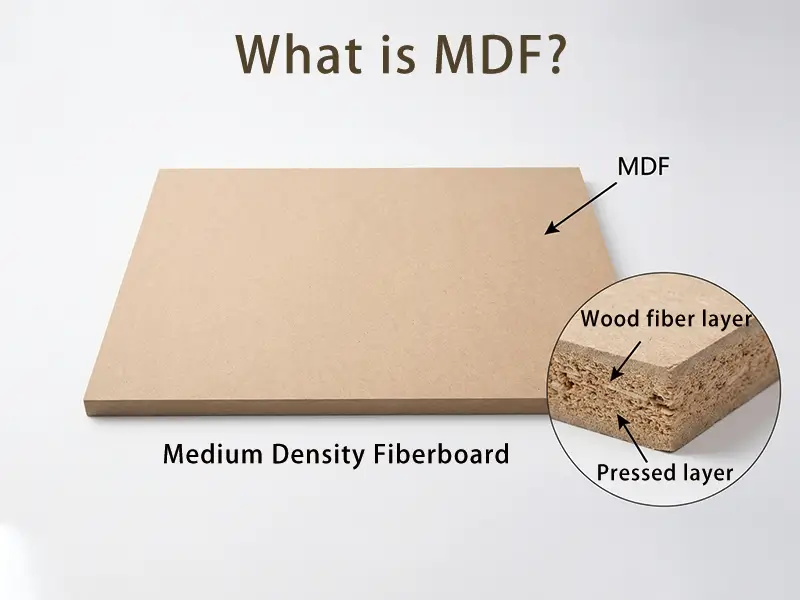
MDF means Medium Density Fiberboard: a panel made from wood fibres with a binder and additives. Composition and density vary by grade and manufacturer; obtain the product data instead of treating a single recipe or density range as a definition.
MDF has no natural grain pattern or knots. Its faces are generally smooth, but machined edges can be more absorbent and may require sealing and sanding before painting.
How Is MDF Made?
- Logs Chipping
The MDF production process begins when logs arrive at the mill. Workers debark the logs and feed them through chippers that reduce the wood into small pieces. You can take these wood chips from softwoods, hardwoods, or even recycled wood from manufacturing waste.
- Defibrating
Next, the chips go into a defibrator where high-pressure steam and mechanical action cut them into separate wood fibers. This step distinguishes MDF from particleboard, which uses larger wood particles. The finer fibers in MDF make a denser, more uniform material.
- Wax Injection
Then, the manufacturing process injects wax into the fiber stream. This wax coats each fiber and provides some moisture resistance in the finished product.
- Fiber Distribution
The fibres form a mat that is pressed to the required thickness and density. Panel thickness depends on mat mass and the press schedule; available dimensions are product-specific.
- Hot Pressing and Resin Bonding
Heat and pressure consolidate the fibre mat and cure the binder. Temperature, pressure, and pressing time depend on the resin system, panel thickness, and production equipment; there is no universal operating recipe.
- Cooling, Trimming, and Sanding
Finally, the pressed panels cool gradually to prevent internal stress. Workers trim the edges to standard MDF sizes like 4×8 feet or 5×12 feet sheets, then sand the surfaces smooth. Some manufacturers add primer to make primed MDF sheets ready for immediate painting.
MDF vs. Plywood
Difference in Structure
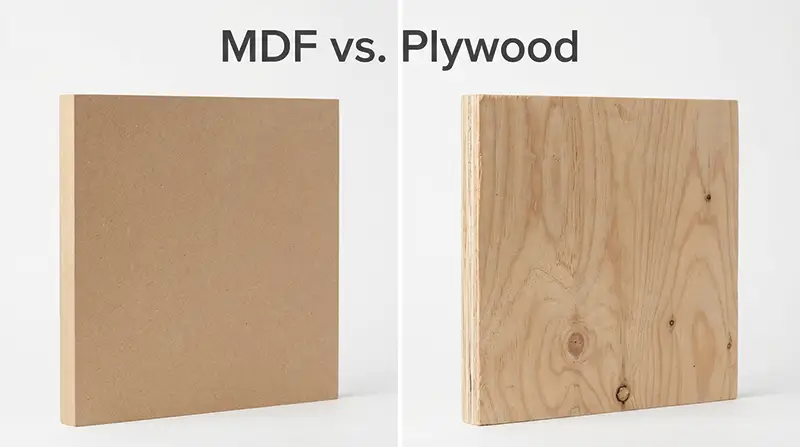
Plywood consists of thin wood veneers stacked in layers with alternating grain directions. This is a cross-grain construction. It provides strength in multiple directions. In contrast, MDF boards contain randomly oriented wood fibers with no grain direction at all.
Plywood and MDF have different structures and direction-dependent properties. MDF can be relatively uniform within the panel plane, but its through-thickness behavior differs. Compare the specified grades and loading direction rather than assuming identical strength in every direction.
Performance Comparison
Strength
For load-bearing uses, compare the specified panel grades, thickness, span, support, and fasteners. Suitable plywood often offers useful bending performance, but the design must be checked; the material name alone does not establish load capacity.
Surface Finishing
However, MDF excels for surface quality. The smooth, void-free face accepts paint without grain telegraphing through the finish. You can also create complex profiles and molding details that would splinter in plywood. Furthermore, MDF edges the machine cleanly for decorative routing.
Moisture Resistance
Standard MDF can swell when wetted. Moisture-resistant MDF and plywood also have grade-specific exposure limits. Choose a product rated for the intended humidity or exterior exposure and follow its finishing requirements; neither material name guarantees water resistance.
Weight
Panel mass depends on dimensions, density, and moisture content. Obtain the manufacturer’s mass per panel or calculate it from the actual product data. MDF is often heavier than comparable plywood, but a fixed percentage difference is not universal.
Compare current local quotations for the same panel size, thickness, grade, and finish. MDF may offer a cost advantage, but undated prices and percentage savings are not reliable for every market or product.
MDF vs. Solid Wood
Solid Wood
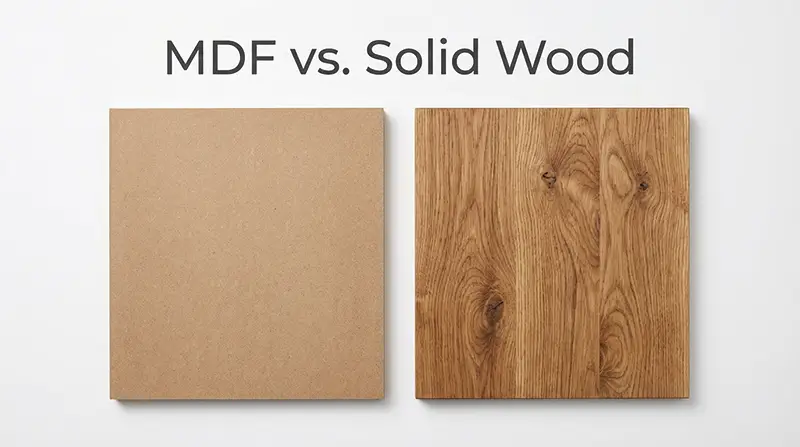
Solid wood gives a natural beauty with visible grain patterns, color variations, and unique character that MDF cannot adopt. When you need aesthetic appeal and are low on budget, solid wood gives a good appearance. However, solid wood also moves seasonally. For example, it expands in humidity and contracts in dry conditions.
MDF
MDF is relatively stable compared with solid wood across the grain, but it still changes dimensions with moisture content. Condition and store panels appropriately; moisture gradients and poor support can cause distortion.
Cost Comparison
Strength
Solid wood gives good strength for high-impact applications. MDF dents and crushes more easily than hardwood when struck. Furthermore, solid wood furniture can be refinished multiple times. On the other hand, MDF accepts only limited sanding before exposing the core material.
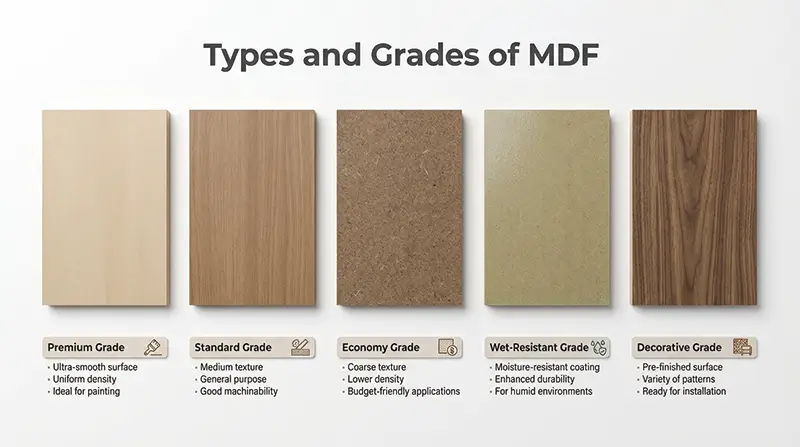
Types and Grades of MDF
Standard MDF is intended for suitable dry interior uses. Moisture-resistant and fire-retardant grades have specific performance classifications. A fire-retardant label alone does not establish compliance for every building or assembly; check the required classification and documentation.
Lightweight, higher-density, and flexible MDF products serve different needs. Check declared density, mechanical properties, bend limits, and installation guidance rather than assuming a universal weight reduction or strength increase.
Labels such as E2, E1, and E0 must be interpreted with their applicable standard and test method. For relevant markets, verify the required documentation for CARB Phase 2 or TSCA Title VI. Do not assume that different labels are interchangeable or guarantee suitability in every indoor environment.
How to Select the Right MDF for Your Application
Assess Environmental Conditions
Match the panel grade to the actual exposure, including humidity, possible wetting, and required fire performance. Follow the manufacturer’s use limits and the applicable building requirements; a room name alone is not a specification.
Evaluate Requirements for Structure
For shelves and other loaded components, verify the grade, thickness, span, supports, fastening, and long-term deflection. MDF may suit decorative and furniture components, but structural suitability needs product-specific design data.
Match Finish Requirements
MDF is also good for painting. You can use it whenever you need paint-grade finish. Furthermore, you can select solid wood or plywood for stained finishes that show natural grain. MDF also works as an excellent substrate for wood veneer. It is important when you need a natural appearance with MDF.
Conclusion
MDF is useful for many painted furniture and joinery components. Select it by considering finish, machining, load, moisture exposure, emissions requirements, and total cost. Use the declared product performance to compare it with plywood or solid wood.
Sundi provides a variety of cutting tools for MDF processing, including router bits, planer blades, and saw blades. Get in touch with us today to find the right solution for your needs and improve your machining performance.
FAQs
Is MDF as strong as plywood?
Not in every application. Compare bending strength, stiffness, fastening, thickness, and the relevant panel grades. Plywood and MDF cannot be ranked by a single universal strength value.
Can MDF be used outdoors?
Standard interior MDF should not be used outdoors. Exterior-rated MDF products exist, with specific exposure and finishing requirements. Moisture-resistant interior board is not automatically exterior-rated; follow the selected product’s instructions.
How do you prevent MDF from swelling when wet?
Use a grade suitable for the exposure and finish faces and edges as instructed by the manufacturer. Coatings can limit moisture uptake but do not make ordinary interior MDF waterproof or suitable for continuous wetting.
What is the difference between MDF and particleboard?
MDF uses refined wood fibres, while particleboard uses larger wood particles. Surface, edge machining, density, strength, and price depend on the particular products; MDF is not universally stronger or denser than every particleboard grade.
Is MDF toxic or safe for indoor use?
Formaldehyde emissions depend on the product and binder. Verify applicable emission documentation and intended-use requirements rather than relying on an E0 or E1 label alone. Machining produces wood dust and requires effective extraction and appropriate exposure controls.
Can you stain MDF like real wood?
Ordinary MDF does not reproduce natural wood grain and may absorb stain unevenly. Painting or veneering is common; specialist coloured boards and finish systems have their own requirements. Test the proposed finish on the actual product.
How much does MDF weigh compared to plywood?
Compare panels of the same dimensions using their declared densities or mass. MDF is often heavier, but the difference varies by grade and moisture content; there is no fixed percentage that applies to every plywood comparison.