










Wood Lathe Turning Tools: Types and How to Use Them
Whether you’re roughing out spindle blanks or sculpting delicate bowls, choosing the right wood lathe tools transforms raw timber into refined artistry. This guide demystifies seven essential woodwork lathe tools – from traditional gouges to modern carbide inserts – detailing their uses, identification, and practical applications. By pairing the correct turning tool with your project’s demands, you’ll elevate efficiency, safety, and creative potential on the wood lathe.
Contents
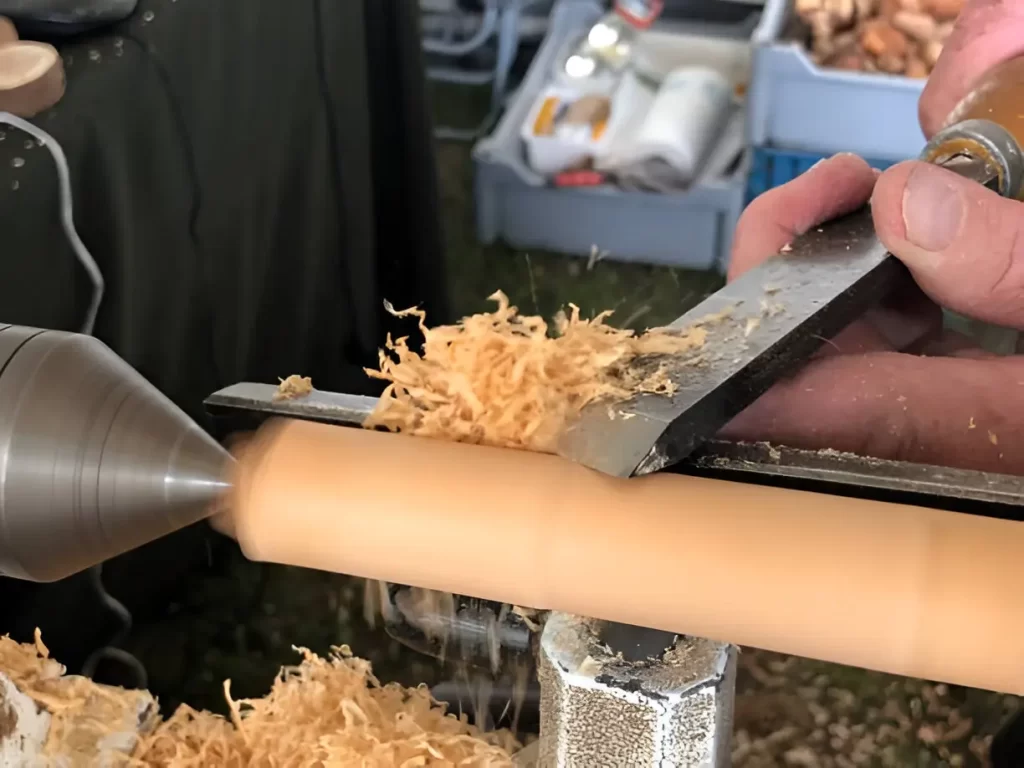
Types of Wood Lathe Turning Tools (Including Carbide Insert Tools)
When building your wood lathe tools collection, understanding these seven core types is essential for efficient woodturning:
Roughing Gouge

The foundation tool for spindle projects. Its wide, U-shaped flute removes corners from suitable spindle blanks. Select speed for diameter, balance, mounting, and the lathe instructions; 800–1,200 RPM is not a universal roughing range. Do not use a spindle roughing gouge for bowl or faceplate work.
Spindle Gouge

Characterized by its relatively shallow flute and ground bevel, this woodwork lathe tool creates beads, coves, and details on spindles. Use a bowl gouge for general bowl shaping; specialized spindle-gouge detail cuts require appropriate training and are not a substitute for bowl-gouge technique.
Bowl Gouge

Featuring a deep flute in a substantial shaft, a bowl gouge shapes bowl interiors and exteriors. Grind and presentation depend on the cut; not every bowl gouge has a fingernail grind, and bowl work is not exclusively end-grain turning.
Parting Tool

The precision finisher. A parting tool cuts narrow grooves, defines diameters and tenons, or separates suitable spindle work. Keep it supported on the tool rest and use the cutting presentation appropriate to its profile; do not use the heel as a lever. Diamond-section variants provide side clearance.
Scraper

Employed for surface refinement. Square-nose scrapers suit suitable flat profiles, while round-nose versions suit curves. Conventional and negative-rake scrapers use different edge preparations and presentations; negative rake is not mandatory for every scraper.
Skew Chisel

A versatile but demanding spindle-turning tool. Its angled blade can plane smooth surfaces with a controlled bevel-supported cut. Presentation varies with the grind and operation; a fixed 45° angle or flat bevel contact alone does not prevent catches.
Modern Woodturning Tools – Carbide Insert Tools

Game-changers for efficiency. Replaceable woodturning inserts eliminate grinding. Three shapes dominate:
Round Indexable Inserts: Ideal for smooth bowl interiors and gentle curves.
Square Indexable Inserts: Use only a cutter specified for the woodturning holder and operation. A square planer insert is not automatically interchangeable with a woodturning cutter.
Diamond Indexable Inserts: Detailed work in corners or hardwoods.
Though costlier upfront, they slash sharpening time and suit exotic woods that dull steel rapidly.
Choosing the Wood Lathe Turning Tools for the Job
Selecting appropriate wood lathe tools depends on workpiece geometry, grain orientation, and your skill level. For spindle projects, consider spindle gouges and skew chisels; for bowl work, consider suitable bowl gouges and scrapers. Carbide insert tools can simplify edge maintenance but still require correct technique. Match tool section, handle, supported reach, and workpiece mounting to the operation; lathe swing alone does not determine safe tool size.
How to Identify Woodturning Tools
Recognizing wood lathe tools is straightforward through blade profiles:
Gouges: Flute depth and cross-section help distinguish spindle and bowl gouges, but profiles vary; confirm the tool type rather than relying on a U-shaped flute alone.
Chisels/Parting Tools: Flat blades (angled for skews, spear-point for parting)
Scrapers: Rectangular bars with burred edges
Carbide Tools: Compatible square, round, or diamond-profile inserts mounted on tool bars. Handle length can affect leverage but does not reliably identify the intended operation.
Applications of Wood Lathe Turning Tools
Your wood lathe unlocks diverse applications when paired with proper tools:
Spindle Turning (parallel to axis): Roughing gouges for blanks, spindle gouges for detailing, parting tools for separation
Faceplate Work (perpendicular to axis): Bowl gouges for hollowing, scrapers for finishing curved surfaces
Hybrid Projects: Carbide woodturning inserts excel in segmented turnings where wood density varies
Critical for furniture components (legs, knobs), vessels (bowls, vases), and artistic turnings (hollow forms).
How to Use Wood Lathe Tools
Master these techniques to maximize your wood lathe tools:
Tool Positioning: With the lathe stopped, secure the rest close to the work with clearance for a full hand-turned revolution. Set height and gap for the tool and cut; 1/4 inch is not a universal setting. Keep the tool supported on the rest.
Cutting Mechanics: Use the presentation appropriate to the tool and cut. Bevel-supported cutting applies to suitable gouge and skew operations; do not apply that sequence indiscriminately to scrapers or carbide insert tools.
Directional Control: Choose the cutting direction for the grain orientation and the cut. Supported fibers can reduce tear-out, but downhill is not a universal high-to-low diameter rule for every spindle, bowl, or end-grain operation.
Special Handling:
Skew chisels: Use a controlled bevel-supported presentation appropriate to the cut and keep the unused corner clear; bevel contact alone does not prevent a catch.
Scrapers: Set rest height and presentation for the scraper geometry and whether the cut is internal or external; do not prescribe below-center cutting and downward pressure for every scraper operation.
Carbide tools: Follow the particular holder and cutter instructions for height, support, and movement. Do not force a cutter straight into the work or assume all carbide tools use the same presentation.
Pro Tip: Apply paste wax to tool rests for smoother movement during extended sessions.
conclusion
Mastering wood lathe tools hinges on matching the right tool to your project. Remember these essentials:
Traditional tools (gouges, skews) offer precision for experienced turners.
Carbide insert tools save time on sharpening and excel in abrasive woods.
Technique trumps force – always prioritize tool angles and grain direction.
With practice, these woodwork lathe tools become indispensable partners in your craft. Now – what project will you tackle first?