



Dynamic Milling: Complete Guide for Beginners
Dynamic milling uses engagement-aware toolpaths to control cutting conditions and avoid abrupt load changes. It can improve roughing performance, but does not guarantee freedom from tool damage or vibration.
Contents
What is Dynamic Milling?
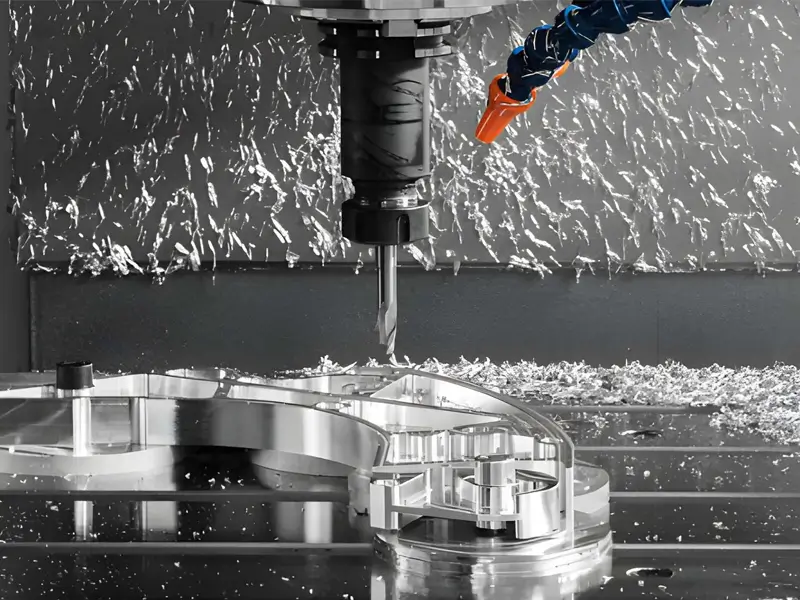
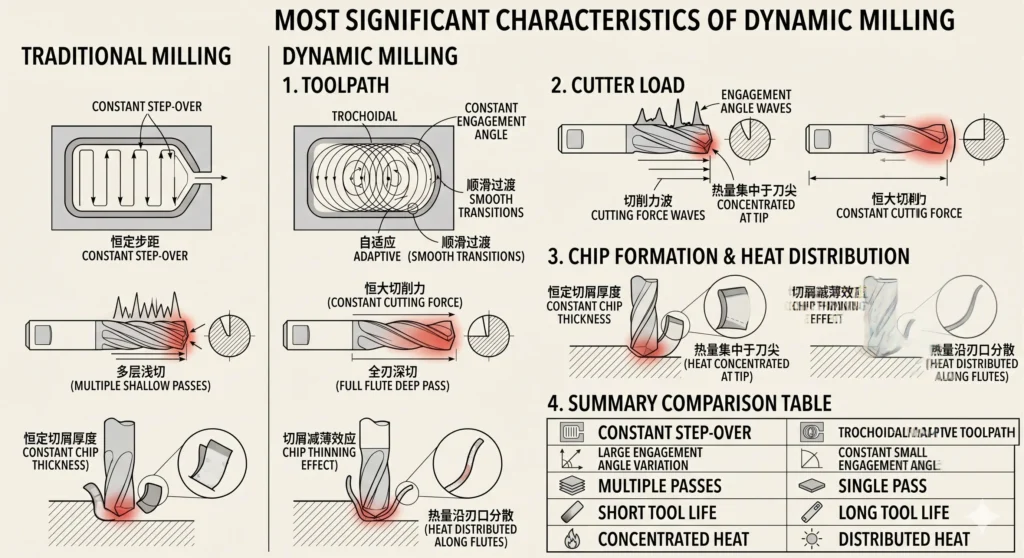
Dynamic milling aims to control cutter engagement and chip formation as the tool follows the available stock. It is not defined by maximum speed or an exactly constant measured load; corners and transitions still require suitable toolpaths and settings.
CAM software calculates engagement-aware paths to reduce overload. Trochoidal loops are one possible approach, not a synonym for every dynamic strategy. Proper settings remain necessary when using solid carbide tools.
Constant Chip Thickness Milling
At low radial engagement, radial chip thinning can make the maximum chip thinner than the programmed feed per tooth. Apply the tool maker’s compensation guidance within machine and tool limits; do not simply increase feed without checking the engagement and setup.
Many high-efficiency strategies combine reduced radial engagement with a larger axial depth to use more of the cutting edge. Full flute length is not mandatory: choose depth within the tool’s usable length, rigidity, chip-evacuation, and machine limits.
Why Use a Dynamic Milling Strategy?
Cycle-time reductions depend on the part, baseline strategy, machine, and tooling. The original 50% or more figure is not a general promise; compare measured results for the actual job.
More consistent engagement can reduce shock loading and uneven wear on roughing end mills. Tool-life and financial gains must be assessed over the actual process; payback is not assured after only a few parts.
Essential Tools for the Job
Choose milling cutters suited to the material, engagement, and machine capability. Toolpath choice does not remove the cutter’s application limits.
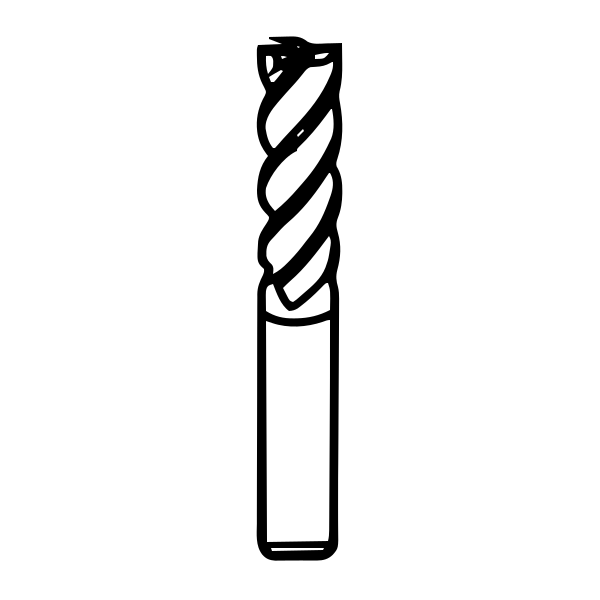
- Variable Helix End Mills: Can reduce chatter tendencies, but cannot eliminate vibration from every cause.
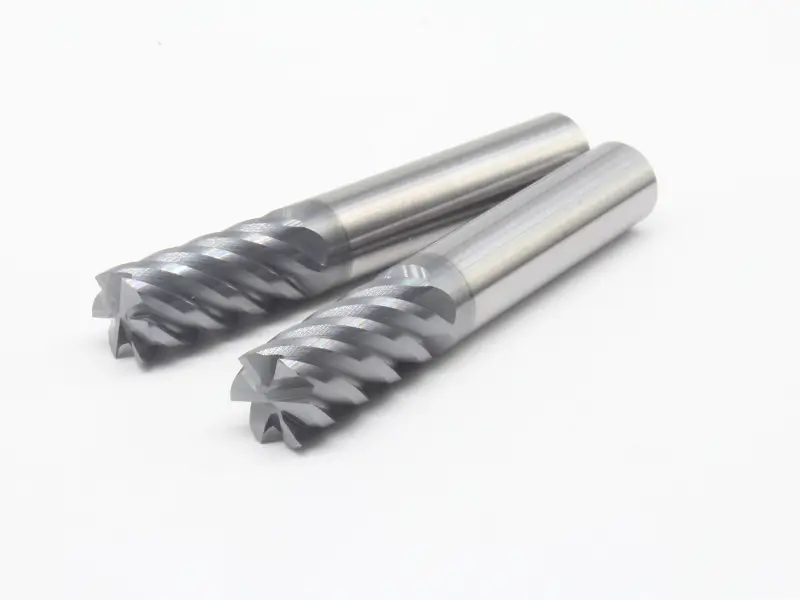
- Solid Carbide Tools Dynamic Milling: Carbide end mills are common choices; suitability depends on the cutting application and setup, not simply high-velocity turns.
- High Flute Count: Options such as 5 or 7 flutes may suit light radial engagement, provided chip clearance and the tool’s application limits are respected.
A 3-flute cutter is one option for aluminum, and higher flute counts can suit some steel applications. Select geometry and flute count for chip space, engagement, reach, and the manufacturer’s application data.
Software and CAM Integration
CAM is the practical way to generate complex engagement-controlled paths. Simple looping paths can be programmed manually, so hand programming is not mathematically impossible.
- Mastercam Dynamic Milling: One of the original leaders in this tech.
- Fusion Adaptive Roughing: Autodesk’s engagement-controlled roughing strategies were previously named Adaptive Clearing; they are distinct from Mastercam Dynamic Motion.
- SolidCAM iMachining: Uses its own toolpath and cutting-condition technology; verify supported operations for the installed version.
- hyperMILL MAXX Machining: Includes high-performance roughing strategies; capabilities depend on the licensed modules and machine configuration.
Define stock, boundaries, tool data, engagement, depth, feed, entry, and clearance correctly. CAM calculates the path from those inputs; validate it and use a suitable postprocessor rather than assuming stepover alone makes the setup complete.
Managing Heat and Speed
Chips carry away part of the cutting heat in both conventional and high-efficiency milling. Suitable chip formation and reduced recutting can improve heat management, but some heat still enters the tool and workpiece.
The control’s block processing, look-ahead, interpolation, and axis dynamics affect how smoothly a path runs. Adjust path tolerances, smoothing, and feeds for the machine; age alone does not determine suitability.
Material Specifics
In terms of the material, every metal acts differently.
- Aluminum: Use tool-specific cutting data and maintain chip clearance; high RPM and feed are not universal settings.
- Titanium: Control cutting temperature and engagement with suitable cutting data and cooling; keeping the tool moving alone does not prevent overheating.
- Hardened Steel: Suitable tools and strategies can machine certain hardened grades within their rated limits; dynamic motion does not make every previously unmachinable material suitable.
Unusual screaming or vibration should be investigated, not treated as evidence of safer spindle operation. Select coolant, air, or dry machining for the tool, material, and machine instructions, with suitable chip containment.
Common Challenges in Dynamic Milling
A loud whistle may indicate chatter, but diagnose its source before changing parameters. Check tool overhang, holder condition, runout, and workholding, and select stable conditions within the manufacturer’s limits.
Poor chip evacuation can cause recutting, heat, and tool damage. Check flute clearance and use a chip-removal method suited to the material and machine; air blast alone is not always sufficient.
The ROI of Dynamic Milling
Now, all of this stated, why change?
- Time: Suitable jobs may have shorter cycles; verify the total process time.
- Tools: More even loading may reduce tool consumption; measure actual wear and replacement costs.
- Electricity: Energy per part may decrease with a shorter cycle, but power demand and auxiliary loads must be measured; the machine does not necessarily work less hard.
The example of reducing a job from one hour to 20 minutes is illustrative, not a forecast. Calculate return using measured cycle time, tooling, programming, setup, and production volume.
Dynamic Milling Troubleshooting Tips
A burnt-looking tool can indicate unsuitable speed or feed, rubbing, poor chip removal, coolant problems, or wear. Diagnose the cause before changing settings; increasing feed is not a universal cure. Investigate vibration through the tool, holder, workholding, and machine.
Check that the entry method suits the available space and cutter. Helical ramping can be useful with a ramp-capable tool and adequate clearance; other applications need a different entry or a prepared opening.
Final Inspection
Use spindle-load trends as one process indicator. Changes can occur during entries, exits, and changing conditions; a perfectly flat meter reading is not the definition or sole validation of a dynamic path.
At the onset, it might take a few tries to get the perfect path. But once you do, you prefer it over the old way every time. Same as always, the right strategy makes the hard work easy.
Conclusion
Dynamic milling can improve roughing through engagement-aware paths and suitable cutting conditions. Select axial depth, radial engagement, tools, and CAM settings for the actual setup, and verify performance rather than assuming full-flute cutting or guaranteed savings.
FAQs
What is the difference between dynamic milling and traditional milling?
Traditional milling covers many depths and widths of cut. High-efficiency strategies often use a larger axial depth with lower radial engagement, but need not use the full flute length. The useful comparison is the actual load, tool wear, and cycle time for the job.
Is trochoidal milling the same as dynamic milling?
Trochoidal milling uses repeated looping motions that advance through material. It can be part of an engagement-controlled strategy, but dynamic or adaptive paths are not all trochoidal and do not guarantee perfectly constant cutting force.
Why does dynamic milling save tool life?
Controlled engagement and suitable chip thickness can reduce overload and uneven wear. Tool life still depends on material, geometry, heat, chip evacuation, and setup; heat does not stay exclusively in the chips.
Can any CNC machine do dynamic milling?
Machine suitability depends on control processing, look-ahead, axis response, rigidity, spindle capability, and the chosen path. Validate feeds and postprocessed motion on the specific machine rather than assuming every modern CNC can run the same settings.
What software do I need for dynamic toolpaths?
CAM products offer different engagement-aware strategies, including Mastercam Dynamic Motion and Autodesk Fusion Adaptive Roughing, previously called Adaptive Clearing. Check the installed version, license, postprocessor, and machine support; software updates alone do not validate the process.