


Positive Angle Inserts vs Negative Angle Inserts
When you put CNC turning and milling under observation, you’ll see how cutting insert geometry plays a critical role in the success of any machining operation. One of the most fundamental geometric properties is the insert angles, positive and negative angle inserts.
The choice you make between a positive and a negative insert will have a direct impact on cutting forces, surface finish, tool life, and overall process stability.
In this article, we provide you with a detailed comparison between positive and negative angle inserts. Read on as we explore their unique characteristics, advantages, disadvantages, and typical use applications. By the end of this piece, you will have a clear understanding of how to choose the correct insert geometry for your machining operations.
Contents
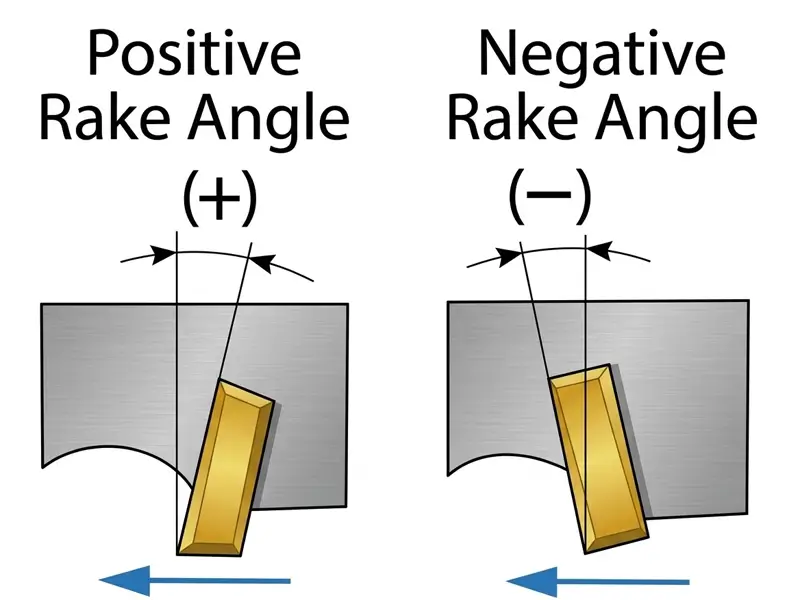
What Are Positive Angle Inserts?
In common turning-insert terminology, a positive insert has built-in clearance on its flank. This classification is distinct from the effective rake angle, which depends on the top geometry and mounting.
Do not define a positive rake angle as an angle below 90°. Rake, clearance, and wedge angles describe different features. A positive-style turning insert has flank clearance; its working rake must be assessed in the actual holder.
Light-cutting positive geometries can be useful for internal turning, slender parts, and limited-power machines. They do not make inadequate workholding or an unstable setup acceptable.
Positive-style inserts are offered in different cutting materials, including carbide and suitable polycrystalline diamond designs. Chip control and permissible operations depend on grade, chipbreaker, feed, depth, and material rather than the positive label alone.
Advantages of Positive Angle Inserts
Positive angle insert boasts several significant advantages that make it an excellent choice for specific machining scenarios, typically for finesse and precision-focused applications.
Some of the advantages of positive angle inserts include:
- Low Cutting Forces: A light-cutting geometry can reduce load compared with a stronger-edge alternative under comparable conditions. Actual forces still depend on engagement, material, and edge preparation.
- Better Surface Finish: A suitable sharp geometry can help surface quality, but dimensional accuracy and freedom from secondary finishing require verification.
- Reduced Vibration: Lower cutting forces can help a compliant setup, but chatter also depends on overhang, support, and cutting conditions.
- Improved Chip Control: Select a chipbreaker and cutting data for the material and operation. Positive insert style alone does not establish chip direction or prevent blockage.
Disadvantages of Positive Angle Inserts
While positive angle inserts are characterized by the advantages we mentioned and even more, it also comes with some limitations. What are some of these disadvantages?
- Weaker Cutting Edge: A smaller wedge angle can trade edge strength for easier cutting. Suitability for interruptions or abrasive work also depends on grade and edge preparation.
- Reduced Tool Life in Demanding Applications: An insufficiently robust edge can wear or chip under excessive load. A negative-style alternative is not automatically longer-lived; compare application-qualified grades and geometries.
- Single-Sided Use: Conventional positive-clearance turning inserts are generally single-sided because of their flank geometry, not simply their rake angle. Usable edge count also depends on insert shape and construction.
Use Applications of Positive Angle Inserts
Positive angle inserts possess unique properties that make them perfect for tasks where precision and low cutting forces are non-negotiable.
Positive clearance, positive rake, and lead angle are different concepts. Light-cutting geometries can suit some non-ferrous or slender components; select the grade for the actual alloy.
Indexable positive-style inserts are used in compatible holders for operations such as boring and finishing. They are not generally described as inserts applied to high-speed steel tools; HSS is itself a cutting material.
For heavy roughing, select sufficient edge strength and a rated grade and holder. Do not rule a design in or out on speed or positive style alone.
What are Negative Angle Inserts?
Negative-style turning inserts have zero nominal flank clearance. Their construction can support robust cutting edges, but they are not restricted to heavy material removal.
Zero flank clearance is not the same as zero rake. The holder inclination provides working clearance, and the rake surface or chipbreaker can produce a positive local cutting geometry.
Negative-style inserts may be single- or double-sided. Check the actual design; zero nominal clearance does not mean every insert can be flipped or used in every holder.
Advantages of Negative Angle Turning Insert
What are the advantages of a negative angle turning point, and why is it the preferred choice for high-demand, high-production environments?
- Superior Edge Strength and Durability: A robust wedge and appropriate edge preparation can support demanding cuts. Grade, interruptions, and operating conditions still determine chipping resistance.
- Longer Tool Life in Roughing: Suitable robust geometries can perform well in roughing, but longer life must be established for the application rather than inferred from insert style.
- Double-Sided for Cost-Effectiveness: Some zero-clearance inserts offer usable edges on both sides. Others are single-sided; compare actual edge count and cost per completed part.
Disadvantages of negative angle turning insert
Insert style alone does not determine cutting action. Negative-style inserts may have light-cutting chipbreakers and finishing geometries; evaluate the complete tool.
- High Cutting Forces: Stronger, less positive effective geometries can increase force requirements. These inserts still remove material by cutting, rather than merely penetrating it. Check the available rigidity and power.
- Increased Heat Generation: Load, speed, friction, grade, and cooling affect temperature. Negative insert style alone does not establish the heat generated.
- Finishing Selection: Negative-style inserts with appropriate finishing or wiper geometries can finish successfully. Match the chipbreaker, nose radius, edge preparation, and cutting data.
- Soft or Gummy Materials: Use a compatible grade and light-cutting geometry with suitable chip control. Aluminium is not rubber, and a zero-clearance insert is not automatically unsuitable.
Use Applications of Negative Angle Inserts
Negative-style inserts are common in external turning and demanding cuts. Select their geometry and grade for the actual operation instead of treating them as the first choice in every case.
A suitable negative-style insert can support roughing. Permitted feed and depth depend on insert dimensions, grade, holder, stock, and machine capacity; they are not guaranteed by thickness alone.
They are excellent for external turning of steel, cast iron, and other hard materials on powerful and rigid CNC lathes. The most common negative inserts are CNMG (80-degree rhomboid), DNMG (55-degree diamond), and WNMG (80-degree trigon).
SNMG identifies a square, zero-clearance insert family; it does not specify a 45° lead angle by itself. The holder and orientation establish the working entering or lead angle and accessible cut.
Difference Between Positive angle Inserts and Negative Angle Inserts
While both are used in turning operations, choosing between a positive and a negative insert will radically alter the machining process. Their contrasting geometries determine different strengths, weaknesses, and ideal use cases.
To make an informed decision, it’s essential to understand these key differences side by side. The following table provides a clear comparison of their most important characteristics.
Feature | Positive Angle Inserts | Negative Angle Inserts |
Geometric Definition | Built-in positive flank clearance; effective rake also depends on geometry and mounting. | Zero nominal flank clearance; working rake is not necessarily zero. |
Edge Strength | A smaller wedge may reduce strength; grade and edge preparation also matter. | Can support a robust edge; strength depends on the complete geometry and grade. |
Cutting Forces | Often lower with light-cutting geometry; verify for the operation. | May be higher with a robust geometry; not determined by style alone. |
Primary Application | Common in internal turning, slender parts, and suitable finishing operations. | Common in external turning and roughing; suitable finishing designs also exist. |
Number of Cutting Edges | Generally single-sided; usable edge count depends on shape and design. | Single- or double-sided, depending on design; no universal edge-count ratio. |
Vibration Tendency | Lower force may help; chatter is still possible. | Stability depends on geometry, overhang, setup, and cutting conditions. |
Surface Finish | Can achieve the specified finish with suitable conditions; not guaranteed. | Suitable finishing and wiper geometries can achieve good surfaces. |
Ideal Materials | Select grade and geometry for the alloy; positive style alone does not define compatibility. | Often used on steels and cast irons with matching grades; material hardness varies. |
How do I Choose the Correct Turning Insert?
Now that you understand the differences, to make the right choice you need to analyze your specific application. There are many parameters that you must consider when choosing the right turning inserts, and that includes careful selection of geometry, grade, shape and size of the insert.
Making the critical choice of which turning insert helps you to achieve good chip control and optimum machining performance depends significantly on the following key factors:
1.Material Being Machined:
For steel and cast iron, choose the grade and geometry for hardness, stock condition, and operation. Negative-style inserts are common roughing choices, but these materials are not all hard and no single style is universally preferred.
For non-ferrous materials or light finishing, a suitable sharp geometry can reduce forces. Positive style alone does not guarantee finish or material compatibility.
2.Machine Tool Capabilities:
The capabilities of your equipment are crucial. High-power, high-rigidity machines with improved stability can handle the high cutting forces generated by negative turning inserts.
On the other hand, for low horsepower machines, lower rigidity machines, or if you’re using long, thin boring bars, we recommend using positive inserts. This is because they produce less cutting force and vibration.
3.Type of Operation (Roughing vs. Finishing):
For roughing, select enough edge strength and chipbreaking capacity for the planned engagement. Longer life is not inherent in every negative-style insert.
For finishing, select a geometry that meets surface and force requirements. Both positive- and negative-style inserts can offer appropriate finishing designs.
4.Tooling and Setup Rigidity:
Internal turning or boring with a long overhang can be sensitive to vibration. This is distinct from drilling a hole.
A light-cutting positive geometry may help reduce forces, but grade and geometry must still match the material. Shorten overhang and improve support where practical.
Conclusion
Choosing between negative and positive turning inserts is a fundamental decision that directly impacts the outcome of your machining operations. Ultimately, there isn’t a single perfect option for every use case; there’s just the right tool for the particular task you’re carrying out.
What turning insert you eventually choose is a representation of the fundamental compromise between the resistance and convenience of negative inserts and the finesse and precision of positive inserts.
Ready to improve the performance of your projects? We’re here to serve your best interest at Sundi Precision Tools.
Explore our catalog to discover a wide range of cutting tools designed for peak performance. After that, reach out to our team of seasoned experts for consultations and to get an instant quote for your project.