


What is a Thickness Planer?
A thickness planer reduces suitable boards to a chosen thickness by cutting the upper face relative to the lower reference face. Accurate, parallel results require a flat supported reference face and a correctly adjusted machine; the planer does not automatically flatten both faces of rough lumber.
Contents
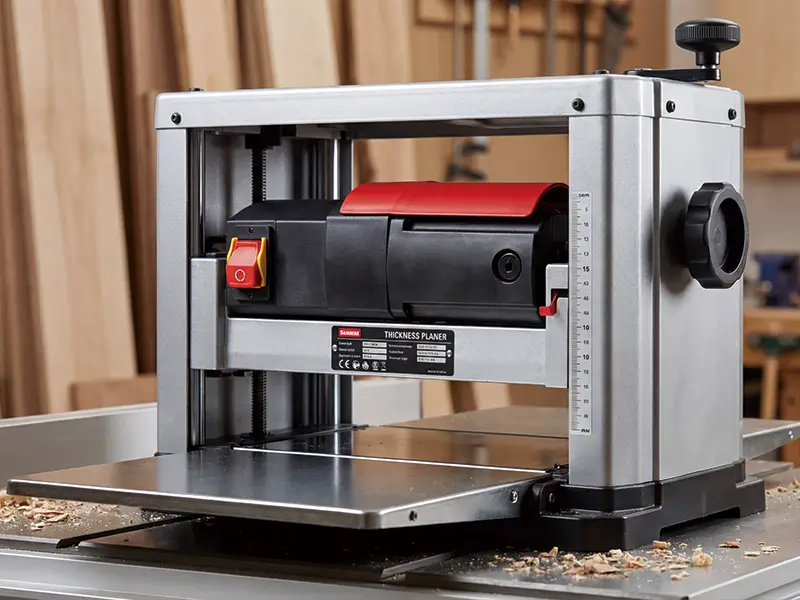
What is a Thickness Planer?
A thickness planer is a woodworking machine. It reduces boards to a consistent thickness throughout their entire length. In the United Kingdom and Australia, manufacturers call this machine a thicknesser. The machine uses rotating cutterhead blades to remove thin layers of material from the top surface while the bottom face rides on a flat reference table.
The primary function focuses on making boards with two perfectly parallel faces. However, you must understand an important limitation: the planer does not flatten warped wood. The machine only makes surfaces parallel to each other. You need a flat reference face on the bottom before you can achieve accurate results.
How Does a Thickness Planer Work?
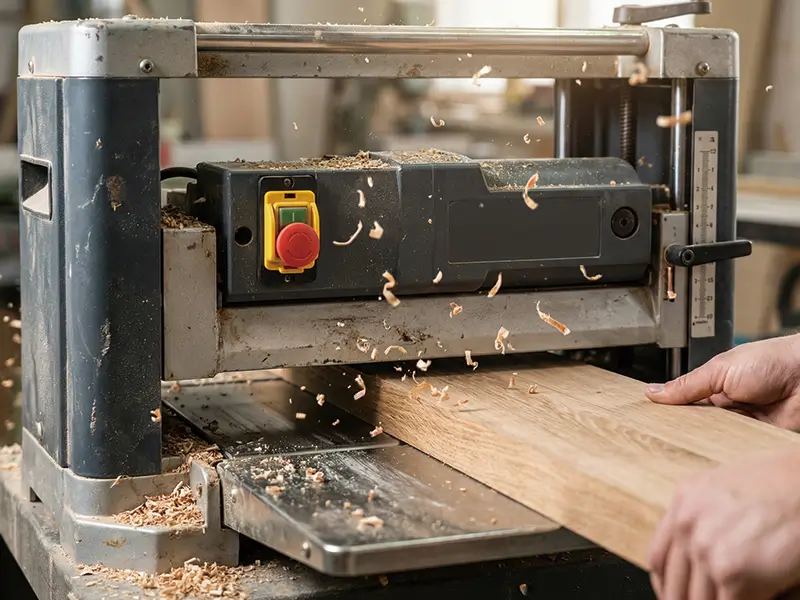
Important Parts
The thickness planer consists of four important systems.
First, the table provides the reference surface. Second, feed rollers move the board through the machine. Third, the cutterhead holds the planer cutting blades. Finally, the depth mechanism sets the distance between cutterhead and table; depending on the model, the table or cutterhead carriage moves. Cutterhead speed and adjustment resolution are model-specific, not universal 8,000–10,000 RPM or 1/64-inch values.
Operating Process
Set the cutting height for a light pass within the machine’s limits for board width and material. Present suitable stock to the feed rollers as instructed, keeping hands clear of the feed opening. The cutterhead removes material as the flat reference face rides on the table. Select depth of cut from the machine instructions rather than a universal 1/16-inch rule.
Use a flat reference face, or an appropriate secured flattening sled where permitted. Unsupported warped stock may flex under roller pressure and spring back after the cut; ordinary thickness planing does not reliably remove warp.
Thickness Planer vs. Jointer
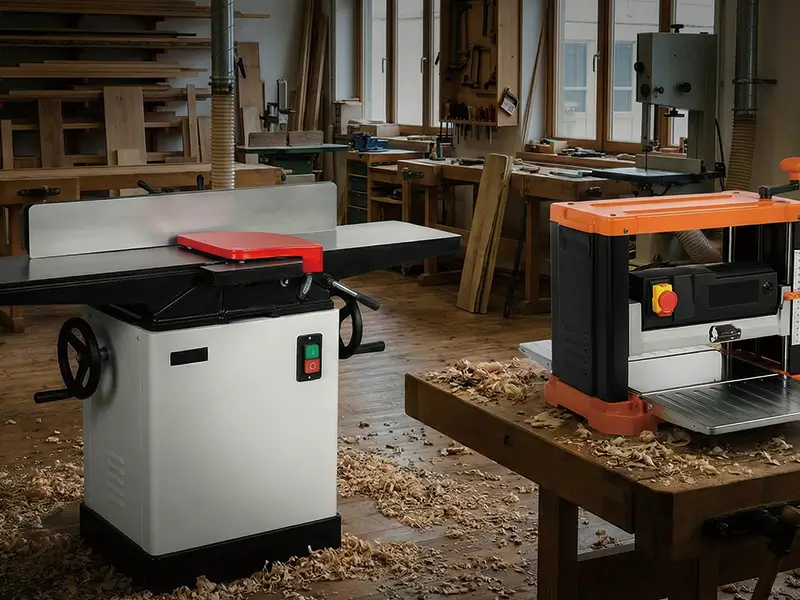
The jointer flattens one face and squares one edge of rough lumber. You push boards across the jointer’s flat table past a rotating cutterhead that removes high spots.
The planer brings the upper face parallel to a flat lower reference face and reduces thickness. Flattening warped stock requires prior preparation or an appropriate supported sled; simply passing it through does not guarantee a flat result.
Both tools work together in proper lumber milling. First, you flatten one face on the jointer. Second, you square one edge on the jointer. Third, you run the board through the planer with the flat face down. This makes the second flat face parallel to the first.
Types of Thickness Planers
Manual Hand Planers: A Different Tool
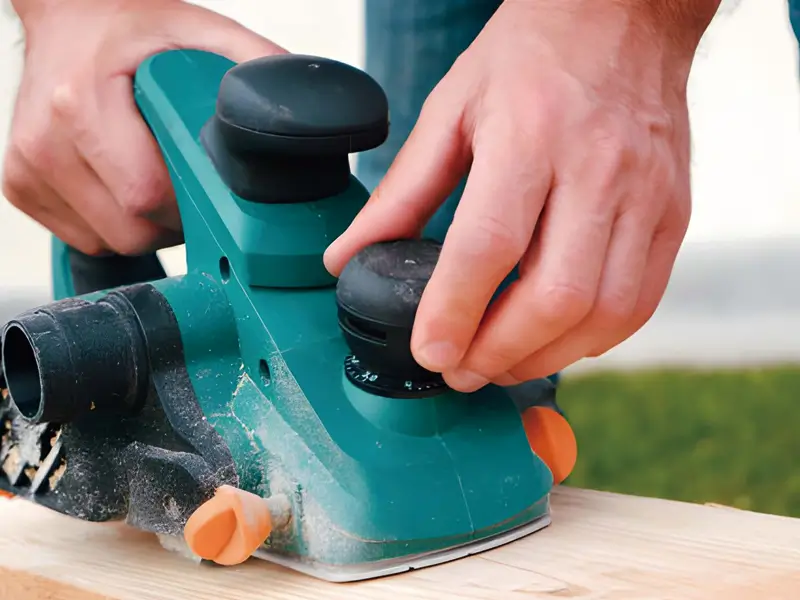
Manual hand planers are an alternative for hand-controlled surface preparation, not a type of powered thickness planer. Consistent thickness depends on reference surfaces, measurement, and operator skill; larger volumes require substantial effort.
Benchtop Planers
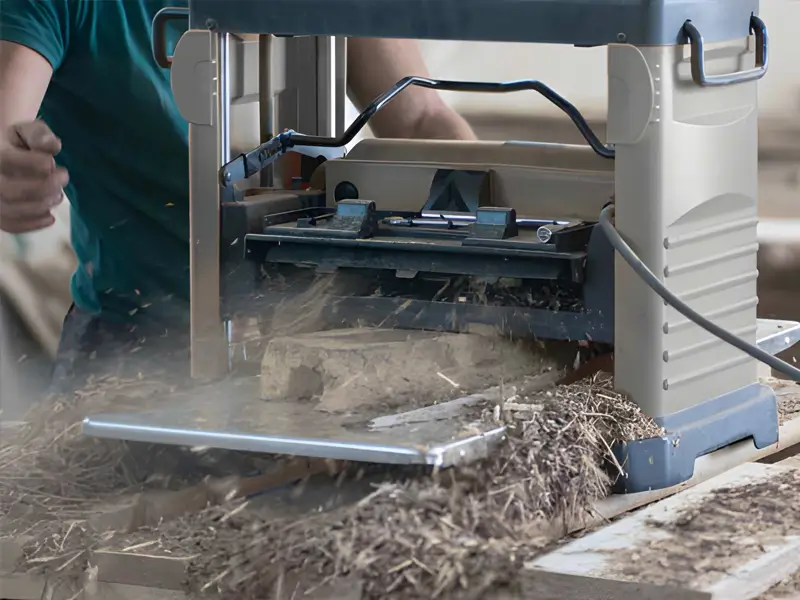
Benchtop planers suit portable or space-limited workshops. Width, thickness capacity, weight, motor rating, and supply voltage vary by model and market; verify the actual specifications rather than treating a 12–13-inch width or 120-volt supply as universal.
Stationary/Industrial Planers
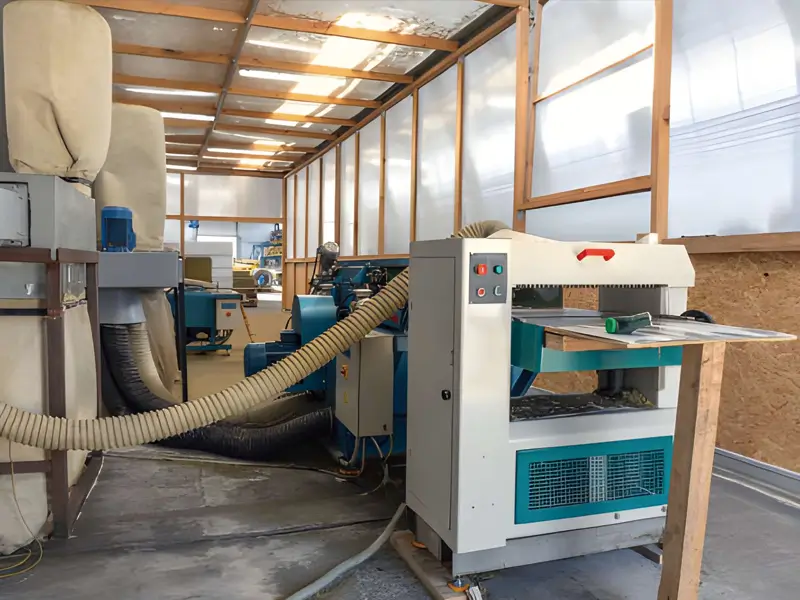
Stationary planers are floor-standing machines available in a wide range of capacities and duty ratings. Compare the actual width, thickness, weight, power, feed system, and installation requirements. Industrial machines are not limited to 15–20 inches or 3–5 horsepower, and price depends on model and market.
How to select a Thickness Planer?
Cutterhead Technology
Straight blade cutterheads use full-width planer knives in model-specific arrangements. Compare price, noise, and finish for the actual machine. Damaged knives may be reversible, resharpenable, or replaceable according to their design; complete replacement is not always required.
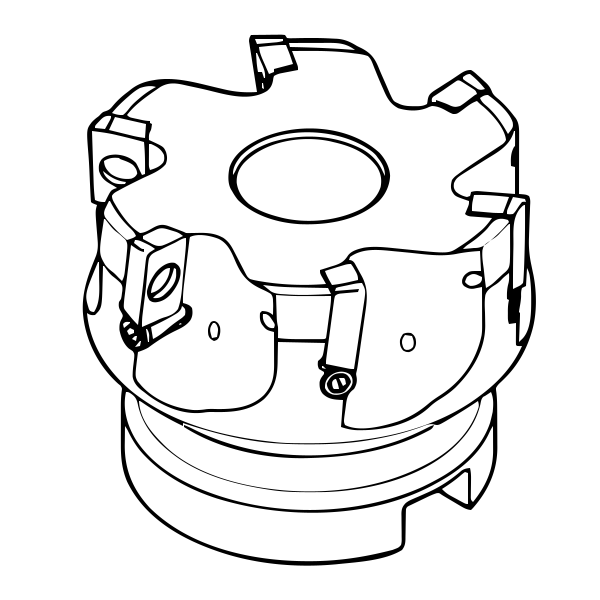
Spiral cutterheads commonly arrange small square carbide inserts in staggered patterns. Compatible four-sided inserts provide indexable edges, but geometry and edge count vary. Localized replacement can be useful; total cost, noise, and tear-out improvement must be assessed in the actual application.
Helical cutterheads commonly use skewed cutting edges for shearing action. Supplier terminology varies, so verify the actual geometry. Finish and price depend on the product and operation; neither the finest finish nor a fixed price premium is guaranteed.
Capacity Specifications
Match the machine’s maximum width and thickness, minimum stock dimensions, feed speeds, and support requirements to your material. These limits vary by model. A slower feed may improve finish in some applications, but cannot guarantee freedom from tear-out.
Motor Power and Performance
Check the actual motor rating, voltage, circuit requirements, and duty rating. Dense material and wider cuts may require a lighter pass. A stationary machine or induction motor does not guarantee continuous heavy cutting without overheating.
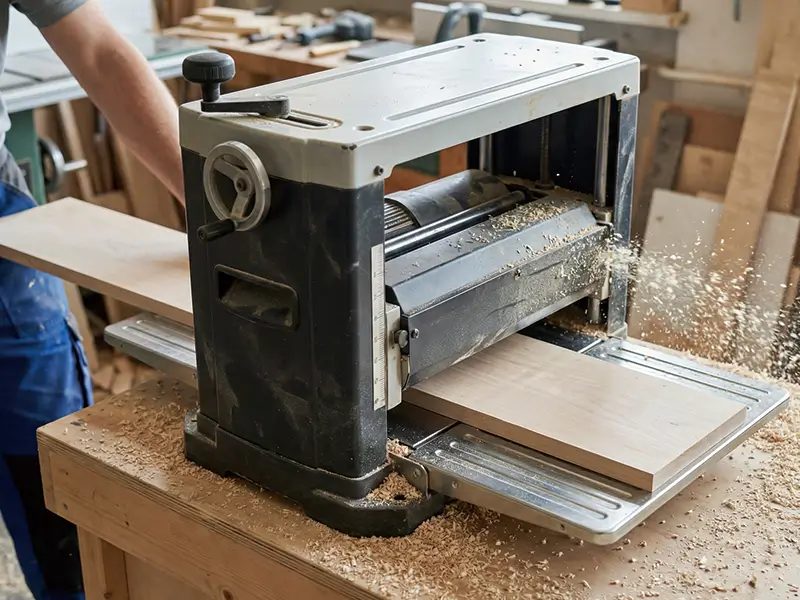
Snipe Reduction Technology
Snipe is an unwanted deeper cut near a board end, associated with changes in work support or cutterhead/roller positioning. Correct setup, suitable support, and model-specific carriage controls can reduce it. No universal 0.13 mm result or elimination of waste and sanding is established.
Dust Collection Integration
Thickness planers generate substantial chips. Use extraction with the airflow, hose size, and filtration required by the machine; a shop vacuum may not meet those needs. A chip blower assists discharge but does not by itself establish better dust collection or adequate exposure control.
Conclusion
A thickness planer can improve dimensional consistency when matched to the work and correctly set up. Compare capacity, cutterhead options, and operating costs against production needs; reduced material cost and investment payback should be verified rather than guaranteed.
FAQs
What are common applications for thickness planers?
Thickness planers can size suitable boards and glue-ups with a flat reference face. Reclaimed wood must be inspected and cleared of metal and other contamination; stock dimensions, grain orientation, and any glued material must be permitted by the machine instructions.
Can a thickness planer flatten warped wood?
Not reliably by ordinary thickness planing alone. Prepare a flat reference face first, or use an appropriate secured and shimmed planer sled where the machine and workpiece permit it.
What is planer snipe and how do you prevent it?
Snipe is a deeper cut at board ends. Use machines with head lock mechanisms, add support tables, and take lighter cuts to reduce it.
What is the difference between portable and industrial planers?
Portable and industrial planers differ in size, weight, feed systems, capacity, duty rating, and installation needs. Compare current model specifications and prices; fixed width, weight, or cost ranges do not define every machine in either category.
How do you maintain a thickness planer?
Isolate power before maintenance. Follow the model’s schedule for knife or insert care, table treatment, chip removal, belts, alignment, and any roller adjustment. Do not impose monthly waxing or alter roller pressure unless the instructions call for it.