










Everything You Need to Know About a Milling Machine
Milling machines remove material with rotating cutters. Their productivity depends on the machine, tooling, workpiece, and process; milling is used for both individual parts and series production.
This article provides in-depth information about the milling machine. We will discuss its components, types, operations, and applications.
Contents
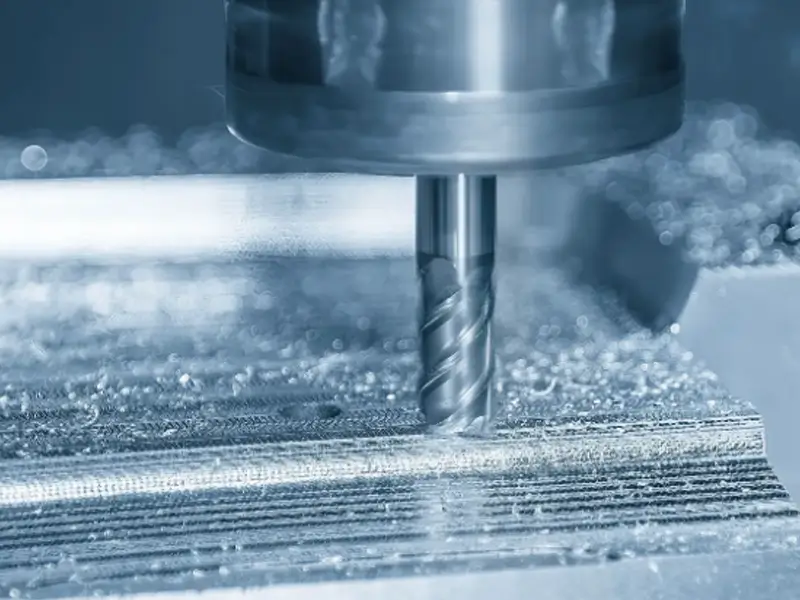
What is A Milling Machine
Milling machines shape a workpiece by progressively removing material with rotating cutting tools and controlled relative feed. Modern designs range from manually operated machines to CNC machining centers.
The workpiece is secured to a table or fixture while the cutter rotates. Feed motion may move the tool, the workpiece, or both, depending on the machine. Suitable tooling allows machining of materials including:
- Metals
- Plastic
- Composite Materials
- Wood
By calling it versatile, we mean it can perform various operations on different materials. You can shape the workpiece into the desired form with specific dimensions. Producing slots, gears, contours, and complex 3D shapes are common milling operations. Using a controlled cutting process, you can achieve tight tolerances. Let’s look at its main component to understand its functionality better.
Components of a Milling Machine
A milling machine is made up of several components. Here is a brief explanation of its main components:
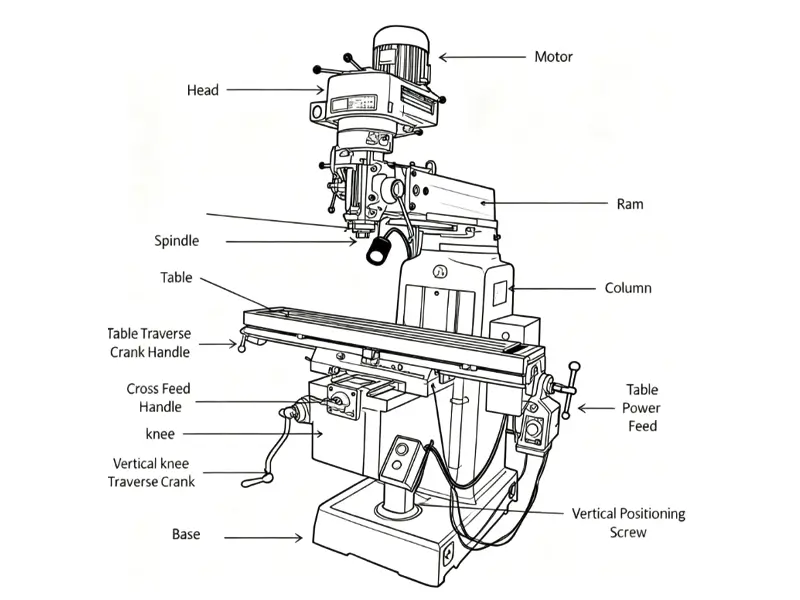
Base
The base supports the machine structure and contributes to stiffness and vibration control. Many designs use cast iron, although construction materials vary. Its role is to carry the structure and machining loads.
Column
The column of a milling machine is the part fixed vertically to the base. It is the structural support that keeps the machine upright. Key components, such as the spindle and overarm, are dependent on the column for support. In short, the column acts as the backbone of the milling machine.
Knee
The knee is the adjustable part that supports the saddle and worktable. You can adjust its height using its screw mechanism. It allows you to control the cutter’s depth. During the cutting mechanism, it is crucial to ensure accurate positioning. The adjustable knee aids this function.
Saddle
On a knee-type mill, the saddle supports the table and typically provides transverse movement toward or away from the column. The table provides longitudinal travel; the exact axis arrangement depends on the machine.
Worktable
The table supports the workpiece through suitable fixtures or clamps. Secure the workpiece against slipping relative to its fixture; the table itself may move during feed. Available table and spindle movements depend on the machine design.
Spindle
The spindle drives the cutting tool. A suitable holder or arbor connects the tool to the spindle. Runout, bearing condition, holder quality, and setup affect machining accuracy.
Overarm
On suitable horizontal mills, the overarm carries an arbor support. This arrangement supports the outboard end of a long arbor and helps limit deflection; it does not eliminate all movement under load.
Arbor
An arbor carries milling cutters, commonly on a horizontal spindle. An outboard arbor support can improve rigidity. Multiple cutters may be mounted for gang milling when the machine and setup permit.
Types of Milling Machine
As mentioned above, nowadays we have advanced milling machines. Milling machines have various designs and variations for different machining needs. In this section, we have explained some well-known types of milling machines. The following are types of milling machines based on spindle orientation.
Vertical Milling Machine
A vertical milling machine has a vertically oriented spindle. It can perform milling and suitable drilling operations with the correct tooling; spindle orientation alone does not determine achievable depth or accuracy.
Key Features
- The vertical orientation allows for producing complex shapes.
- It is ideal for making slots, pockets, and profiles on flat workpieces.
- With a vertical milling machine, you can achieve high accuracy.
Horizontal Milling Machine
A horizontal milling machine has a horizontal spindle. Suitable designs can support demanding material removal and arbor-mounted cutters. The spindle orientation does not mean that cutting is limited to the X axis.
Key Features
- It helps in the roughing process by removing large pieces of material in one go.
- It provides high speed and accuracy.
- It can mount multiple cutters side by side on the arbor.
Universal Milling Machine
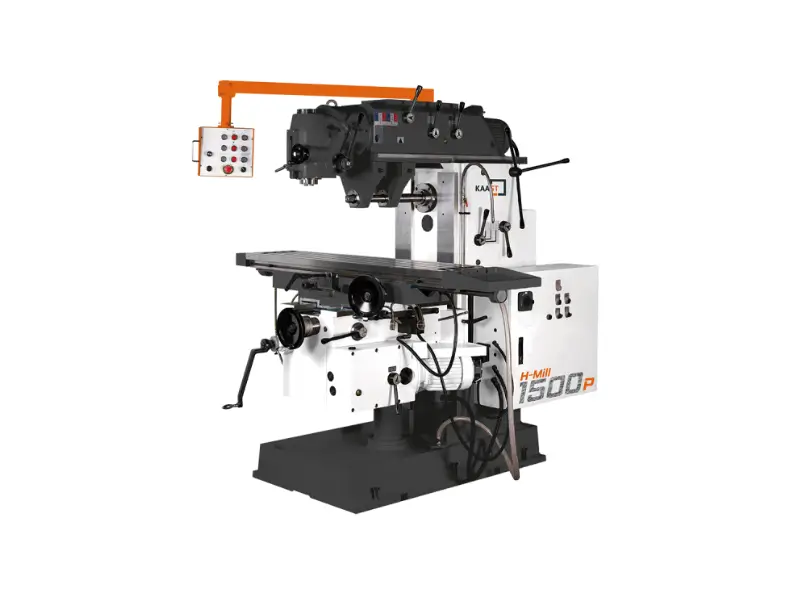
Image from: kaast
Universal milling machines offer adjustable arrangements, such as a swivelling table or additional heads. Horizontal and vertical operations depend on the installed equipment; the spindle does not necessarily switch orientation on every model.
Key Features
- It allows precise cutting at specific angles.
- It can perform various operations such as face milling, end milling, and peripheral milling.
- A universal milling machine is a multi-purpose tool that can perform several operations in one setup.
Knee Mills
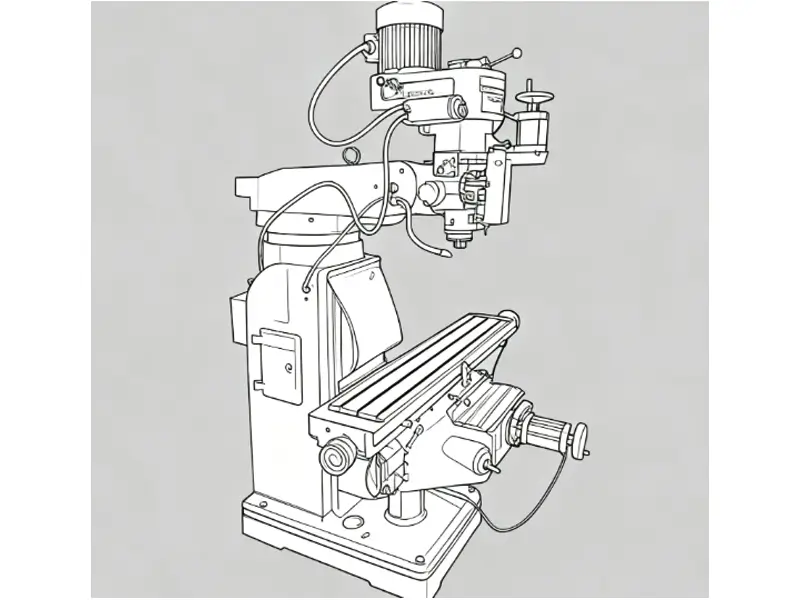
A knee mill supports its table and saddle on a vertically adjustable knee. The vertical direction is normally Z, not X. Knee mills can have different spindle orientations and may use manual, powered, or CNC control.
Key Features
- Due to its versatility, it can handle multiple tasks.
- The complexity depends on the machine configuration and control system; a knee mill can also be CNC-controlled.
- It can be used for drilling, boring, slotting, and profiling.
CNC Milling Machine
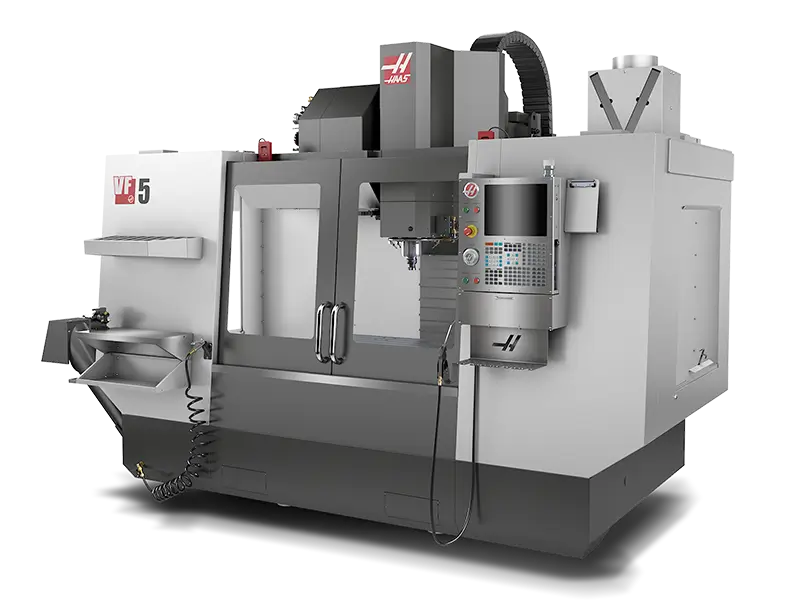
Image from: Haas
A CNC milling machine follows a program through its numerical control. CAM software can generate toolpaths and a postprocessor can produce machine-specific code; the machine controller executes the movements after setup and verification.
Key Features
- It can produce complex parts that are difficult to make manually.
- It can replicate the same parts hundreds or thousands of times with high accuracy.
- It required minimal human intervention.
How Does a Milling Machine Work?
Milling combines a rotating cutting tool with controlled relative feed between tool and workpiece. The following steps outline setup and operation.
Setting Up the Workpiece
Secure the workpiece using a suitable fixture and clamping method. It must not slip relative to the fixture during cutting; the table or fixture may still move as part of the programmed feed.
Installing the Cutter
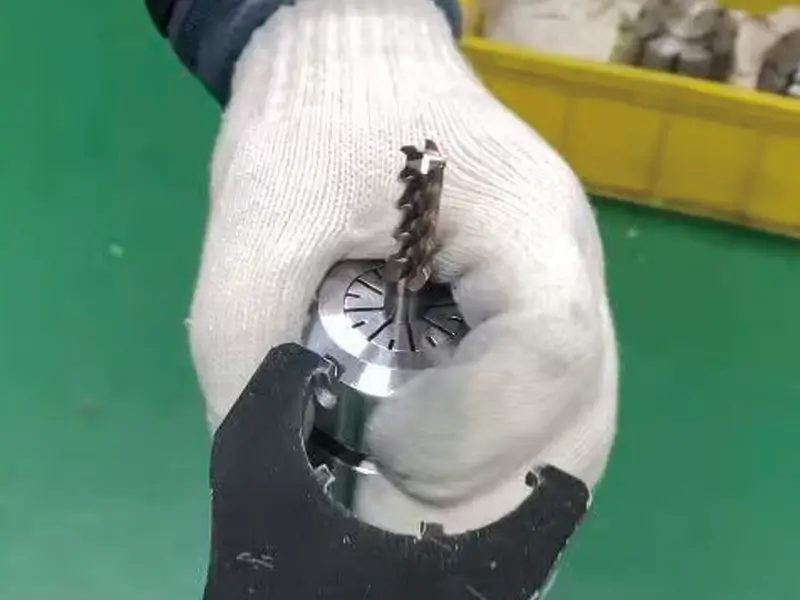
Select tooling for the required operation, such as an end mill, face mill, or drill. Mount it in a suitable holder and verify workholding, offsets, travel, and clearances before machining.
Adjusting the Parameters
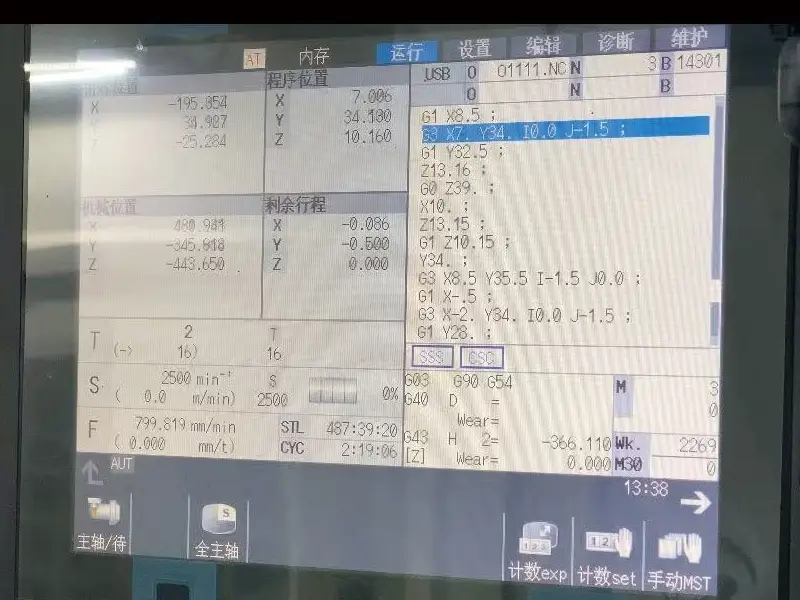
The key parameters, such as RPM, feed rate, and depth of cut, are adjusted by the operator.
- RPM: RPM is the speed at which the cutter rotates.
- Feed rate: The rate of relative tool-to-workpiece movement during cutting.
- Depth of cut: The cutting engagement depth, specified for the operation; it is not the total volume removed.
Milling
.gif)
During milling, the rotating cutter removes material as chips. Cutting speed, feed, engagement, and chip evacuation must suit the tool, material, and setup.
Finishing
After material removal, the workpiece is processed to achieve a smooth finish. Then the final piece goes through a quality check.
What does a Milling Machine Do?
Milling machines are an indispensable tool widely used across the manufacturing industry. It transforms raw materials into functional components. They shape solid materials by removing excess material. These versatile machines can handle complex shapes and geometries.
Milling Operations
There are various milling operations designed for specific purposes. Some of the milling operations include face milling, plain milling, end milling, side milling, and thread milling. All of these milling operations are performed using a milling machine. Different cutters and configurations are applied in these operations.
Applications of the Milling Machine in Various Industries
Here are some applications of milling machines in crucial industries:
- Automotive Industry: In the automotive industry, the engines and vehicle structure require precise metal parts. Common components include engine blocks, cylinder heads, transmission housings, and brake components.
- Aerospace: The aerospace industry demands extremely precise and lightweight components. Milling is used to make turbine blades, structural frames, and landing gear.
- Electronics: In electronics, milling is applied to make heat sinks, circuit housings, connector plates, and other small-scale components.
- Medical Device Manufacturing: Medical devices such as surgical instruments, orthopedic implants, dental implants, and prosthetic joints are made using milling machines.
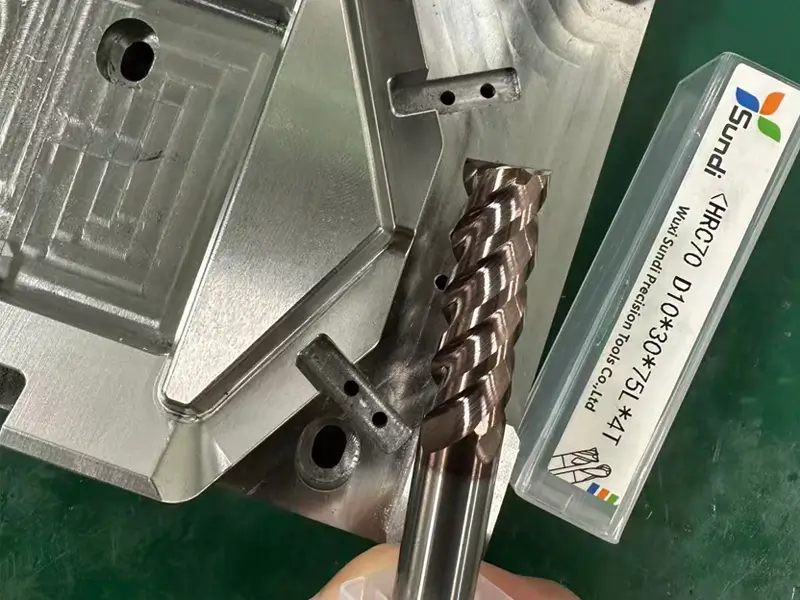
- Tools and Die Industry: In the tool and die field, milling is used to manufacture dies, molds, punches, jigs, and fixtures.
Advantages of the Milling Machine
In modern manufacturing, milling machines provide multiple benefits. Here are some of them:
- Speed and Flexibility: One of the greatest advantages is their speed and flexibility. Whether you are making a single prototype or thousands of parts, these machines can remove a large amount of material quickly. Switching cutting tools and/or settings can be done rapidly, resulting in increased productivity.
- Compatible with Versatile Materials: Suitable tooling and parameters allow milling of metals, plastics, and composites. Achievable accuracy varies with material behavior, workholding, machine capability, and the process.
- Accuracy and Surface Finish: The controlled movement and effective cutting tools produce parts at a high level of smoothness and precision.
- Cost-effective: In the long term, milling machines are cost-effective. Milling reduces errors, results in less wasted material, and can operate for decades with adequate maintenance.
- Increased Efficiency: CNC can automate programmed movements and tool changes on suitably equipped machines. Setup, monitoring, maintenance, and process verification remain necessary; unattended operation requires a specifically assessed and suitable system.
Conclusion
Milling machines play a critical role in the manufacturing process by taking raw material and producing a finished, precise part. Milling machines can work on a variety of milling tasks from simple cuts to complex 2D and 3D shapes. If operated properly, a milling machine can provide consistent quality production for years.
FAQs Related to Milling Machine
What tools are used on a milling machine?
A milling machine uses tools such as pcd end mills, carbide milling cutter, face mills, slot milling tools, ball-nose cutters, fly cutters, and chamfer tools. These tools are used to shape, cut, and contour materials efficiently.
Do multi-axis machines improve machining accuracy and surface quality?
Multi-axis machines can reduce reclamping and improve tool access. Accuracy and surface finish still depend on calibration, rigidity, tool orientation, programming, and process control; additional axes do not automatically improve every result.
What is the difference between 3-axis, 4-axis, 5-axis, and 6-axis milling machines?
A 3-axis machine controls three linear axes. A 4-axis arrangement adds a rotary axis, and a typical 5-axis arrangement combines three linear with two rotary axes. A 6-axis designation is machine-specific; check which axes are controlled and whether motion is simultaneous.
How much does a milling machine cost?
Machine prices depend on size, configuration, control, tooling, installation, and support. Obtain a current quotation for the required specification; broad price ranges without a date and defined configuration are not a reliable purchasing basis.
What is the difference between a milling machine and a lathe?
In milling, the cutting tool rotates and relative feed removes material. In conventional turning, the workpiece rotates while a usually non-rotating tool feeds against it. Mill-turn machines can combine these functions.
What is the difference between a milling machine and a router?
Many metal-cutting mills prioritize stiffness and cutting-force capacity, while many routers emphasize large working areas and high spindle speeds for sheet materials. Capabilities overlap; compare the actual machine, spindle, tooling, and workholding for the intended material.
What is the difference between a milling machine and a machining center?
A machining center typically combines CNC control with automatic tool changing and supports several operations in one setup. Milling machines may also be automated; the distinction is the machine configuration, not a universal manual-versus-automatic divide.