





CBN Inserts vs Carbide: Which Cutting Tool Is Right for Your Application?
An unsuitable insert can increase the risk of edge failure or an unacceptable part. CBN and carbide have overlapping, grade-specific application ranges. This guide explains the factors to check when choosing between them.
Contents
What Is a CBN Insert and How Is It Made?
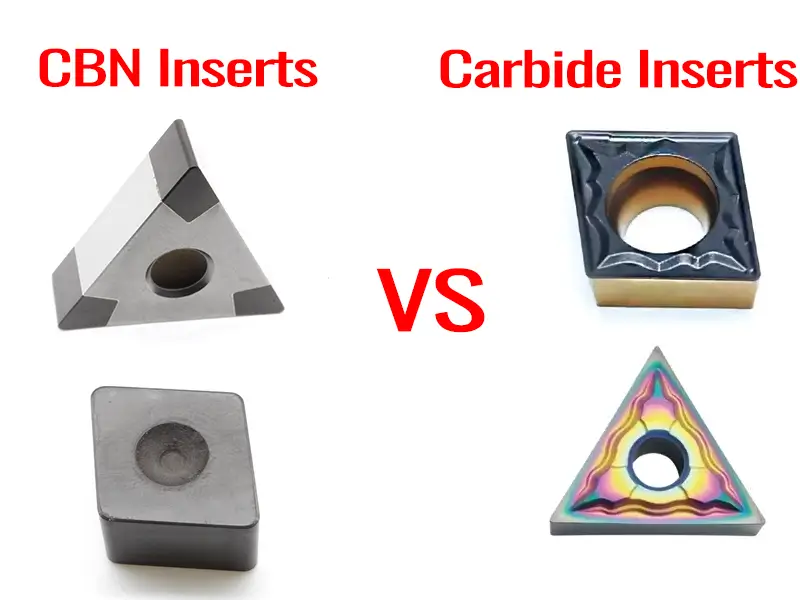
CBN means cubic boron nitride, a synthetic superhard material produced under high pressure and temperature. Commercial PCBN cutting grades differ in CBN content, binder, and microstructure; hardness values require a specified grade and test method.
Diamond tools can suffer rapid chemical wear when machining ferrous materials at elevated cutting temperatures. CBN offers greater suitability for many such applications, but it is not immune to chemical wear or other wear mechanisms.
CBN inserts include brazed-tip, layered, and solid PCBN constructions. A carbide body supports the cutting segment in supported designs. Solid construction does not automatically imply suitability for heavier cuts; select the grade, edge preparation, and geometry for the application.
In engine component work, CBN tools for valve seat machining can matter when hard seat materials make ordinary tooling unstable.
Tipped CBN Inserts
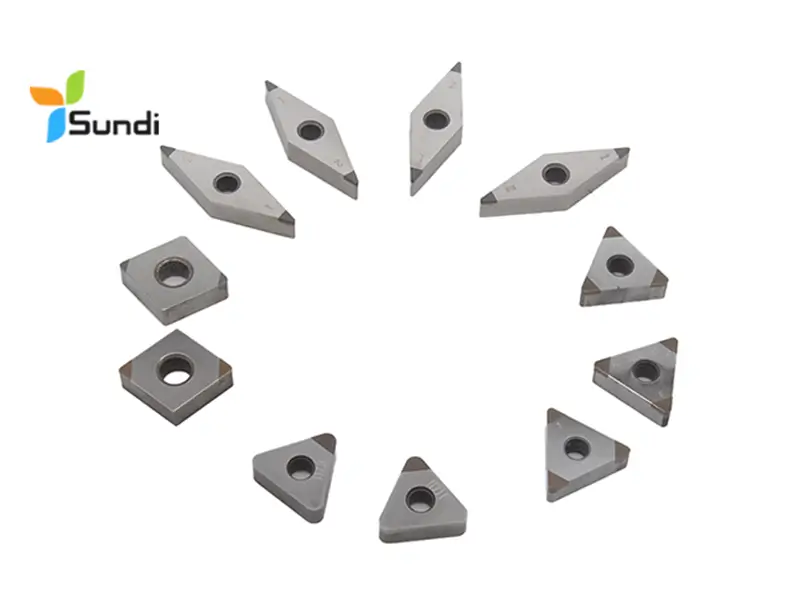
A tipped CBN insert has one or more PCBN cutting segments supported by a carbide body. Available cutting edges, segment attachment, insert designation, and suitability for finishing or semi-finishing depend on the product design. Check the supplier’s catalog for the exact insert and holder combination.
Solid CBN Inserts
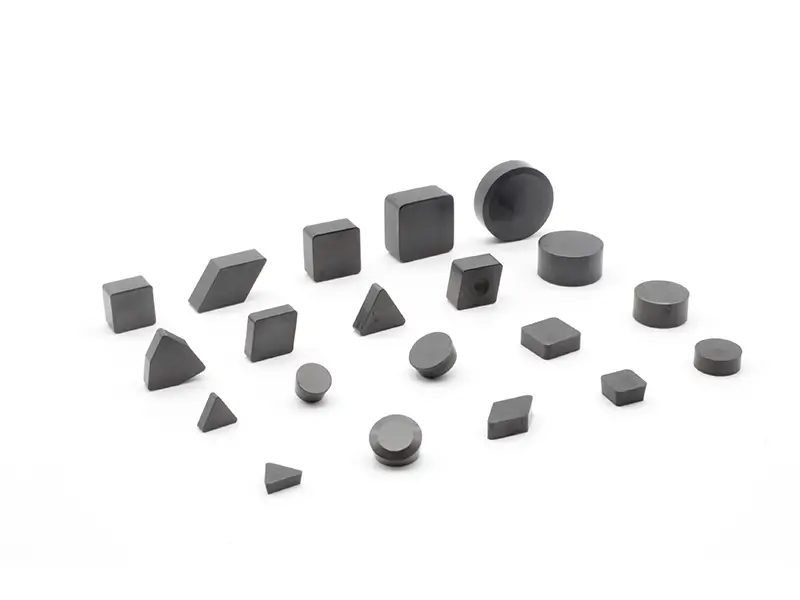
A solid CBN insert has a PCBN cutting body rather than only a small brazed cutting tip. Suitable designs can serve demanding applications, but roughing capacity and permissible speed depend on the grade, edge preparation, material, and setup. Do not select maximum spindle speed merely because the insert is solid CBN.
What Is a Carbide Insert and Where Does It Reach Its Limit?
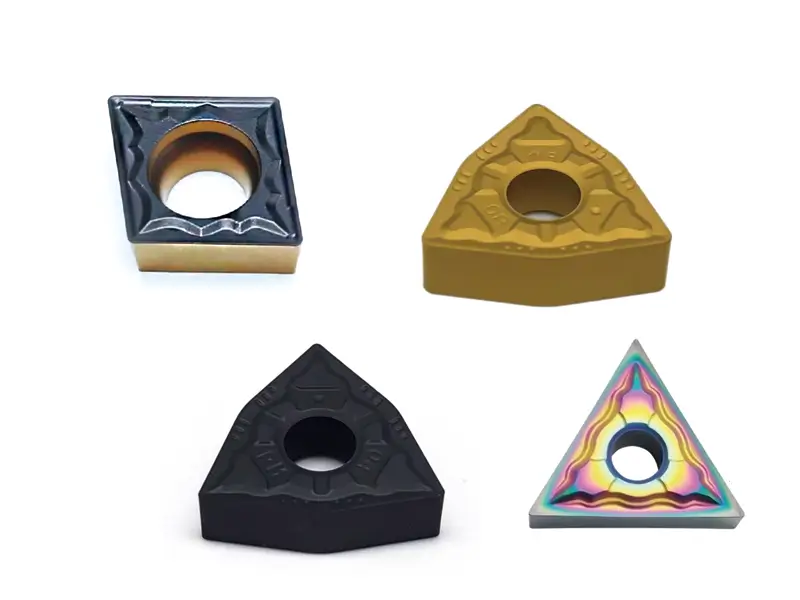
Carbide inserts commonly contain tungsten carbide particles in a metallic binder, often cobalt, and may contain additional carbides. Their hardness and toughness depend on composition and microstructure; compare specified grades rather than assigning every insert one hardness range.
Carbide is widely used for turning, milling, drilling, and boring. Suitable grades serve carbon steels, stainless steels, aluminum, brass, titanium, and other alloys. Substrate, coating, and geometry must be selected for the material and operation; a coating alone does not establish a universal hardness or temperature limit.
Coated Carbide Grades
PVD and CVD coatings can improve the performance of suitable carbide grades. Hardness limits depend on the workpiece, operation, grade, and cutting conditions; neither 45 nor 50 HRC is a universal boundary between carbide and CBN.
Carbide Limitations in Hard Machining
Carbide wear in hard machining depends on abrasion, temperature, chemical interaction, edge loading, and the grade. A single binder-softening temperature does not define the failure point of every insert or establish a universal workpiece-hardness limit.
CBN vs Carbide Application Selection Guide
| Workpiece Condition | Common Tool Choice | Notes |
|---|---|---|
| General machining where carbide grades are recommended | Carbide or coated carbide grades matched to the operation | Check material condition, geometry, cutting data, and cost per acceptable part |
| Applications with overlapping carbide and CBN grade recommendations | Compare qualified carbide and CBN candidates | Use supplier data and trials; hardness alone is not a universal switch point |
| Continuous finishing of suitable hardened steel | CBN grade and edge preparation recommended for continuous finishing | Select insert construction for the required geometry and application; verify finish and dimensional capability |
| Interrupted cutting of suitable hardened steel | CBN grade and edge preparation qualified for the interruption | Confirm interruption severity and setup; solid construction or CBN content alone does not determine suitability |
| Very tight tolerance or special surface requirement | A qualified cutting or grinding process | Verify geometry, tolerance, surface texture, and surface integrity; include additional finishing if required |
The Most Common Mistake with CBN
Selecting CBN solely by workpiece hardness can be a mistake. Many grades target hardened-steel finishing, while other grades serve applications such as cast iron. Confirm material and grade compatibility and compare cost per acceptable part; a single HRC cutoff cannot cover all applications.
The Most Common Mistake with Carbide
Using carbide cutting data intended for softer steel on a hardened workpiece can cause rapid wear or edge failure. Check the specific grade’s approved application and cutting data rather than assuming all carbide fails above 50 HRC.
CBN vs Carbide Heat Resistance: Which Insert Handles High Temperatures?
Hard turning can generate high local cutting temperatures, but the temperature varies with material, speed, feed, engagement, tool, and cooling. It cannot be assumed to exceed a fixed value in every cut.
How CBN Handles Heat
CBN retains useful hot hardness in suitable hard-machining applications, but heat can still contribute to wear and damage. Follow the grade supplier’s wet or dry strategy and avoid uncontrolled thermal cycling; no single temperature guarantees an undamaged edge.

How Carbide Handles Heat
Carbide has no single universal failure temperature. Select the grade and cooling strategy for the operation; consistent coolant can benefit some processes, while some milling applications use dry cutting to limit thermal cycling.
Can CBN Inserts Replace Grinding for Surface Finish?
The required surface finish is one factor in choosing a process. Evaluate it together with dimensional tolerance, surface integrity, material condition, and production capability.
Surface Finish with CBN Inserts
Suitable CBN hard turning can meet demanding finish and dimensional requirements. Achievable roughness and tolerance depend on the material, tool, setup, and process; confirm them by measurement. Any quoted AISI 4140 test result requires an identifiable source and its cutting conditions.
Hard turning may replace some grinding operations when the geometry, tolerance, surface texture, and surface-integrity requirements are met. It does not guarantee a mirror finish or final dimensions in a single pass.
Before replacing grinding, validate roundness, dimensional stability, surface integrity, and any functional surface requirements over the required production run. Include additional finishing if the drawing or measured result requires it.
Surface Finish with Carbide on Hard Material
Surface finish with carbide on hard material depends on grade, geometry, wear, and process conditions. There is no universal best achievable Ra value; compare actual results against the drawing and the qualified process.
A deteriorating finish warrants inspection of wear, edge damage, rigidity, and cutting conditions. It may justify testing another carbide grade or CBN, but a fixed part count is not a diagnostic threshold.
CBN Insert Tool Life vs Carbide
CBN may outlast carbide in suitable hard-turning applications, but no general tool-life multiplier applies. Compare equivalent quality limits and actual cutting conditions for the selected grades.
Establishing a CBN Wear-Monitoring Plan
A qualified process can use measured wear and part-quality data to establish an indexing interval. Determine that interval from trials and production monitoring rather than assuming a fixed number of parts per edge.
CBN can also suffer chipping or sudden fracture, and dimensional errors may arise before a visible finish change. Monitor the relevant dimensions and wear indicators; do not rely on surface appearance alone for unattended machining.
Carbide Tool Life on Hard vs Soft Material
Carbide wear and its repeatability depend on the selected grade, workpiece, and cutting conditions. Diagnose variability before attributing it to carbide as a material class.
Carbide is often an economical choice for softer steels and many other materials, but application-specific CBN opportunities cannot be excluded solely by a 45 HRC threshold.
When to Use CBN Inserts?
Automotive Hard Turning
CBN hard turning is used for suitable hardened transmission and bearing features. Other automotive applications, including camshafts and cast-iron parts, require their own grade and process selection. Heat treatment does not eliminate the need to assess distortion, allowance, interruptions, and final inspection.
A hardened gear bore can be a candidate for CBN. Establish edge life, indexing frequency, and dimensional capability with a documented comparison rather than assuming one insert lasts a full shift.
Cast Iron Machining
Selected CBN grades can machine suitable cast irons at productive cutting speeds. Grey iron and high-chromium white iron have different microstructures and machining requirements; do not apply one speed range to both. Carbide also remains suitable for many cast-iron operations.
Die and Mold Hard Turning
Suitable CBN grades can finish-turn some hardened tool-steel features in die and mold components. Selection still depends on hardness, geometry, interruptions, allowance, and surface requirements; hard turning does not replace every grinding operation.
Aerospace and Superalloys
Some CBN grades are developed for selected nickel-based superalloy operations. Carbide is also widely used for these materials. Use application-specific supplier data rather than transferring hardened-steel cutting recommendations to superalloys.
When to Use Carbide Inserts Instead of CBN
Soft and Medium Hardness Steels
Carbide is widely used for mild and medium-carbon steels, stainless steels, aluminum, and brass with appropriate grades and geometries. Choose by material specification and operation rather than treating all these materials under a single HRC rule.
Non-Ferrous Materials
For aluminum and brass, suitable carbide or PCD inserts are common options. The choice depends on alloy, abrasiveness, finish, and production needs; coated carbide is not universally faster or cheaper. Specialized CBN applications also exist beyond ferrous materials, so its scope should not be defined as iron only.
Prototyping and Short Runs
Carbide often offers an economical starting point for short runs, but compare the actual insert price, usable edges, machining capability, quality, and any avoided finishing operations. Neither a fixed price multiplier nor production quantity alone determines whether CBN pays for itself.
General Purpose Machining
Carbide covers a broad range of turning, milling, drilling, and boring applications. CBN is generally more specialized, but tool availability and process suitability must be checked; do not infer that CBN cannot be used in other tool forms.
CBN Inserts vs Carbide Cost Per Part Comparison
Insert purchase price is one component of cost per acceptable part. Include usable edges, tool changes, cycle time, inspection, scrap, and any additional finishing operations.
When CBN Can Lower Cost Per Part
CBN can lower cost per acceptable part when validated edge life, cycle time, or elimination of a finishing step offsets its purchase cost. Include tool changes, inspection, scrap, and any remaining grinding operations in the calculation.
For a hardened transmission gear, compare candidate grades against the actual material condition, dimensional tolerance, and surface requirement. A cost example should use measured edge life and cycle time with traceable assumptions; an unspecified full-shift result is not evidence of capability.
Hard Turning vs Grinding
CBN hard turning may replace selected cylindrical-grinding operations after process qualification. Compare complete equipment, tooling, fixturing, inspection, and operating costs; there is no universal grinder-to-lathe purchase-price ratio.
When Carbide Is the Cheaper Option
Compare carbide and CBN using their measured consumption, quality, cycle time, and total operating cost for the same work. Do not assume one CBN insert can process the volume covered by multiple carbide inserts without trial data.
CBN and Carbide Insert Cutting Speeds, Feeds, and Depth of Cut
CBN Cutting Parameters for Hard Turning
Obtain cutting speed, feed per revolution, and depth of cut from the supplier for the exact CBN grade, workpiece condition, operation, and edge geometry. Hardened steel and different cast irons require separate recommendations; an unqualified generic range should not be used as a setup instruction.
Grain size is one factor in CBN selection, together with binder, content, edge preparation, and process conditions. Do not assign a universal Rz limit to coarse-grain grades. Follow the specified wet or dry strategy and avoid unplanned thermal cycling.
Select nose radius and engagement for the required profile, chip control, and setup stiffness. Some CBN grades are designed for interrupted cutting, but interruptions and vibration must remain within their application limits. Keeping the nose radius fully buried is not a universal requirement.
Carbide Cutting Parameters
Select carbide speed, feed, depth of cut, geometry, and cooling from the grade supplier’s recommendations for the actual material and operation. Positive or negative geometry and interruption capability vary by design; one speed range cannot safely represent mixed materials.
How to Choose the Right CBN Insert Grade
CBN content and binder matter, but grain size, edge preparation, coating, insert construction, and cutting conditions also affect performance.
Low CBN Content Grades
A ceramic binder can contribute to wear resistance in suitable low-CBN-content grades. Chemical stability and cutting performance depend on the complete grade and its application. Check the supplier’s recommendations for continuous or interrupted cutting and validate the required finish on the actual hardened-steel component.
High CBN Content Grades
Some high-CBN-content grades suit interrupted cutting or selected cast-iron operations. Binder systems and wear behavior vary; high content does not universally mean a metallic binder, lower wear resistance, or greater toughness. Check the specific grade’s application range.
Coated CBN Grades
Some CBN grades use coatings to influence wear behavior. Coating chemistry, substrate, edge preparation, and the intended application determine the benefit; coated CBN is not defined by one coating or one speed and depth-of-cut regime.
CBN Grain Size
Discuss grain size together with CBN content, binder, edge geometry, and application with the supplier. Fine or coarse grain alone does not guarantee a particular roughness or tool life.
Machine Rigidity Requirements for CBN Hard Turning
Why CBN Demands a Rigid Setup
CBN hard turning requires a suitable stable setup. Check spindle condition, tool and workpiece clamping, overhang, and vibration, while also reviewing grade, geometry, and cutting data. Do not assume the machine is always the primary cause of failure.
Check insert seating, toolholder condition, and clamping torque against the manufacturer’s instructions. A loose or incorrectly seated insert can contribute to edge damage, but chipping can also result from grade selection, edge preparation, interruptions, vibration, or unsuitable cutting data. Diagnose these factors rather than assigning every failure to clamping.
Many CBN hard-turning edges use a chamfer or other preparation to strengthen the edge. Effective rake and cutting forces depend on the insert, holder, and application; not all CBN tools use the same negative geometry. Match the setup to the expected forces.
Carbide Grade Selection and Setup Stability
Carbide grades offer different balances of toughness and wear resistance. Binder composition and content, carbide grain size, edge preparation, and geometry all affect performance. A suitable grade may tolerate a particular interruption better than another tool, but carbide is not a remedy for loose clamping or excessive vibration. Correct the setup and qualify the tool for the actual cutting conditions.
CBN vs Carbide Insert Selection
Step 1: Check Workpiece Hardness
Use hardness as one selection factor alongside material, interruptions, tolerance, finish, stability, and production economics. Compare suitable carbide and CBN grades with supplier data and trials rather than applying fixed HRC switch points.
Step 2: Check Material Type
Check compatibility with the exact workpiece material and condition. CBN is commonly used for suitable hardened steels and selected cast irons; other applications require specific grade recommendations. Carbide and PCD are common options for many non-ferrous alloys and composites, subject to alloy composition, abrasiveness, geometry, and finish requirements. Hardness alone does not establish compatibility.
Step 3: Check Batch Size
Production quantity affects how tooling and setup costs are spread across parts, but does not determine payback by itself. Compare measured tool consumption, cycle time, quality, and any avoided finishing operation. CBN can be economical in some short runs, while a longer run does not guarantee a saving.
Step 4: Check Surface Finish Requirement
Compare the required surface roughness with measured results from the candidate tool and process. Carbide cannot be ruled out by one Ra threshold, and CBN does not guarantee compliance. Include tool geometry, wear, material condition, machine stability, and surface-integrity requirements in the assessment.
Step 5: Check Cut Type
For interrupted cuts on hardened parts, such as keyways or cross-holes, assess the severity and frequency of the interruption. Select a grade, edge preparation, and insert design explicitly recommended for those conditions. Solid construction or high CBN content alone does not establish suitability, and tipped CBN is not limited to continuous cuts. Ceramic grades also differ; confirm application limits rather than assuming every ceramic insert must fracture.
Conclusion
CBN and carbide have overlapping, grade-specific application ranges. Select for the workpiece, operation, quality requirements, and measured cost per acceptable part. Consult the supplier when qualifying a grade; hardness alone is not a complete decision rule.
FAQs
What is the difference between CBN and carbide inserts?
CBN is a synthetic superhard material used in suitable PCBN cutting grades, including grades for hardened steels and selected cast irons. Its suitability depends on the material and process, not only a hardness threshold.
Cemented carbide commonly combines tungsten carbide particles with a metallic binder such as cobalt. Grades and coatings cover many machining applications; it is not simply a mixture of elemental tungsten and cobalt.
Is CBN harder than carbide?
CBN is generally harder than cemented carbide, but compare values measured under defined conditions for the actual materials. A ratio based on broad unspecified hardness ranges is not a grade-selection rule.
Is CBN harder than tungsten carbide?
CBN generally has higher hardness than tungsten-carbide-based cutting materials. Actual measured values depend on composition and test conditions, and hardness alone does not determine cutting performance.
When to use CBN inserts?
Consider CBN for applications within the selected grade’s range, such as suitable hardened-steel finishing or cast-iron machining. Verify dimensional capability, finish, interruptions, and cost; CBN does not guarantee identical results on every part.