


CNC Wheel Turning Tools: The Complete Selection Guide
You need high precision and speed to machine wheels profitably. This guide helps you choose the right CNC tools for large diameters and interrupted cuts. You will learn how to select insert grades and geometries that reduce your cost per wheel.
Contents
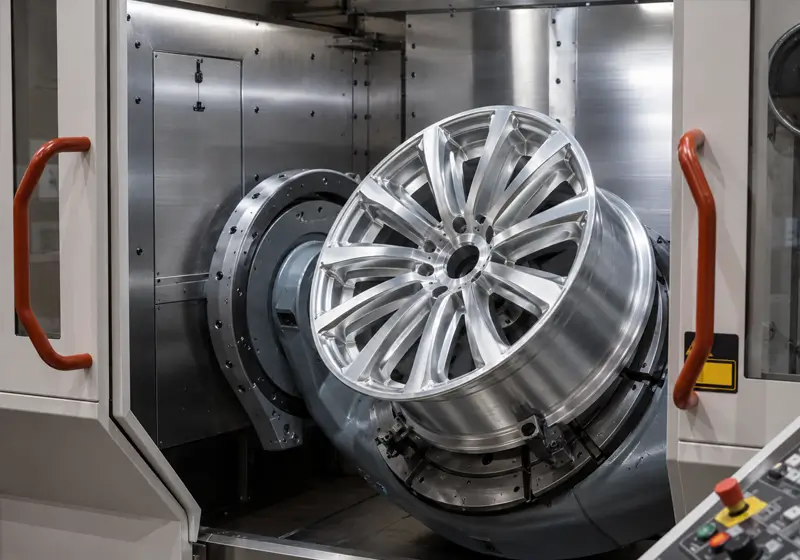
What cutting tools are required for CNC wheel turning?
Wheel turning often involves large diameters, thin sections, and demanding surface requirements. Check the actual wheel dimensions and alloy; diameter affects cutting speed at a given spindle speed.
A wheel machining plan may use several tool families. The following six categories are common options, not a mandatory set for every wheel:
- Turning inserts
- Boring bars
- Grooving tools
- Threading inserts
- PCD tools
- CBN inserts
Plan tooling, workholding, speed limits, and chip control for the actual wheel geometry and material.
Wheel Turning Tooling Strategy
Large rotating wheels require secure, balanced workholding within the machine and fixture limits. Thin walls, tool overhang, and interrupted engagement can affect stability; standard tools are not automatically unsuitable.
Account for interruptions where the actual tool path crosses spokes or holes. As a simplified example, five interruptions per revolution at 500 RPM produce 2,500 interruptions per minute. Bolt holes count only if the cutting path actually crosses them.
How to read a wheel turning job before selecting any tool?
Before you pick a tool, check the material hardness. Is it cast aluminum or forged steel? Look at the drawing for tight tolerances in the center bore.
Use the drawing and applicable wheel specification to set runout and dimensional acceptance limits. Identify interrupted-cut regions before selecting the grade and geometry; there is no single runout limit that applies to every wheel.
6 Important CNC Wheel Turning Tool Types
What is the function of each wheel turning tool? Understand this and you will not waste money on the wrong equipment.
Turning Inserts
You use turning inserts to remove the bulk of the material from the outer diameter and the face of the wheel. Here, you need inserts that can handle high heat and constant friction.
Boring Bars
The hub bore requires the specified size, location, and finish. Select a rigid boring bar appropriate to the bore depth and access. Keep overhang short and follow the supplier’s length-to-diameter guidance for the particular bar material and damping system.
Excessive boring-bar overhang can promote chatter. Select finishing feed for the insert geometry, bore tolerance, material, and surface requirement; validate it in the actual setup.
Grooving Tools
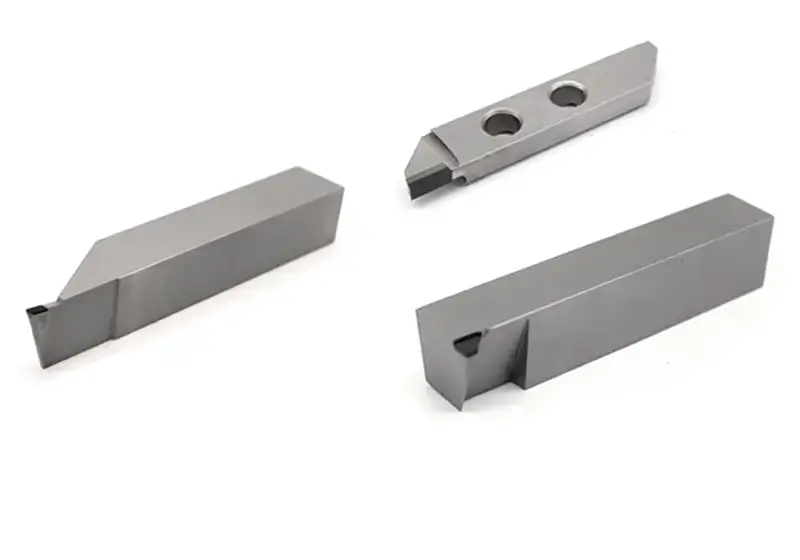
On the bead seat, the tire meets the wheel. It requires a specific profile. You use grooving tools to cut these narrow channels. The problem is that chips can get stuck in these tight spaces. So, you must choose a tool with good chip control.
Machine retaining-ring grooves to the drawing and relevant groove specification. Select ground or other suitable inserts according to the required profile and tolerance rather than assuming a universal dimensional limit.
Threading Inserts
Some wheel designs include threaded features. Select threading inserts, taps, or thread mills according to the feature, machine access, thread specification, and material. Valve sealing depends on the complete valve and wheel design, not simply on the presence of a thread.
PCD Tools
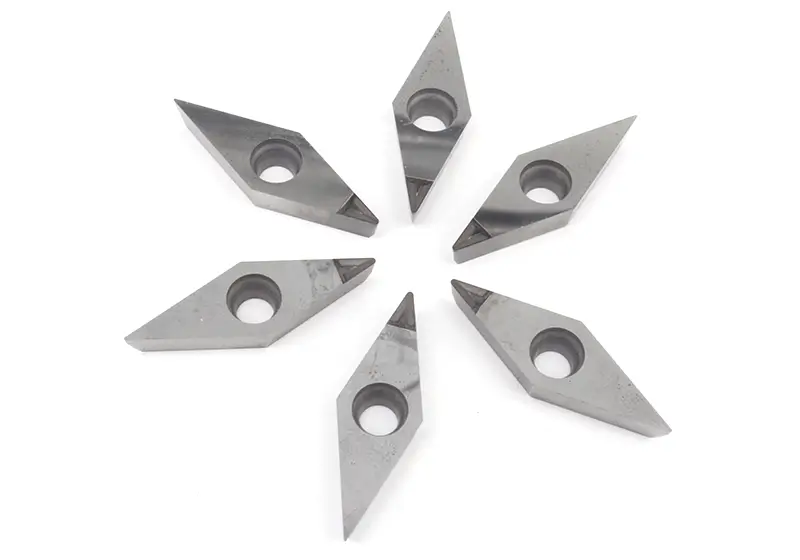
Polycrystalline Diamond tooling can be suitable for bright finishing of aluminum wheel faces. A PCD insert may provide useful wear resistance and surface quality, but finish and tool life depend on alloy, geometry, cutting data, machine condition, and the acceptance criteria. Do not assume a fixed number of wheels per edge.
CBN Inserts
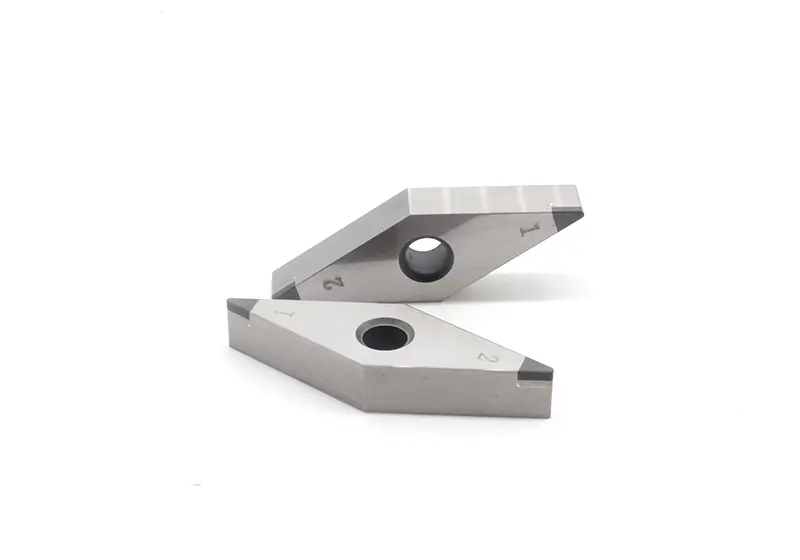
CBN inserts are not normally used for aluminum wheel machining. They are mainly used for hard turning hardened steel, cast iron, or other abrasive ferrous wheel-related parts. When the workpiece hardness is high, conventional carbide inserts may wear quickly or fail to maintain stable surface finish.
For hardened steel wheels or hardened wheel components, CBN inserts can provide better wear resistance, heat resistance, and dimensional stability during finishing. However, CBN should not be treated as a universal wheel turning tool. For aluminum alloy wheels, PCD tools or sharp polished carbide inserts are usually more suitable.
Which insert grade should you choose for your wheel material?
Application-Group and Tooling Guide — Validate the Actual Grade
Material Category | Application Group / Candidate Tool | Coating Options — Grade-Specific |
Aluminum Alloy (e.g., A356, A357) | N application group | Uncoated or qualified DLC system |
High-Silicon Aluminum (>12% Si) | N application group (PCD candidate) | N/A |
Cast Iron | K application group (qualified carbide grade) | CVD option; thickness is grade-specific |
Steel / Forged Steel | P application group | Qualified PVD or CVD coating |
Hardened Steel (>45 HRC) | H application group (CBN candidate) | N/A |
The letters in the table identify work-material application groups, not complete insert compositions or coatings. Select the specific manufacturer’s grade and geometry for the actual alloy, hardness, engagement, and surface requirement.
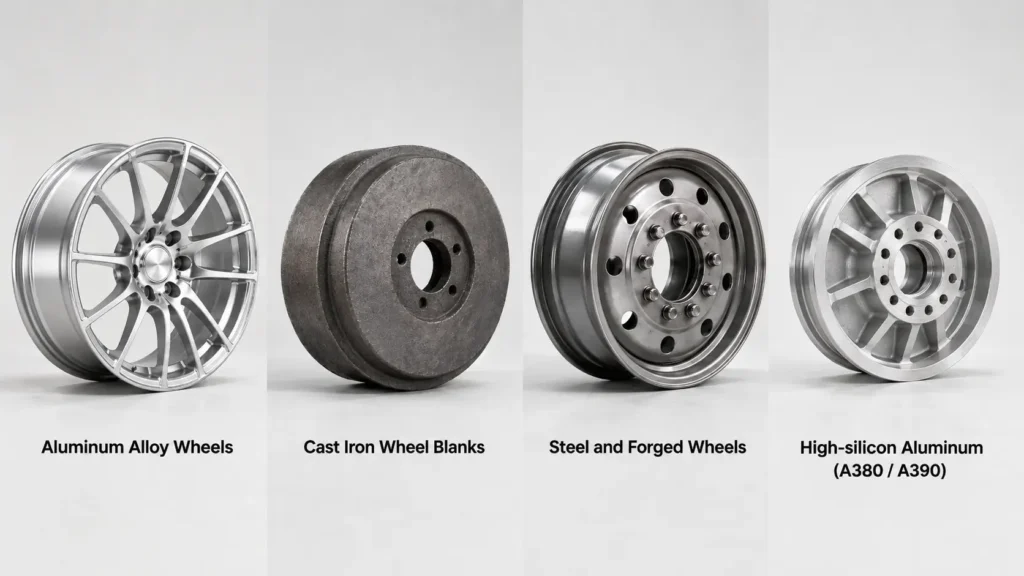
Aluminum Alloy Wheels
Aluminum wheel alloys vary in silicon content and material condition. Aluminum can adhere to the cutting edge and form a built-up edge. Sharp, polished carbide geometries are one option; verify the alloy certificate and tool recommendation.
PCD can be economical in suitable aluminum production, especially where abrasive wear or finish matters. It does not eliminate all adhesion or guarantee lower cost; compare tested tool life and total cost per accepted wheel.
Silicon Content in Cast Aluminum (A380 / A390)
A380 and A390 should not be treated as the same silicon-content category. Confirm the actual alloy specification and certificate. Silicon-rich constituents can increase abrasive tool wear, but the rate depends on microstructure, cutting conditions, and tool system.
PCD is a common candidate for abrasive aluminum alloys. Compare qualified grades with other suitable tooling using application tests; neither an exclusive material choice nor a fixed tool-life multiplier is justified for every alloy.
Cast Iron Wheel Blanks
For cast-iron parts, select a grade for the specific iron type, hardness, and cut. Qualified CVD-coated carbide is one possible option, but coating thickness and cutting speed are grade- and application-dependent. Use the supplier’s starting data and validate wear and stability.
Steel and Forged Wheels
For forged steel, balance edge toughness and wear resistance with the actual material condition and engagement. Both suitable PVD- and CVD-coated carbide grades may be options. Coating thickness alone does not determine suitability; obtain grade-specific cutting data.
Application Groups and Cutting-Data Selection
Material | Application Group / Candidate Tool | Coating Technology | Cutting-Speed Selection |
Aluminum Alloy (A356/A357) | N application group | Uncoated / Polished | Use grade-specific supplier data |
High-Silicon Aluminum (>12% Si) | PCD | N/A | Use grade-specific supplier data |
Cast Iron (Gray/Ductile) | K application group | CVD option; thickness is grade-specific | Use grade-specific supplier data |
Forged Steel | P application group; select the actual grade | Qualified PVD coating | Use grade-specific supplier data |
Hardened Steel (>45 HRC) | H application group (CBN candidate) | N/A | Use grade-specific supplier data |
Insert Geometry Guide for CNC Turning Wheels
Geometry is the shape of the tool. It determines how the tool enters the metal and how the waste metal leaves.
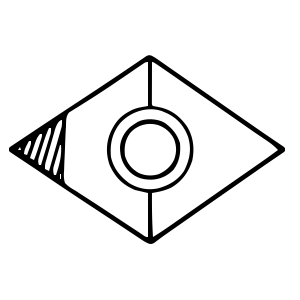
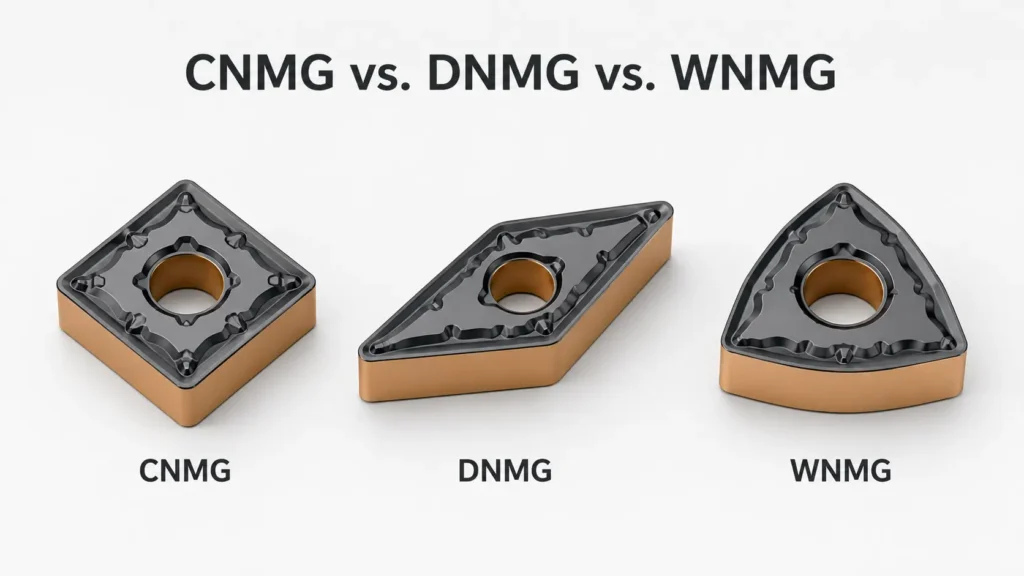
Insert shape — CNMG vs. DNMG vs. WNMG
- CNMG: This is an 80 degree diamond shape. It is very strong and great for roughing.
- DNMG: This is a 55 degree diamond. It is thinner. You use this to get into tight angles where a CNMG cannot fit.
- WNMG: This has six cutting edges. It is very economical because you get more edges for your money.
Rake and Relief Angles
Sharp positive-rake geometries often suit aluminum, while cast-iron geometry depends on grade, engagement, and stability. Select effective rake and clearance for the complete insert-holder system. Do not assign universal clearance-angle ranges solely from the material name.
Chipbreaker Selection
Aluminum often creates long, stringy chips. These can wrap around the wheel and scratch it. You need a chipbreaker that curls the metal until it snaps. But the problem is that chipbreakers only work if your feed rate is correct. Always check the manufacturer’s guide for the right feed range.
Corner Radius
Choose nose radius to balance edge strength, profile access, cutting forces, and surface requirements. A larger radius can increase radial force and chatter risk in a flexible setup. Confirm the insert and holder recommendations rather than using one radius range for every wheel feature.
Wiper Inserts
Wiper inserts use a modified edge profile that can improve finish at an appropriate feed. The result depends on geometry, orientation, rigidity, and material. Use the supplier’s operating range and verify the surface; no feed value guarantees a perfect finish.
CVD vs. PVD vs. Uncoated Carbide
Coatings are thin layers on the tool that improve performance.
CVD (TiCN / Al2O3)
Suitable CVD tool coatings can provide wear resistance in demanding turning, including some cast-iron applications. Select the actual coating and substrate for the operation; deposition method or thickness alone does not establish the best choice.
PVD
PVD coatings can support suitable tool systems for steel or interrupted cutting. Edge sharpness, toughness, and wear resistance depend on the coating, substrate, edge preparation, and geometry. Check the qualified application range rather than inferring performance from the deposition method.
Uncoated Carbide and PCD
For aluminum, consider suitable polished carbide, PCD, or qualified coated tools according to adhesion, wear, and finish requirements. Compare total cost per accepted wheel, including reconditioning and downtime. Monthly production volume alone does not prove that PCD is always the cheapest option.
5 Common Wheel Turning Tool Problems and Solutions
Even with the best tools, problems happen. Here is how you solve them.
Built-up Edge (BUE) on Aluminum Wheels
BUE forms when work material adheres to and accumulates on the cutting edge; bulk melting is not required. Check cutting speed, edge condition, geometry, lubrication, and material. Adjust within the tool supplier’s recommended range rather than applying a universal minimum speed.
Insert Chipping on Interrupted Cuts
For chipping in interrupted cuts, inspect edge preparation, grade toughness, workholding, engagement, and cutting data. Use a qualified tougher grade or adjusted parameters when appropriate. Validate the change; a fixed percentage speed reduction is not suitable for every operation.
Poor Surface Finish on Diamond-cut Faces
For a dull diamond-cut face, inspect the PCD edge with suitable magnification and check contamination, runout, vibration, and cutting data. Assess the result against the specified surface and machine limits; no single runout value predicts every finish problem.
Rapid Tool Wear on High-silicon Aluminum
If carbide inserts wear rapidly, examine the alloy, silicon content, wear pattern, grade, and cutting conditions. PCD may be a suitable alternative for abrasive aluminum, but it is not the only possible response and no fixed wheel count can be promised.
Chatter on Wheel Bore Turning
For chatter during bore turning, check boring-bar overhang, rigidity, clamping, workholding, and cutting data. Keep overhang as short as practical and follow the bar supplier’s guidance. Chatter has several possible causes; bar length alone is not a complete diagnosis.
How to lower cost-per-wheel?
Profit comes from efficiency. Here is how you save money.
Optimize Cutting Speed and Feed Rate
Set cutting speed and feed from the selected tool grade, alloy, operation, and machine limits. Convert surface speed to spindle speed for the actual diameter and respect the wheel and fixture speed ratings. Validate tool life and finish; no universal speed range guarantees longer life.
Coolant Strategy for Wheel Turning
Choose dry cutting, minimum-quantity lubrication, or flood coolant according to the tool, alloy, operation, and machine. Follow coolant supplier concentration guidance and maintain consistent delivery, filtration, and chip evacuation. More coolant does not inherently increase aluminum adhesion.
PCD Tool Reconditioning
A qualified supplier may be able to recondition worn PCD tools. Feasibility, remaining tip size, restored geometry, number of regrinds, and price depend on the tool and damage. Obtain an inspection and quotation rather than assuming fixed savings or regrind counts.
When to Index vs. Replace
Inspect flank wear, crater wear, chipping, and surface results against the tool-change criteria. Index to a usable edge or replace the insert as appropriate, and investigate abnormal wear. Crater wear can have several causes; it does not by itself prove excessive speed.
Conclusion
Choosing the right CNC wheel turning tools requires matching the grade to your material and the geometry to your part shape. You must prioritize rigidity and chip control. By following these steps, you will produce better wheels in less time and reduce your total tooling costs.
FAQs
What is the best cutting tool for machining aluminum alloy wheels?
Suitable polished carbide or PCD tools are common options for aluminum wheels. Choose the grade and geometry for roughing or finishing, silicon content, interruptions, and surface requirements. Validate life and cost rather than assuming one material always performs best.
Can I use the same carbide inserts for both aluminum and cast iron wheel blanks?
Do not assume one insert is suitable for both materials. Aluminum and cast iron often benefit from different geometries and grades, but some tools have broader application ranges. Follow the specific grade’s guidance and validate each operation.
Why do my inserts keep chipping when turning wheels with bolt holes?
Holes can create interrupted engagement when the cutting path crosses them. Check grade toughness, edge preparation, corner radius, rigidity, and cutting data. A larger radius may increase cutting forces, so choose it for the actual setup rather than increasing it automatically.
How many wheels can a PCD insert machine before it needs repair?
There is no universal wheel count per PCD edge. Alloy, silicon content, stock removal, cutting conditions, edge geometry, machine condition, and finish criteria all affect life. Use production trials and a defined wear limit to establish the reconditioning interval.
What insert shape is best for turning both the OD and face of a wheel in one setup?
CNMG can be a robust option for accessible outside-diameter and facing cuts. DNMG or another suitable geometry may improve access to restricted profiles. Check the required approach angle, clearances, holder, and engagement before selecting a shape.