




Metal Removal Rate Formula, Meaning, and How to Increase MRR Safely
People search metal removal rate when they are trying to cut cycle time, compare roughing strategies, or understand why a cut that looked productive on paper still failed in the machine. So the article cannot stop at the formula. The real reader problem is that MRR looks like a master metric, but it does not tell the whole truth about tool load, chatter, chip evacuation, or spindle limits.
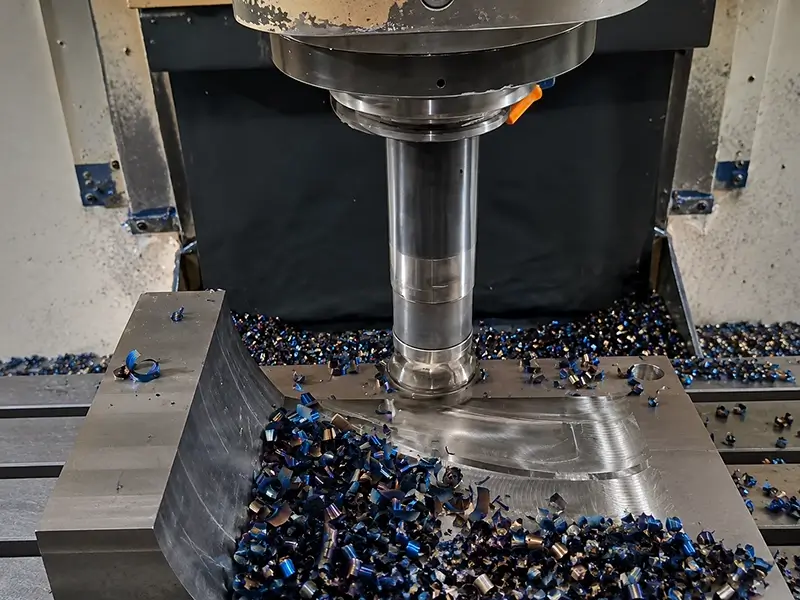
That is why this topic has to start with a boundary: MRR is an output metric, not a standalone feeds-and-speeds rule. A carbide end mill, an Indexable milling cutter, and a pcd face milling cutter can all show attractive MRR numbers while living in completely different risk conditions. If the article does not tie MRR back to chip load, engagement, and setup stability, it turns into spreadsheet comfort food instead of machining guidance.
Quick answer: MRR is useful for productivity, but chip load and engagement still decide whether the cut survives
Use metal removal rate to compare how much stock a process removes over time. Do not use it by itself to decide whether the tool is happy. The tool still lives or dies by chip thickness, radial engagement, axial depth, holder rigidity, and spindle power.
That is why a cut with strong MRR can still chatter, recut chips, rub the edge, or break the tool. MRR tells you how ambitious the process is. It does not tell you whether the process is balanced.
| Metric or variable | Good for | Dangerous misunderstanding |
|---|---|---|
| MRR | Comparing process productivity and roughing efficiency | Treating it like a direct replacement for chip load |
| Chip load | Protecting edge-level cutting action | Ignoring total machine load while focusing only on the tooth |
| Radial and axial engagement | Understanding how the tool really meets material | Assuming the same MRR means the same tool stress |
| Spindle power and torque | Checking whether the machine can sustain the cut | Assuming stable spindle load guarantees stable finish |
| Toolpath style | Controlling how load enters the tool | Comparing slotting, adaptive roughing, and face milling as if they were equal situations |
What metal removal rate actually means
Metal removal rate is the volume of material removed over time. The exact formula changes with the operation, but the logic stays the same: width of cut times depth of cut times feed, expressed in cubic units per minute.
That makes MRR very useful for comparing roughing strategies. If one toolpath removes more stock in less time without hurting tool life or finish, it is a better production move. MRR is also helpful when discussing spindle power, cost per part, and roughing efficiency.
Where people get into trouble is assuming that identical MRR means identical cutting stress. It does not.
The same MRR can come from very different cuts
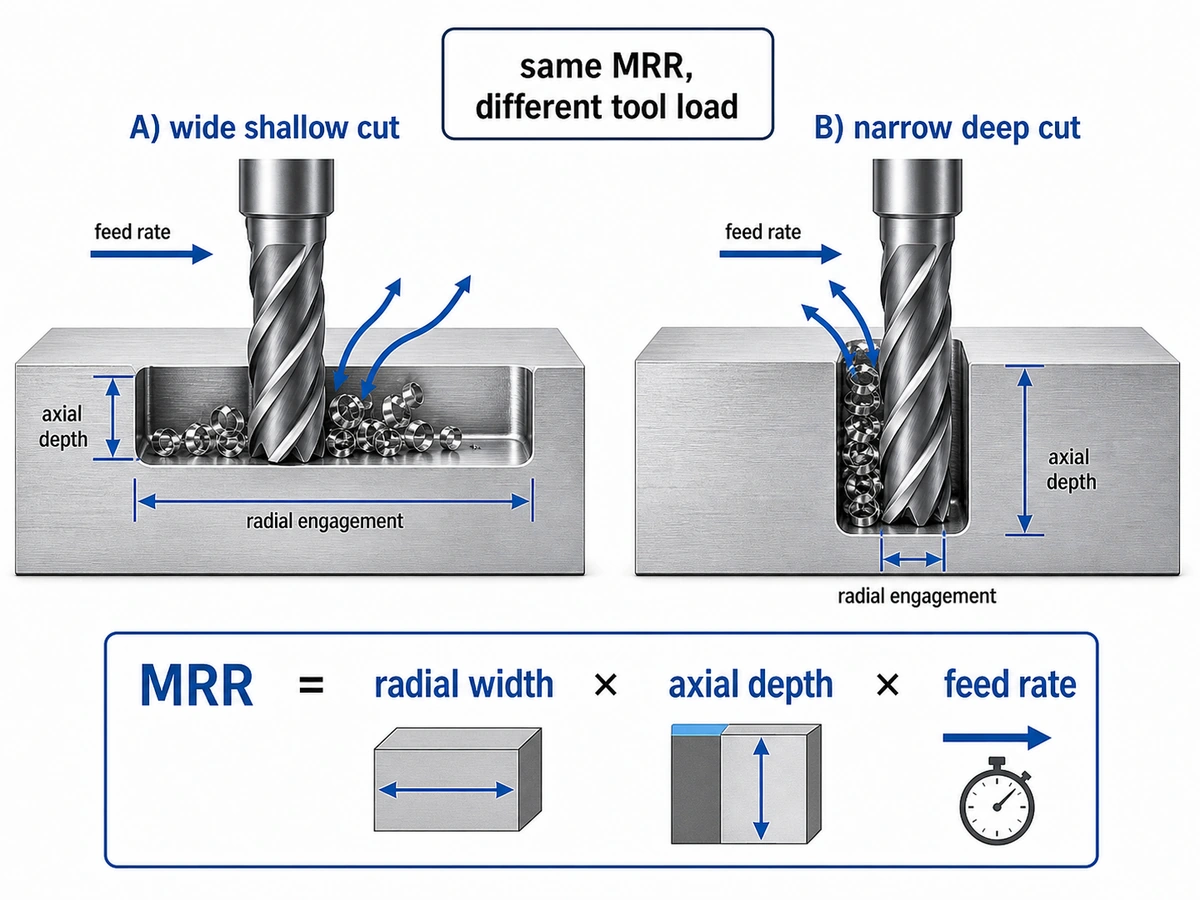
You can reach the same MRR with a wide shallow cut or a narrow deep cut. You can reach it with slotting or with adaptive paths. You can reach it with a large Indexable milling cutter or with a smaller carbide end mill. Those cuts do not load the tool the same way.
That is why two setups with the same MRR can behave completely differently. One sounds smooth, clears chips, and holds size. The other chatters, recuts chips, and beats the tool up even though the spreadsheet celebrates the exact same cubic number.
MRR matters most when the process is already under control
Once the cut is stable, MRR becomes a useful optimization tool. Before the cut is stable, MRR is often a tempting distraction. Shops that chase MRR too early sometimes skip the less glamorous questions: Is the holder rigid enough? Is the tool too long? Is the chip thinning correction understood? Is the machine actually making a chip, or just rubbing at high RPM?
Why chip load still matters even when MRR looks great
Chip load is the thickness of material each tooth is meant to remove on each pass. This is the number that keeps the edge cutting instead of rubbing. If chip load is too low, the tool may look safe in the control but still run hot and smear the part. If chip load is too high, the edge overloads and can chip or break.
MRR does not replace that logic because MRR does not tell you how the load is distributed tooth by tooth.
MRR is a system view, chip load is a tooth view
This is the best way to think about the relationship:
- MRR asks how hard the entire process is working.
- Chip load asks how hard each cutting edge is working.
The machine cares about both. A spindle can bog because total MRR is too high. A tool can fail because the edge-level load is wrong even when spindle load looks acceptable.
Engagement changes the meaning of feed
A cut with light radial engagement behaves differently from a slot. Adaptive toolpaths, trochoidal paths, helical entries, and side milling all change how the edge sees the material. If the programmer ignores that and only watches table feed, the tool may be underfed or overloaded relative to the actual engagement.
This is where chip thinning enters the conversation. At low radial engagement, the actual chip can be thinner than it looks from raw feed numbers. That often means the feed can be raised safely. But the correction only makes sense if the rest of the setup is rigid and chips can still clear.
High-efficiency machining made MRR more useful, not simpler
High-efficiency machining pushed this conversation forward because HEM intentionally changes engagement. The cutter uses more axial depth and less radial width so the process can keep the edge busy without burying it like a slot.
HEM is about managing engagement, not just taking giant cuts
People sometimes hear "high efficiency" and imagine reckless speed. Good HEM is not reckless. It is controlled. The toolpath reduces radial engagement, keeps chip thickness in range, and often allows deeper stepdown with better chip evacuation.
That is why HEM discussions almost always pull MRR and chip load into the same room. The point is not to brag about MRR. The point is to remove material quickly without letting radial load and heat get out of control.
Machine and holder limits still decide the ceiling
A nice HEM calculator or CAM strategy cannot turn a flexible setup into a rigid one. Tool stickout, holder condition, spindle taper, workholding, and machine horsepower still set the real ceiling. When HEM works well, it often looks easy. When the setup is weak, the same strategy becomes a chatter generator.
That is why one programmer's successful HEM example is not a universal number set. The machine, the holder, the material, and the actual cutter matter too much.
MRR by operation: the metric changes with the tool and toolpath
The more useful articles about MRR connect the number to the operation in front of the reader.
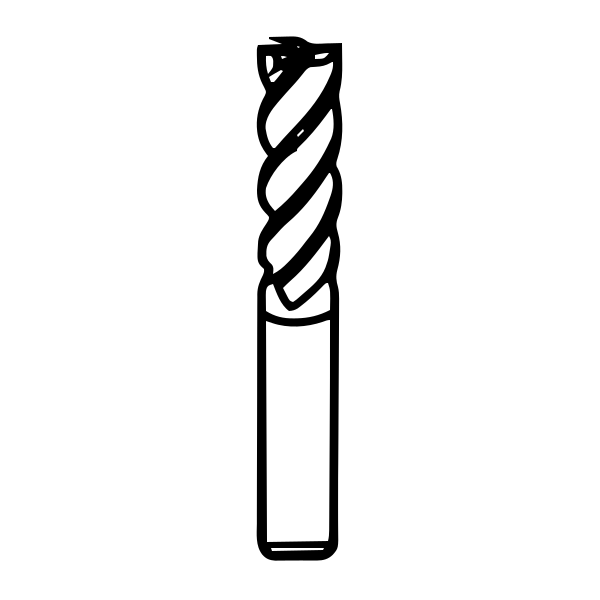
Carbide end mill roughing
A carbide end mill is where many readers first meet MRR in a meaningful way. In roughing, the toolpath, flute count, stickout, and chip evacuation can change the result dramatically. The same nominal MRR can be safe with a short, rigid 3-flute roughing path and dangerous with a long-reach slotting tool.
This is why adaptive roughing often feels more productive than brute-force slotting even when the raw cubic numbers are similar. The edge is doing healthier work.
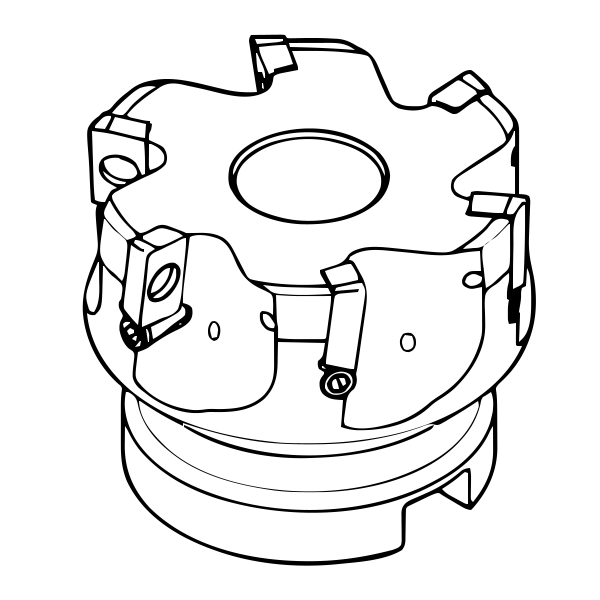
Indexable milling cutter applications
An Indexable milling cutter changes the picture because cutter diameter, insert count, and engagement style are different. Face milling and shoulder milling often let the process pursue higher system-level output when the machine has enough horsepower and the insert geometry fits the material.
But the same rule still applies: total MRR is not the only question. Insert strength, insert count, radial width, and surface-finish goals all still matter.
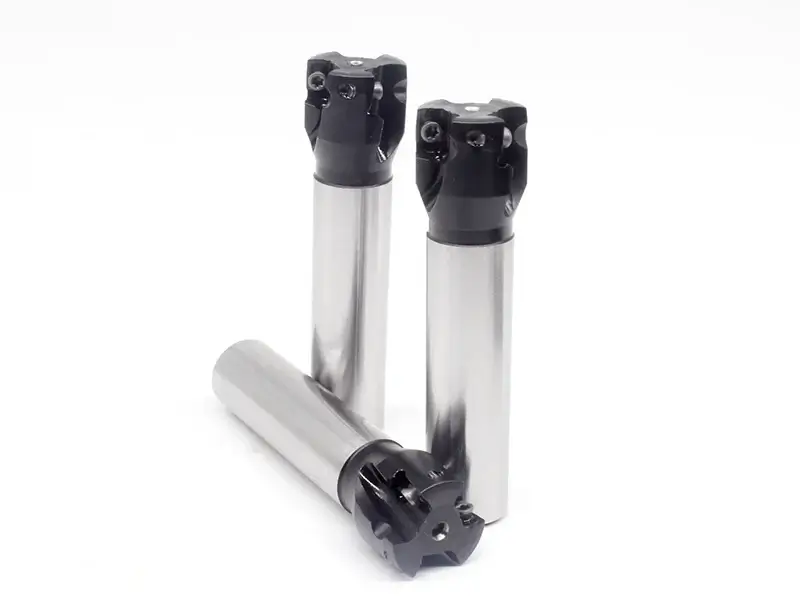
Where a pcd face milling cutter enters
A pcd face milling cutter belongs in more specialized nonferrous or high-volume finishing/roughing discussions. It can support high productivity and long life in the right material set, but it is not relevant because of the MRR number alone. It makes sense when the material, finish target, and production economics justify it.
The important point is that tooling category changes what MRR means in practice. A production face mill and a small solid tool do not live in the same decision world even if the formula shape looks similar.
Common ways shops misuse MRR
Most MRR mistakes come from using it without enough context.
Using MRR to replace chip load
This is the classic mistake. A reader sees that MRR captures "how much work is happening" and assumes it can replace chip load for tool selection. It cannot. MRR is too blunt for tooth-level cutting behavior.
Comparing cuts that do not share engagement conditions
A slot, a light radial adaptive path, a face-milling pass, and a helical entry are not comparable just because the cubic output looks close. The load path through the tool is too different.
Ignoring power and torque curves
Some processes look fine on paper until spindle speed, torque drop-off, or horsepower limits show up. A machine can be "fast" and still weak in the exact part of the curve where the cut is trying to live.
Treating a dramatic video cut as a universal recipe
Videos of aluminum roughing at high MRR are useful because they show what is possible. They are dangerous when readers copy the feed and speed numbers without the same tool, same holder, same machine, same path, and same chip evacuation.
Practical checklist: use MRR without letting it fool you
| Before you push MRR, check this | Why it matters |
|---|---|
| Confirm chip load first | The edge must cut, not rub |
| Check radial and axial engagement | Engagement changes the real tooth load |
| Watch chip evacuation | Packed chips destroy good-looking numbers |
| Know spindle load and power behavior | MRR can outrun the machine quickly |
| Check stickout and holder rigidity | Weak setups fail before formulas do |
| Match the metric to the operation | Face milling, adaptive roughing, and slotting are not interchangeable |
Conclusion
Metal removal rate is a valuable metric, but it becomes truly useful only when it is tied to chip load, engagement, rigidity, and horsepower. MRR tells you how productive the process is trying to be. It does not tell you whether the cutter is happy. That second answer comes from chip thickness, chip flow, toolpath, and setup behavior.
If a shop wants to use MRR well, it should treat it as one part of a decision system. Start with a stable cut, understand engagement, respect tooth-level loading, then use MRR to improve output. That logic applies whether the process uses a carbide end mill, an Indexable milling cutter, or a pcd face milling cutter in a more specialized production role.
FAQ
What is metal removal rate in machining?
It is the volume of material removed over time, usually expressed in cubic units per minute.
Is a higher MRR always better?
No. A higher MRR is better only if the tool, holder, spindle, chip evacuation, and finish remain under control.
Can MRR replace chip load when choosing feeds and speeds?
No. Chip load is still needed to judge tooth-level cutting behavior.
Why does a cut with good MRR still chatter?
Because chatter depends on rigidity, engagement, stickout, toolpath, and how the edge is loaded, not only on the total cubic output number.
Does HEM automatically mean higher MRR?
Not automatically, but HEM often improves usable MRR because it changes engagement to let the tool cut more efficiently and more predictably.