










What is M-Code: A Detailed Insight Into M-Code in CNC Machining
At the core of modern manufacturing is computer numerical control (CNC) programming. In recent times, machines have become more sophisticated and advanced, they have been designed to run entirely on programmed instructions.
For this reason, it has become crucial for engineers, operators, and programmers to possess a well-informed understanding of the codes that relay these instructions.
Contents
What is M-Code?
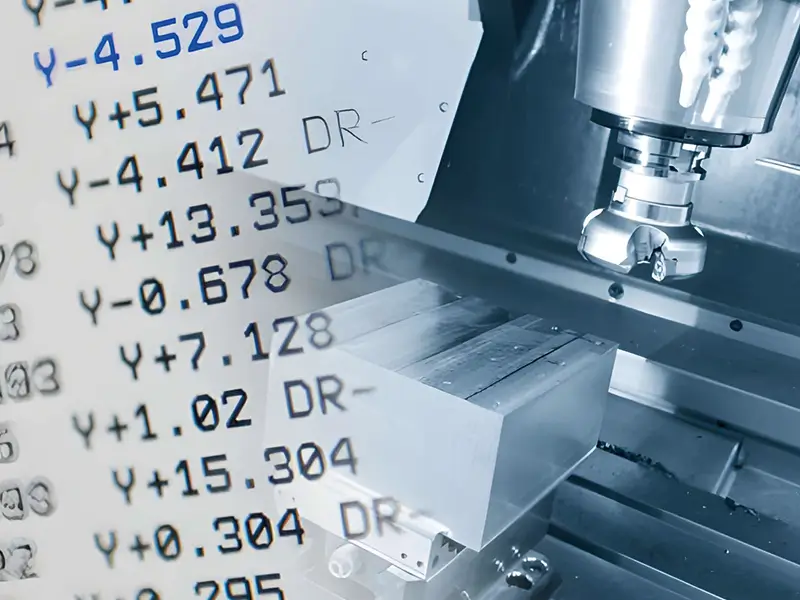
M-codes, also known as miscellaneous function codes, are commands used in CNC (computer numerical control) programming to drive the non-motion functions of a machine. These miscellaneous function codes are typically integrated with what we call G-codes, needed for control the movement of the machine, thereby creating a complete CNC program.
M-codes are miscellaneous-function commands within a CNC programming language, rather than a separate universal programming language. Their meanings and supported functions depend on the controller and machine builder.
G-codes include many motion and operating-mode commands, not just three basic commands. M-codes commonly handle auxiliary and program-control functions; the division depends on the control.
Examples of these direct commands include:
- Start or stop the spindle
- Change a tool
- Turn on the coolant
- Stop the program.
Navigating the world of CNC machining can be quite complex, especially in the aspect of programming languages. In this article, we will delve into everything you need to know about M-code, giving you a detailed insight into this fundamental component that drives manufacturing excellence, and transforms a digital design into a practical and physical part
How Does an M-Code Work?
As a CNC programmer, engineer, or even machine operator, it is critical that you understand the sequence of operations, and how these things work. After a M-Code has been deployed, it is no longer just a mere software command, it translates into an action and triggers a process.
The following sequence illustrates a machine auxiliary function; not every M-code uses hardware feedback or waits for a physical action to finish.
- Code Parsing
The CNC controller reads the blocks of code, line by line, identifying the M-code instruction in each one.
- Signal to PLC
For an auxiliary function, the CNC may communicate with a Programmable Logic Controller or equivalent machine logic. The exact interface depends on the machine.
- Hardware Activation
Machine logic actuates the required device: M08 commonly requests flood coolant, while M06 commonly requests a tool change, not the entire machining sequence.
- Action Confirmation
Where fitted and configured, sensors report completion or faults. For example, a tool-clamp sensor may confirm the cutting tool is secured; coolant-flow feedback is not present on every machine.
- Program Continuation
For a function that requires completion acknowledgement, the machine logic returns that status before the controller continues. Other functions may have different synchronization rules.
Interlocks and feedback can reduce risk, but do not guarantee prevention of collisions or failures. Correct setup, validated programs, and the machine operating procedures remain necessary.
What is the Structure of an M-Code?
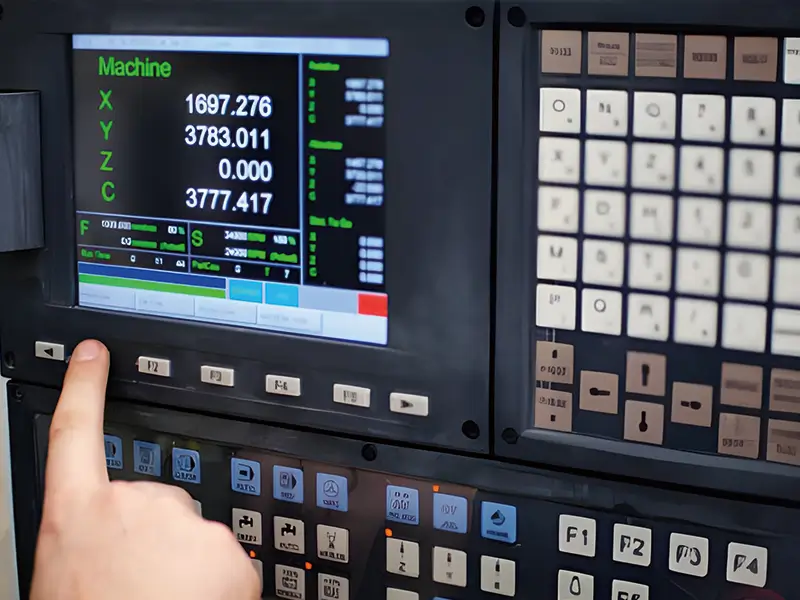
An M-code word uses M followed by a numeric code. Supported numbers, parameters, and execution rules must be checked in the specific machine manual.
- Each code starts with M followed by a number, such as M03 or M08. Accepted digit counts depend on the controller.
- A majority of modern CNC controllers recognize leading zeros. What this means is that the M8 code will be ideally interpreted the same way M08 would.
- Some controls, including Haas mills, allow only one M-code per block; other controls permit codes from different groups. Follow the specific control manual.
- M-code position and timing depend on the control. In G01 X2.5 Y1.0 F15.0 M08, F15.0 means 15 inches per minute only with inch units and feed-per-minute mode active. Coolant timing must not be inferred from its position in this example; the line is not a complete runnable program.
The Importance of M-Code in CNC Machining
M-codes are an essential part of CNC machining, their importance can not be exaggerated. This set of codes allows for improved automation in machines and gives more room for efficiency in the manufacturing process. Below are a few notable reasons why M-Code is crucial to CNC machining:
- Optimization of CNC Operations
M05, M06, and M08 commonly request spindle stop, tool change, and coolant. Automation can reduce manual steps, but spindle stop alone does not authorize reaching into the machine for inspection.
- Enabling Complex Operations
M-codes support multi-operation programs by controlling auxiliary functions and program flow. Their availability and any required operator intervention depend on the machine.
- Synergy with G-Code
M-Code doesn’t work in isolation, it partners with G-Code. Together, they form a complete set of instructions that covers every essential aspect of the CNC machining process. From precise geometric movements to the machine actions that support them, these sets of codes work hand-in-hand to give you an absolutely seamless operation.
How M-Code Differs from G-Code
G-codes commonly specify motion and operating modes, while M-codes commonly request auxiliary functions and program control. The exact command set is controller-dependent.
G-codes can set toolpaths, units, coordinate systems, and other modes; M-codes can control spindles, coolant, tool changes, and program flow.
Below is a table of detailed comparison we have prepared to make it easier for you to understand the differences between M-Code and G-Code.
Feature | M-Code | G-Code |
Primary Function | It controls non-geometric functions and hardware of the machine. | Controls motion, positioning, and machining modes. |
Focus | Focuses on the machine’s actions. That is, what to do and when to do it. | Toolpath geometry and modes such as units and coordinate systems. |
Examples | M03 (Spindle On), M06 (Tool Change), and M08 (Coolant On). | G00 (Rapid Move), G01 (Linear Feed), and G02 (Circular Move). |
Execution | Some commands request one-time actions; others establish persistent states, such as spindle or coolant on, until changed. | Includes modal and non-modal commands; modal commands persist within their group until replaced or cancelled. |
Analogy | An instance of how M-Code works is like the control of a car. It tells the car to turn the engine on, switch on the headlights, or activate the windshield wipers. | The G-Code comes into action in directions, telling the car where to turn and how fast it should go. |
Commonly Used M-Codes in CNC Machining
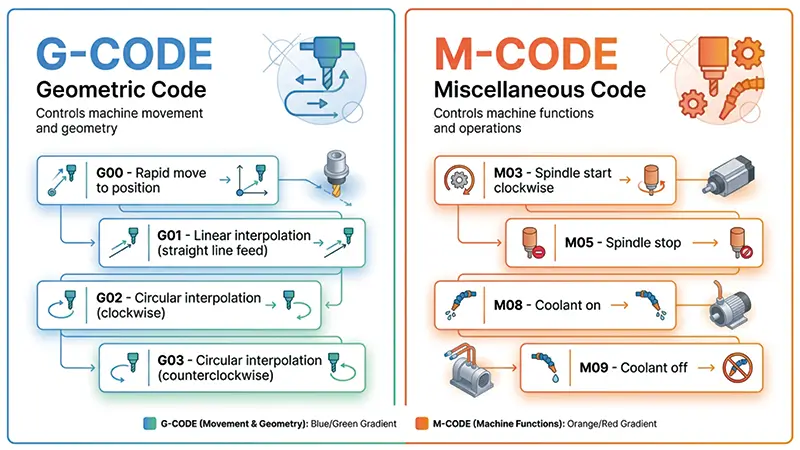
The following are common M-code conventions, not a universal executable reference. Confirm each function and its options in the machine builder and controller manuals before use.
1. Program Control Codes
- M00 (Program Stop): It pauses the program unconditionally. The operator must press a button to resume it.
- M01 (Optional Stop): Pauses the program only when you enable the “Optional Stop” function on the control panel.
- M02 (End of Program): Ends the program. Reset and restart behavior can differ from M30, so the two should not be assumed interchangeable.
- M30 (Program End and Reset): Ends the program and resets the code back to the beginning, ready for the next part.
2. Spindle Control Codes
- M03 (Spindle On – Clockwise): Starts the spindle rotating in the standard forward/clockwise (CW) direction.
- M04 (Spindle On – Counter-Clockwise): Requests reverse spindle rotation where supported. Tapping requires the correct cycle and synchronization; M04 alone is not a tapping cycle.
- M05 (Spindle Stop): Stops the spindle’s rotation.
3. Tool and Coolant Control Codes
- M06 (Tool Change): Requests a tool change on controls that use this convention. Automatic or manual handling and the sequence with T depend on the machine.
- M08 (Flood Coolant On): Activates the primary coolant system.
- M09 (Coolant Off): Switches off the coolant functions assigned to this code. Separate coolant or air systems may have their own commands.
What Machines Use M-Code?
Many CNC machines use M-codes for auxiliary functions. The mapping is machine-specific, so codes cannot be transferred between equipment without checking the manuals.
- CNC Milling Machines and Machining Centers
Milling controls commonly use M03 for spindle rotation, M06 for tool changes, and M08 for flood coolant. Through-spindle coolant may use a separate command, such as M88 on equipped Haas mills.
- CNC Lathes & Turning Centers
M-codes manage the chuck (clamp/unclamp), tailstock, and turret indexing, in addition to standard spindle and coolant control.
- Plasma & Laser Cutters
M-codes are used to turn the plasma torch or laser beam on and off (M03/M05 are often used for this) and control cutting gas pressure.
Machine-specific commands can control the high-pressure water pump and abrasive feed on waterjet equipment; verify the actual command mapping.
- Electric Discharge Machines (EDMs)
M-codes control the flushing of dielectric fluid, wire cutting, and power settings for the electrical discharge.
Why You Should Partner with Us
At Sundi Precision Tools, we know that M-code is the language that brings our tools to life. An M08 (Coolant On) command is only as useful as the tool it’s cooling. Our cobalt drills are made with geometries that enhance coolant flow to the cutting edge, allowing them to withstand the intense heat of drilling stainless steel.
Selecting suitable solid carbide end mills supports machining performance, but M06 does not validate tool geometry, offsets, clamping, or surface finish. These require setup and process checks.
We don’t just sell tools; we provide the important components that translate your programming expertise into substantial, profitable results. As industry leaders, we understand the entire production process, from the code on the screen to the cutting-edge chip. We make sure you, our esteemed customer, attain incomparable precision and durability.
Conclusion
Understanding M-code supports correct CNC programming and automation. Safe operation and dimensional results also depend on machine-specific commands, setup, tooling, and program verification.
In the end, a perfect written program is not always enough. True value can only be achieved when M-codes commands are executed by reliable, precise and powerful tools.
Ready to equip your operations with tools that can execute your commands flawlessly? Explore the Sundi Precision Tools catalog or contact our team of experts today, to find the perfect cutting solutions for your project.
FAQs
Is M-Code a programming language?
M-codes are a family of miscellaneous-function commands used within CNC programs, rather than a separate general-purpose programming language.
What do the M-Codes do in CNC Machining?
M-code handles instructions relating to turning the spindle on or off, coolant control, tool change, and program stops.
What does M in M-Code stand for?
M denotes miscellaneous functions in CNC programming. The assigned functions depend on the controller and machine builder.
Can M-Codes Control External Automation Systems?
Yes, M-codes can control external automation systems when connected to the controller. This connection uses signals from specific codes to control external components like conveyor belts or measuring tools.