Skip to content
Trochoidal Milling: When It Helps, When It Does Not, and How to Set It Up
Trochoidal milling is useful when the toolpath solves a real cutting problem: too much cutter engagement, heat, chatter, poor chip evacuation, or tool breakage in a slot or pocket. It is not automatically faster than every conventional milling strategy. The value comes from controlling how much of the cutter is engaged at one time, then matching the stepover, depth of cut, feed rate, tool length, coolant, and machine motion to that strategy.
Start with the real question: should you use trochoidal milling?
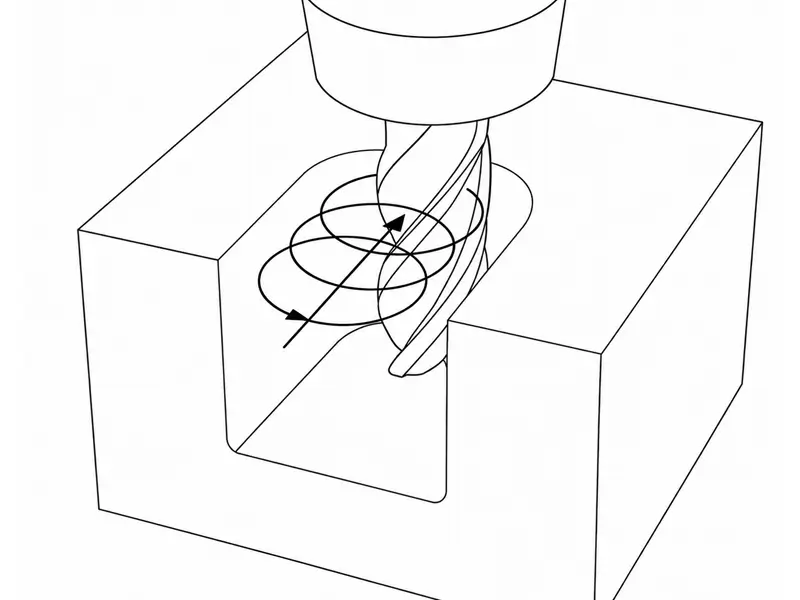
Use trochoidal milling when a straight slotting or heavy roughing move would bury too much of the cutter and create heat, chatter, or unpredictable load. The toolpath helps because the cutter enters and exits the material in a looping motion instead of staying fully engaged through the slot.
The practical question is not “Is trochoidal milling advanced?” It is “Does this part need better engagement control than a simpler toolpath can provide?”
| Situation | Trochoidal milling is usually a good fit? | Why |
|---|---|---|
| Deep slotting with a narrow cutter | Yes | It reduces continuous full-width engagement. |
| Hard or heat-sensitive materials | Often | Lower radial engagement can help control heat and tool wear. |
| Small tools that break easily | Often | Smoother engagement can reduce shock loading. |
| Unstable workholding | Sometimes | It can reduce cutting force spikes, but the setup still matters. |
| Shallow open roughing with a rigid setup | Maybe not | A simpler high-feed or adaptive roughing path may remove material faster. |
| Machine with poor acceleration or rough motion | Maybe not | The looping path may slow down or leave inconsistent motion marks. |
If the part is open, rigid, and easy to rough, trochoidal milling may add extra motion without improving the result. If the cutter is trapped in a slot, the material is difficult, or the tool is small and fragile, it becomes much more attractive.
What trochoidal milling means in the cut
Trochoidal milling uses a looping toolpath, often in a repeated circular or spiral-like motion, to move through a slot or pocket. Instead of forcing the cutter through a straight full-width slot, the path keeps cutting engagement more controlled.
The toolpath keeps engagement more controlled
In a straight slot, a large portion of the cutter may be engaged for a long time. That raises cutting forces, packs chips in the slot, and pushes heat into the tool and workpiece. A trochoidal path reduces the radial width of cut at each moment, so the cutter spends less time buried.
That is why feeds and speeds cannot be treated separately from the toolpath. The same cutter, material, and RPM can behave very differently when the radial engagement changes. A light radial engagement may allow a higher feed rate, but only if chip load, machine motion, tool rigidity, and chip evacuation support it.
It is related to HSM and HEM, but not identical to every adaptive path
Trochoidal milling overlaps with high speed machining and high efficiency machining because all three care about engagement control. Still, not every adaptive path is a trochoidal path, and not every trochoidal-looking CAM move is automatically efficient.
Think of trochoidal milling as one specific way to manage cutter engagement. The goal is stable cutting, not decorative tool motion. If the CAM path creates loops but the machine slows down excessively, chips stay packed in the cut, or the cutter rubs instead of cutting, the strategy is not doing its job.
Where trochoidal milling helps most
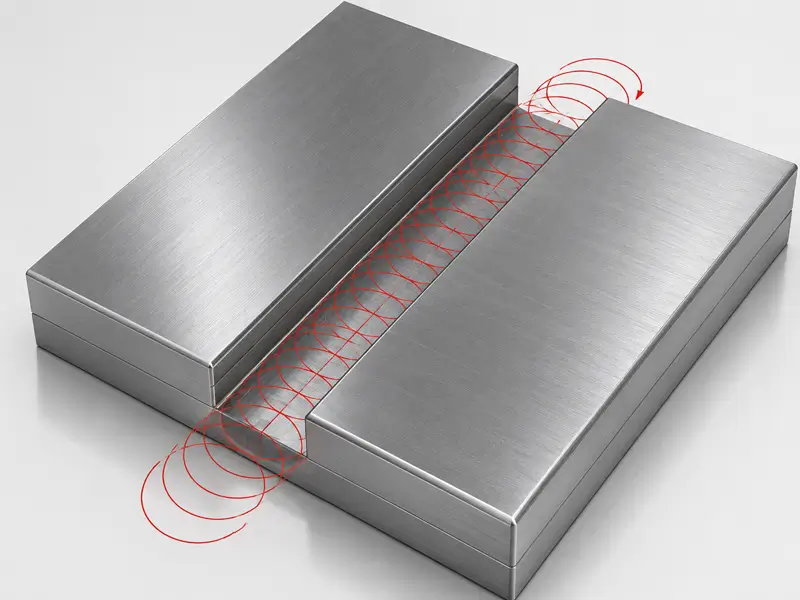
Trochoidal milling is most useful when the cutting zone would otherwise be overloaded. It is especially valuable in slotting, deep pockets, hard materials, small-tool work, and setups where sudden engagement changes create failures.
Slotting and deep pockets
Slotting is one of the clearest use cases because the cutter can become surrounded by material. Full-width slotting gives chips fewer escape paths and puts a large contact arc on the tool. A trochoidal path opens the cut in smaller bites and can keep the cutting tool from staying buried.
This does not mean the operation becomes effortless. Deep slots still need chip evacuation, coolant or air blast, enough flute length, and a tool that is not hanging too far out of the holder. The toolpath reduces one problem, but it does not cancel the rest of the setup.
Hard materials and heat-sensitive cuts
In difficult materials, tool life often depends on controlling heat and avoiding sudden load spikes. Trochoidal milling can help because lower radial engagement gives heat and chips a better chance to leave the cutting zone. This is why it appears often in conversations about hard milling, stainless, high-temperature alloys, and other demanding materials.
The article should not promise that trochoidal milling makes hard material easy. It only gives the process a better shape. Tool material, coating, holder rigidity, coolant strategy, and realistic chip load still decide whether the cut survives.
Small tools or less forgiving setups
Small end mills have less cross-section and less margin for abuse. A sudden corner load, packed chip, or aggressive slotting move can snap the tool before the operator has time to react. A controlled looping path can reduce shock and make the cut more predictable.
The same logic applies to less forgiving workholding. If the part, fixture, or machine cannot handle heavy engagement, reducing force spikes can help. But if the workholding is visibly moving, trochoidal milling is not a cure. Fix the setup first.
Where it may not be the best choice
Trochoidal milling can be the wrong toolpath when the added motion costs more time than it saves. If the stock is open, the machine is rigid, the cutter is large enough, and chips leave easily, conventional roughing, high-feed milling, or another adaptive strategy may be more productive.
It can also disappoint on machines that cannot maintain smooth high-speed motion. A trochoidal path contains many direction changes. If the controller slows heavily through each loop, the programmed feed rate may look good while the real cycle time is poor.
Another weak case is using too small a cutter just because the path is trochoidal. Smaller tools are more flexible and remove less material per pass. Sometimes a larger cutter with a simpler strategy is the better choice.
Parameters that decide whether it works
Trochoidal milling succeeds or fails through parameters. The strategy gives you a toolpath shape, but the cut still depends on radial engagement, axial depth, chip load, tool length, machine motion, and chip removal.
| Parameter | What it controls | Common failure if wrong |
|---|---|---|
| Radial engagement / stepover | Cutter contact, heat, allowable feed | Too high causes overload; too low hurts MRR and may rub. |
| Axial depth | How much flute length is used | Too deep for the setup causes deflection or chatter. |
| Feed rate and chip load | Whether the edge cuts or rubs | Too low rubs; too high overloads the edge. |
| Tool stickout | Rigidity and deflection | Excess stickout causes chatter, taper, or breakage. |
| CAM smoothing and machine acceleration | Real motion quality | Poor motion causes slow cycle time and inconsistent finish. |
| Coolant / air blast | Chip and heat removal | Packed chips recut, weld, or damage the edge. |
Radial engagement and stepover
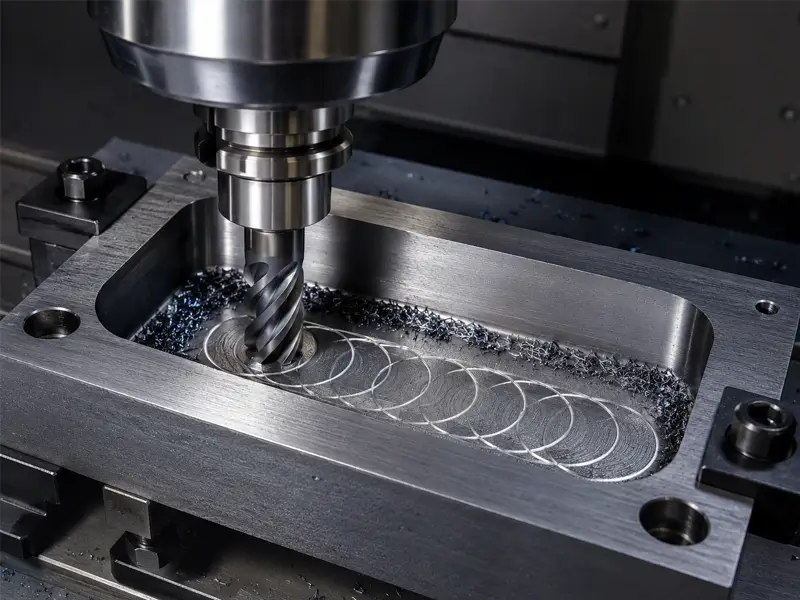
Radial engagement is the heart of trochoidal milling. Reducing the width of cut can reduce heat and force, but it also changes feed calculation. If the stepover is too large, the path loses its advantage and starts acting like a heavy slotting move. If the stepover is too small, the cutter may spend a lot of time moving without removing much material.
The useful range depends on tool diameter, material, axial depth, machine power, and the CAM strategy. Treat any fixed stepover percentage as a starting point, not a universal rule.
Axial depth and tool length
Trochoidal milling is often paired with deeper axial cuts because radial engagement is reduced. That can be efficient, but only when the tool is rigid enough. A long flute length or long stickout may flex under the cut even if the radial stepover is light.
Use the shortest tool and stickout that can safely reach the feature. If reach is unavoidable, reduce the load and watch for chatter, tapered walls, or poor finish.
Feed rate, chip load, and chip thinning
When radial engagement is low, chip thinning can make the actual chip thinner than expected. That is why some trochoidal programs use higher feed rates than a conventional slotting pass. The point is not to “go faster” blindly. The point is to maintain a real chip load so the edge cuts instead of rubbing.
If the tool sounds like it is polishing instead of cutting, or if heat rises without good chip formation, the feed may be too low for the engagement. If the spindle load jumps, the tool squeals, or edges chip, the feed or engagement may be too high.
CAM smoothing, machine acceleration, and coolant
A trochoidal path only works if the machine can move through it smoothly. CAM smoothing, tolerance settings, look-ahead, controller behavior, and acceleration all affect the real feed at the cutter. A program that looks efficient in CAM can slow down dramatically on the machine.
Chip control matters just as much. Trochoidal milling often creates many small chips in a slot or pocket. If they stay in the cut, the tool recuts them and heat rises. Use coolant, air blast, or a chip evacuation strategy that fits the material and machine.
Common mistakes in trochoidal milling
The first mistake is using trochoidal milling as a label instead of a process decision. If the cutter does not need engagement control, the path may only add cycle time.
The second mistake is using too much radial engagement. A looping path with a heavy stepover can still overload the tool, especially in corners or hard material.
The third mistake is going too light. Extremely small stepovers can reduce material removal and cause rubbing if feed is not adjusted. The operation may look safe but waste time and generate heat.
The fourth mistake is ignoring machine motion. Trochoidal paths demand frequent direction changes. If the machine cannot maintain speed, the result may be slower than expected.
The fifth mistake is forgetting chip evacuation. The path may reduce engagement, but chips still need somewhere to go.
A practical setup checklist
Before using trochoidal milling, confirm the reason for using it. Is the goal to reduce slotting load, protect a small tool, control heat in hard material, or handle an unstable setup? If the reason is vague, test a simpler strategy first.
Then choose the cutter and stickout. Use enough flute length for the feature, but avoid unnecessary reach. Check holder grip and runout. Set radial engagement conservatively, then connect feed rate to chip load and chip thinning.
Finally, prove the path on the machine. Listen for chatter, watch chip shape, check spindle load, and compare real cycle time with the CAM estimate. A good trochoidal process should sound controlled, evacuate chips cleanly, and leave the tool in better condition than a buried slotting pass.
Conclusion
Trochoidal milling is strongest when engagement control solves a real machining problem. It can improve tool life, heat control, and slotting stability, especially in hard materials, deep pockets, small-tool work, and difficult setups. It is weakest when it is used only because it looks advanced. Choose it for the cut condition, then set stepover, chip load, depth, stickout, CAM motion, and chip evacuation as one system.
FAQ
Is trochoidal milling the same as adaptive milling?
Not exactly. Both can manage cutter engagement, but trochoidal milling usually refers to a looping path often used in slots or pockets. Adaptive milling is a broader CAM strategy category.
Does trochoidal milling always improve tool life?
No. It can improve tool life when it reduces heat and engagement spikes, but poor stepover, chip evacuation, tool length, or feed rate can still damage the tool.
What is the biggest parameter in trochoidal milling?
Radial engagement is usually the key starting point because it controls how much of the cutter is in the material. It must be matched with chip load, axial depth, tool rigidity, and machine motion.
Is trochoidal milling good for slotting?
Often, yes. Slotting is one of the best use cases because the path can reduce continuous full-width cutter engagement and improve chip evacuation.
Can trochoidal milling be slower?
Yes. If the machine slows through the looping path, if the stepover is too small, or if a simpler roughing strategy would work, trochoidal milling can increase cycle time.