Skip to content
Machining copper tungsten: build the process around the actual composite
Machining copper tungsten is easiest to misjudge when the material is treated as either copper, tungsten or an EDM electrode. Cu-W is a heterogeneous two-phase composite: a porous sintered tungsten skeleton is commonly infiltrated with copper. The composition, microstructure and production route affect what the edge encounters, so the part drawing needs more than the word “copper-tungsten” before a conventional cutting plan is chosen.
Before selecting cutting data, confirm the Cu/W ratio, grade designation and production route with the material supplier. Then choose tooling and coolant for the actual operation. A successful external cut on a copper-rich grade does not establish how a small feature in a tungsten-heavy grade will behave.
Start with the grade, not a generic alloy name
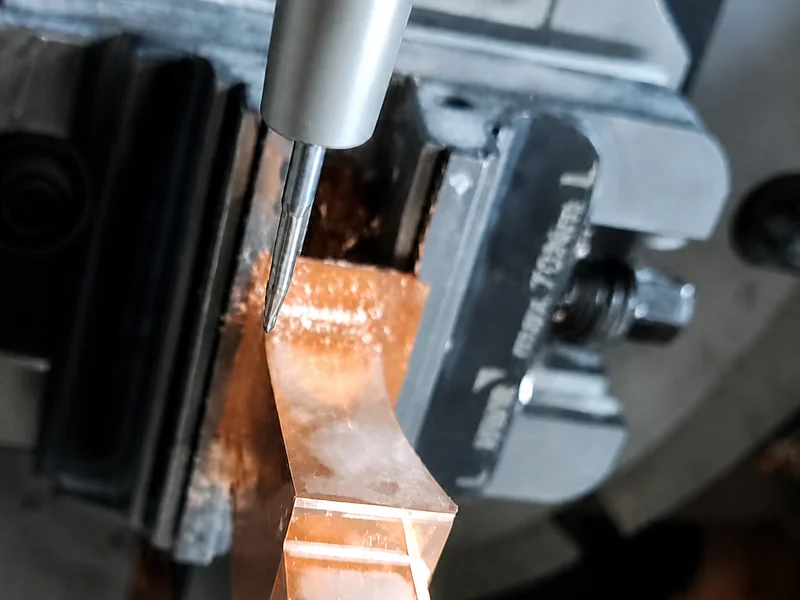
Pure-copper data and pure-tungsten or tungsten-heavy-alloy data are not interchangeable with a Cu-W composite. Increasing copper generally moves machinability in a more favorable direction; increasing tungsten calls for more care and changes the trade-offs among hardness, stiffness, wear and conductivity. That is a directional composition rule, not a formula that converts a percentage into a cutting setting.
Ask the material supplier for the actual grade and route, then compare that identity with the operation. Residual porosity and local microstructure can change the observed edge behavior. A statement that Cu-W is “machinable” therefore does not establish that a particular small drill, thin wall or finish requirement will behave like an external turning pass.
| First process question | Evidence needed before the trial | Practical direction |
|---|---|---|
| Is the Cu-W grade identified? | Cu/W ratio, grade designation, density or additives, and production route | Stop using generic copper or tungsten data until the composite is identified. |
| Is the feature mechanically sensitive? | Tool diameter, wall or feature size, support, runout and effective stickout | Qualify the feature separately from a robust external cut. |
| Is conventional cutting a reasonable first route? | Operation, tool geometry, machine rigidity, chip path and toolmaker limits | Begin with a bounded carbide trial and record wear, vibration, dimensions and surface condition. |
| Is another process being considered? | Geometry, tool-life or surface-integrity requirement | Qualify grinding or EDM under its own process conditions. |
Use carbide as a bounded starting direction
Eagle Alloys and ESPI Metals compare conventional Cu-W machining with hard gray cast iron and recommend carbide tooling. Read that as a starting direction for tool material—not proof of a universal speed, feed, coating or geometry. Before a first pass, keep the operation, grade, tool diameter and geometry, machine rigidity, runout, stickout and toolmaker limits attached to that direction.
Start with a conservative process trial that the shop can observe. Record wear location, chip behavior, vibration, dimensional result and surface condition. If the edge is wearing or chipping early, do not immediately infer that carbide is unsuitable. First confirm the material identity, edge condition, reach, support and chip path. Change one variable at a time so the next trial can discriminate between a setup effect and a material/tool-system mismatch.
Separate small features from the general operation
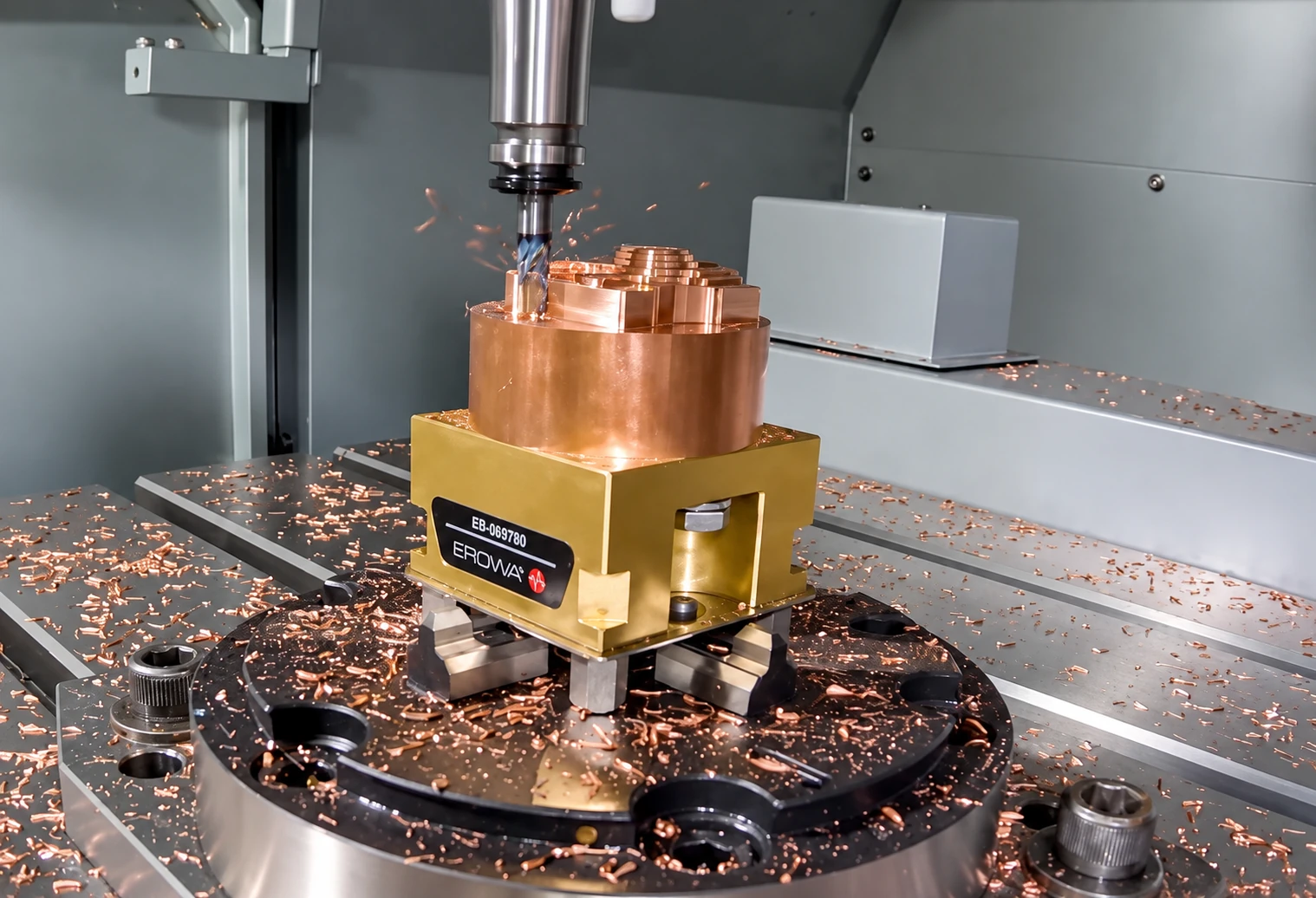
Drilling and small features deserve their own validation. Binding, chip clearance and edge fragility can dominate when the feature is small, and local composition can matter more than it did on a broad cut. A shop discussion about Elkonite involved a 1/32-inch end mill. It illustrates the small-feature problem but does not establish a reusable setting or tool choice.
Surface appearance should be read with the same caution. Cu-W stiffness can reduce some pure-copper burr behavior, but tool wear, vibration, local porosity and edge chipping can still affect the result. “Good machinability” is conditional. Inspect the actual edge, measured finish and feature condition rather than promising a burr-free or defect-free part from the material name.
Make coolant an operation-specific choice
Supplier guidance ranges from optional water-soluble coolant to dry turning and lubricant for tapping or drilling. Choose coolant by operation, grade, toolmaker recommendation, chip evacuation and any oxidation or corrosion constraints, then verify the result in a controlled trial.
This makes a coolant change a test variable, not a universal correction. Document how fluid reaches the feature, whether it clears chips and whether the change alters edge condition or finish. A drilling or tapping lubricant decision cannot be assumed to settle an external turning or milling decision.
Keep EDM and alternate processes in their own qualification
Cu-W is also used as an EDM electrode material, but electrode wear during electrical discharge does not tell you how a milling cutter, turning insert or drill will perform in Cu-W. Keep those two uses separate when comparing supplier data.
When geometry, tool life or surface-integrity risk is unacceptable for conventional cutting, grinding or EDM may be alternatives. That is a branch for a separate qualification, not an automatic upgrade. EDM needs its own electrode composition, work material, current, pulse, flushing and wear-goal decisions; grinding needs its own wheel, coolant and surface-risk controls.
Identify the actual composite, begin with a bounded carbide direction, isolate sensitive features and qualify coolant for the operation. Keep EDM, grinding and conventional-cutting data in separate records. A short, well-documented trial is more useful than a confident table borrowed from another material system.