










Cemented Carbide Cutting Tool Material Basics Summary
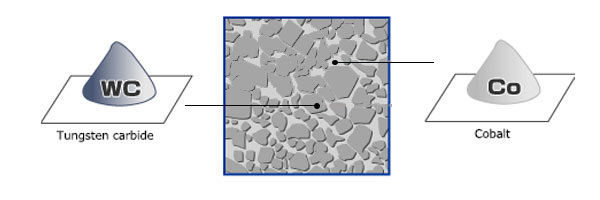
Cemented carbide is a widely used cutting-tool material made by powder metallurgy. Hard tungsten carbide (WC) particles are combined with a metallic binder, commonly cobalt (Co). Some grades use nickel (Ni), while chromium (Cr) may be an addition rather than the principal binder. Composition and microstructure explain why different grades suit different machining tasks.
Hardness and Toughness
WC-Co cemented carbides combine a hard carbide phase with a tougher metallic binder. Hardness, toughness, stiffness, and hot performance depend on composition and microstructure. Do not assume tungsten carbide is always harder than alumina, or that hardness remains unchanged as temperature rises. Tool selection must balance wear resistance with resistance to fracture under the actual cutting conditions.
Both coated and uncoated WC-Co cutting tools are used. The substrate remains important even with a coating: its stiffness, toughness, and resistance to deformation support the cutting edge. These properties depend on binder content, grain size, and processing; a high elastic modulus does not mean that deformation is impossible. Powder preparation and sintering both influence final performance.
Powder-Making Process
Tungsten carbide powder can be produced by carburizing tungsten (W) powder. Starting particle size, temperature, time, and carbon control affect the result. Stoichiometric WC contains about 6.13% carbon by weight; the required carbon balance for a cemented-carbide batch also depends on its other constituents and processing. Powder suppliers offer different particle sizes and compositions for specific downstream requirements; confirm current grade data rather than relying on historical product counts.
Tungsten carbide powder is mixed with a selected metallic binder. Cobalt content varies with the grade; nickel-based binders and other additions may be used for particular corrosion or performance requirements. Increasing binder content generally trades hardness and wear resistance for toughness, but the full microstructure matters. Ruthenium additions are grade-specific and must not be assumed to improve toughness without any other property changes.
Finer tungsten carbide grains can increase hardness, but grain growth during liquid-phase sintering must be controlled. Vanadium carbide (VC) and chromium carbide (Cr3C2) are used as grain-growth inhibitors in suitable formulations. Titanium carbide (TiC), tantalum carbide (TaC), and niobium carbide (NbC) can also modify phase structure and cutting behavior. These additions are not interchangeable; their amounts and the sintering cycle must be matched to the grade.
Recycled cemented carbide can supply valuable tungsten and binder metals. Chemical routes through ammonium paratungstate (APT), zinc reclamation, and selected direct-reuse processes serve different feedstocks. Sorting, contamination control, and testing are essential. Recycled powder is not automatically denser, more predictable, or suitable for every grade; its acceptance depends on the specified composition and powder properties.
Wet milling mixes carbide powder with binder metals and helps control particle size. Organic pressing aids provide green strength for handling before sintering. Their chemistry and amount influence flow, compaction, and debinding. Excess or poorly dispersed binder can create defects, so the formulation must balance handling strength with density and clean removal rather than simply maximizing binder strength.
After grinding, the powder is usually spray-dried, producing free-flowing clumps held together by the organic binder. By adjusting the composition of the organic binder, these clumps can be customized for flowability and packing density as needed. By screening out coarser or finer particles, the particle size distribution of the clumps can be further customized to ensure good flowability when loaded into the mold cavity.
Workpiece Manufacturing
Die pressing, isostatic pressing, extrusion, and injection molding are used for different carbide shapes and production volumes. Many cutting inserts are compacted in rigid dies. Consistent powder filling, granule flow, tooling, and controlled pressure are important for repeatable green density and dimensions. Use the powder supplier’s compaction data and a validated process window; one broad pressure range is not an operating prescription for every grade.
During compaction, particles and granules rearrange and the binder system helps form a coherent green compact. Increased pressure can raise density within a suitable process window, but excessive pressure may damage particles, tooling, or the compact. Compaction behavior depends on powder morphology, binder content, granulation, and pressing aids. Supplier pressure-density curves help match the powder to the forming process.
Large or slender blanks, including those for milling cutters and
drills, can be formed by cold isostatic pressing in flexible tooling. Pressure is transmitted through a fluid, and the resulting blank may be machined before sintering. Cycle time, tooling, machining allowance, and production volume determine cost; this route is not always cheaper than rigid-die pressing.
In cold isostatic pressing, powder is placed in a sealed flexible mold and compacted under fluid pressure. The pressure and filling procedure must be validated for the powder and geometry. Tooling dimensions account for compaction, subsequent sintering shrinkage, and machining allowance. Consistent filling and density remain important: excess stock increases machining and recycling work, while insufficient material can produce an undersized blank.
Cemented carbide workpieces can also be formed using extrusion molds or injection molds. The extrusion molding process is more suitable for mass production of axially symmetric workpieces, while the injection molding process is typically used for mass production of complex-shaped workpieces. In both forming processes, graded cemented carbide powder is suspended in an organic binder, giving the cemented carbide mixture a uniform consistency similar to toothpaste. Then, the mixture is either extruded through a hole to form a shape or injected into a mold cavity to form. The characteristics of the graded cemented carbide powder determine the optimal ratio of powder to binder in the mixture and have a significant impact on the flowability of the mixture through the extrusion hole or into the mold cavity.
After pressing, extrusion, or injection molding, organic constituents are removed in a controlled debinding stage before final densification. Liquid-phase sintering brings the metallic binder into a liquid phase and reduces porosity. Capillary forces and the particle skeleton help retain the overall form, but density, distortion, and defects depend on the thermal cycle, atmosphere, and grade.
Sintering produces substantial shrinkage, and distortion can occur. Tooling and green machining must allow for validated shrinkage behavior and finishing stock. The final dimensions depend on powder properties, green density, geometry, and the sintering cycle; the original geometry is not guaranteed to remain unchanged.
Many carbide tools require grinding, edge preparation, or other finishing after sintering. The operations depend on the required geometry, tolerances, and surface condition; not every part needs the same treatment. Grinding residues can be collected for appropriate recycling, but recovery depends on contamination, collection methods, and the recycler’s acceptance criteria.
Workpiece Coating
Suitable coatings can improve wear behavior, reduce friction, or limit chemical interaction, depending on the coating and application. Substrate properties remain critical. Some grades use a cobalt-enriched surface zone to improve edge toughness, but this also affects hardness and deformation behavior. Surface engineering must be evaluated with the coating and cutting conditions; cobalt enrichment does not universally improve every property.
Debinding, heating rate, atmosphere, carbon potential, temperature, and holding time influence sintered carbide. Vacuum sintering, sinter-HIP, and separate hot isostatic pressing (HIP) are different process options. Pressure-assisted treatment can reduce residual porosity under suitable conditions, but grain growth and carbon balance must also be controlled. Match powder specifications to the validated furnace cycle; carbon potential, not an undefined carburizing voltage, is the relevant concept.
Tool manufacturers and powder suppliers must coordinate composition, grain size, pressing behavior, and sintering requirements. Many commercial grades exist because different equipment and applications need different property balances. Use current supplier specifications and qualification data rather than an unverified historical count of available grades.
Grade Classification
The combination of different types of tungsten carbide powder, mixture components, and metal binder content, as well as the type and amount of grain growth inhibitors, results in a wide variety of cemented carbide grades. These parameters determine the microstructure of the cemented carbide and its properties. Some specific combinations of properties have become the preferred choice for certain machining applications, making it meaningful to classify the various grades of cemented carbides.
The historical C classification and ISO application groups provide broad guidance, not complete definitions of carbide chemistry or performance. Manufacturer grade names describe particular products and cannot be replaced by an application code alone. Select a grade using the workpiece material, operation, cutting conditions, and the manufacturer’s recommendations.
A useful descriptive distinction is between straight WC-Co grades, fine or submicron grades, and grades containing additional cubic carbides. Straight grades contain tungsten carbide and a metallic binder, so calling them pure tungsten carbide is misleading. Submicron grades use controlled fine grains, often with growth inhibitors. Additional carbides change phase structure and properties; these descriptions do not form an exact substitute for a supplier grade specification.
- Plain WC-Co Grades
Straight WC-Co grades cover different binder contents and grain sizes. Hardness, transverse rupture strength (TRS), and fracture toughness must be checked for the actual grade and test conditions. Finer grains often increase hardness, while higher binder contents tend to favor toughness, but defects and microstructure also influence strength. Recycled material can be used when it meets the required controls; no single property range defines the entire family.
For turning, milling, planing, or boring, select the grade and geometry together. Finishing may favor wear resistance and edge stability, while interrupted roughing often needs greater fracture resistance. Historical C codes and ISO application groups do not establish a universal one-to-one composition mapping; use the supplier’s recommended application range.
Suitable WC-Co grades are used for cast iron, stainless steel, non-ferrous metals, and other work materials when the tool system and cutting conditions are appropriate. Separate grades are also developed for rock drilling, dies, punches, and wear parts. Binder content, grain size, coating, and geometry must be selected for the application rather than inferred from the label straight grade.
- Microcrystalline Cemented Carbide Grades
Submicron grades have a carbide grain size below 1μm. Grain-growth inhibitors and controlled sintering help maintain a fine structure. These grades can combine high hardness with useful strength, but neither a fixed cobalt range nor a transverse rupture strength above 500ksi applies to all of them. Edge angle and cutting force depend on the full tool geometry, work material, and operation.
By strictly identifying the quality of various raw materials in the production of graded cemented carbide powders and strictly controlling the sintering process conditions, it is possible to obtain appropriate material properties while preventing the formation of abnormally large grains in the material microstructure. To maintain small and uniform grain sizes, recycled regenerated powders can only be used when comprehensive control over raw materials and recycling processes is possible, along with extensive quality testing.
Submicron describes grain size, not an automatic assignment to the ISO M application group. Suitable grades can support sharp edges and good surface finish, but the correct choice depends on the work material, edge preparation, coating, and cutting conditions. Consult the manufacturer’s application data.
Suitable fine-grained carbides are used for drills, milling cutters, and demanding alloy machining. Their allowable cutting conditions depend on the grade, coating, geometry, and cooling; a universal 1200°C capability must not be assumed. Ruthenium additions or graded binder distributions can modify selected properties, but their benefits and trade-offs require product-specific data.
- Alloy Cemented Carbide Grades
Grades containing cubic carbides such as titanium carbide (TiC), tantalum carbide (TaC), and niobium carbide (NbC) can improve particular high-temperature wear characteristics in steel machining. They modify chemical interaction, crater wear, and deformation behavior, with trade-offs in other properties. Addition levels are grade-specific; do not treat broad percentage ranges as a universal formulation.
Cubic-carbide-containing grades span different hardness, strength, and toughness balances. Finishing, general machining, and interrupted roughing call for different combinations of substrate, coating, and edge geometry. Historical C codes and ISO application groups are selection guides, not exact chemistry or mechanical-property specifications. Check supplier data rather than assigning a universal hardness or rupture-strength range to all alloy grades.
Grades intended for stainless steel, steel, or heat-resistant alloys must be selected from the manufacturer’s application recommendations. ISO labels such as M10 and M40 describe application ranges, not stand-alone material recipes or guarantees for a particular operation. Grain size, binder content, coating, and edge preparation remain important.
Carbide grades for wear parts are selected for the actual wear mechanism, loading, corrosion environment, and dimensional requirements. Nickel-containing binders and chromium-containing additions may improve corrosion behavior in suitable formulations. Grain size, binder content, and recycled feedstock must meet the specified grade requirements; one composition or recycled proportion does not apply to every wear component.
conclusion
To meet the dual requirements of technical and economic considerations for tool manufacturers, cemented carbide powders are a key element. Powder designed for tool manufacturers’ processing equipment and process parameters ensures the performance of finished workpieces, leading to the emergence of hundreds of cemented carbide grades. The recyclable nature of cemented carbide materials and the ability to cooperate directly with powder suppliers enable tool manufacturers to effectively control their product quality and material costs.