




Cutting Fluid for CNC Machining and How to Fix Common Coolant Problems
People rarely search cutting fluid because they want a chemistry lecture. They search because the fluid started smelling bad, the coolant split, the tool life fell off, the part began staining, or the shop could not tell whether the real problem was concentration, delivery, or the fluid choice itself. That means this topic should start from process control, not from definitions.
The practical sequence is simpler than most coolant debates make it sound. First decide what the operation needs most: lubrication, cooling, flushing, or sump stability. Then match the delivery style and concentration to that job. Only after that should the shop argue about brand preference. A milling job built around Carbide End Mills may need cooling and chip evacuation first, while drilling or reaming may need more lubricity at the edge. Pretending those needs are the same is how coolant becomes background noise until it turns into a production problem.
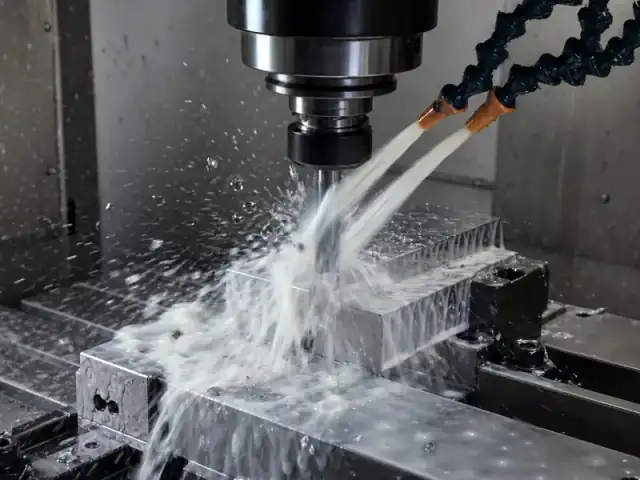
Quick answer: choose cutting fluid by operation first, then control concentration and sump health
The fastest way to make coolant decisions less messy is to stop asking for a universal "best cutting fluid." A better question is: what does this operation need the fluid to do, and what usually goes wrong when that need is ignored?
Start there and the sequence becomes practical:
1. identify whether the cut mainly needs lubrication, cooling, chip flushing, rust protection, or cleaner sump behavior; 2. match the fluid style and delivery method to that need; 3. measure concentration correctly and keep it stable; 4. treat separation, smell, foam, tramp oil, and skin irritation as process alarms, not side issues.
| Process situation | Better starting move | Why it is the right first decision |
|---|---|---|
| General CNC milling or turning with a sump | Start with a water-miscible coolant in the maker's operating range | It balances cooling, flushing, and workable lubrication for mixed production |
| Tapping, reaming, or high-friction hole finishing | Bias the setup toward lubricity or a richer concentration window | Boundary lubrication matters more than flood-cooling theory here |
| Aluminum with chip welding or finish drift | Choose the cleanest chip-evacuation strategy first, then verify fluid fit | Bad chip flow gets blamed on tools long before coolant logic gets checked |
| Manual or low-usage shop environment | Choose a fluid the shop will realistically maintain | A perfect coolant with no maintenance plan becomes a sump problem quickly |
| Sudden multi-job finish or tool-life decline | Check concentration, tramp oil, and delivery before changing tooling | Coolant drift often masquerades as a tooling problem |
What cutting fluid is really doing in the cut
Cutting fluid is asked to do several jobs at once. It may lubricate the tool-work interface, pull heat away, flush chips, prevent rust, reduce built-up edge, improve finish, and support sump hygiene. No single fluid does all of these equally well in every operation. That is why selection has to start with the process, not the catalog.
Cooling and lubrication are not the same job
A milling cut at high spindle speed may mainly need chip flushing and heat control. In high speed machining, coolant delivery has to support chip evacuation instead of simply making the enclosure look wet. A tapping or reaming operation may care more about lubrication at the edge than about bulk cooling. This is why the same shop may run one concentration for general machining and a richer concentration for tougher holemaking work.
When people treat coolant concentration as a single global number, they miss this tradeoff. More concentration may improve lubricity but raise residue and cost. Less concentration may improve cooling and cleanliness in some operations but reduce film strength where the cut needs it most.
Chip evacuation is part of fluid performance
Fluid only helps if it gets to the cut and moves chips out of the way. A coolant system that wets the enclosure but misses the tool-work contact is not solving the main problem. The same is true for packed chips in a pocket or slot. In those situations, air blast, nozzle placement, and toolpath strategy may matter as much as the fluid itself.
The same pattern shows up in holemaking: with carbide drills, many edge failures get blamed on tool grade even when heat and chip recutting are the real cause. That makes coolant delivery and chip clearance part of the tool-life decision, not just a machine housekeeping detail.
Machine cleanliness and sump health change machining results
Coolant is also a maintenance system. If the sump is contaminated, low in concentration, loaded with tramp oil, poorly mixed, or allowed to sit stagnant, the fluid stops behaving like the fluid the shop bought. It becomes a different process input.
That is why two shops can buy the same product and get very different results. The bottle may match, but the water source, concentration control, machine cleaning, and tramp-oil control do not.
How to choose cutting fluid by material and operation
The easiest way to avoid writing a generic coolant article is to tie the decision to actual operations.
Milling and turning
For general milling and turning, a water-miscible coolant is often the default because it gives a workable balance of cooling, lubricity, and flushing. It is a reasonable baseline for steel, stainless, and many mixed-production environments if the machine has a real sump system and the shop maintains it.
The mistake is assuming that "general purpose" means "maintenance free." Once concentration drifts or tramp oil builds up, the same coolant can begin causing smell, rust, stain, or finish complaints.
Drilling, tapping, and reaming
Holemaking often exposes the difference between cooling and lubrication. Tapping and reaming are narrow-contact, high-friction operations. A shop drilling with carbide drill bits may get by with one concentration for general production, but a finer hole-finishing step with a carbide reamer may need richer concentration or a different local application method.
This is one reason operators disagree when they compare "best coolant" by memory. They may be describing different operations, not different truths.
Aluminum and nonferrous work
Aluminum changes the conversation because edge welding, smearing, and chip evacuation become more visible. Some machines do well with clean water-miscible coolant. Others benefit from mist or lighter targeted lubricant. The same chip-control logic shows up in aluminum tooling choices, especially when shops compare coolant behavior with guidance on choosing an end mill for aluminum. The right answer depends on the machine, RPM, enclosure, and how easily chips leave the cut.
The useful test is not whether the coolant looks shiny on the part. The useful test is whether chips leave cleanly, the edge stays clean, and the finish remains stable over time.
Coolant concentration: the most common hidden problem
Many coolant problems begin with concentration drift. Shops top off with plain water, guess at mix ratio, or use a refractometer reading as if the Brix number directly equals coolant percentage. That is where a lot of confusion starts.
Use the manufacturer recommendation first
There is no universal concentration number that fits every coolant and every operation. The correct starting range comes from the coolant maker, then gets adjusted based on application. Tapping, broaching, and reaming often run richer. General machining may run lower. Aluminum may want a different balance than steel.
If the shop begins from internet folklore instead of the actual product range, all later troubleshooting becomes noisier.
Brix is often not the same as concentration
A refractometer reading is useful, but it often needs a coolant-specific conversion factor. If a shop ignores that factor, the sump may be running richer or leaner than the team thinks. That can explain why one operator says the concentration looks fine while the coolant still behaves poorly.
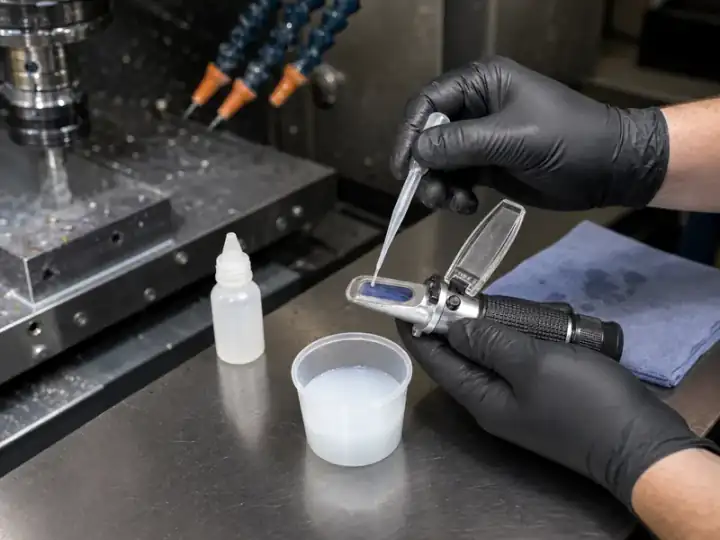
This is why concentration control belongs in the process sheet, not in memory. Measure, convert correctly, document, and compare over time.
Concentration problems look like machining problems
Low concentration may show up as rust, weak lubricity, or shortened tool life. High concentration may show up as sticky residue, excess foam, staining, or cleanliness issues. In both directions, the symptom can get misread as a tool or feed issue first.
If a finish problem appears across several jobs at once, concentration should be checked before changing every insert and offset in sight.
Why coolant separates, smells bad, or turns into a sump headache
When machinists say the coolant is "separating," they usually mean the emulsion has broken. The oil and water no longer stay mixed in a stable way. That is a real process alarm, not only an appearance issue.
| Symptom | Common causes | First checks |
|---|---|---|
| Oil/water separation | Wrong mixing method, contamination, poor water quality, tramp oil | Check mix practice, concentration, and visible contamination. |
| Sour or rotten smell | Bacteria, stagnant sump, dirty machine, trapped tramp oil | Inspect cleaning routine, pH, skimming, and idle time. |
| Rust or stain | Low concentration, wrong fluid, water quality | Verify actual concentration and top-off practice. |
| Foam | Overagitation, contamination, low concentration, wrong fluid fit | Check concentration, return flow, and tramp-oil level. |
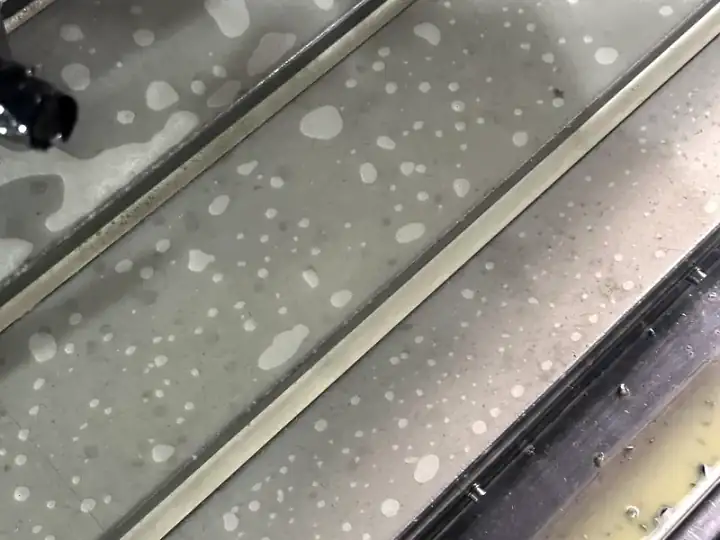
Broken emulsion usually means start over, not kitchen-sink fixes
Once the emulsion has clearly broken, random additives are rarely the answer. Bleach, soap, brake cleaner, and improvised sump chemistry usually create a second problem. The more reliable path is to inspect the cause, clean the sump properly, and refill with correctly mixed coolant.
Tramp oil is not just ugly
Tramp oil seals off the coolant surface, traps heat, supports bacterial growth, and changes how the sump behaves. It also confuses visual judgment. Operators may think the coolant itself is failing when a big part of the issue is leaked way oil or hydraulic oil sitting on top.
Water quality changes everything
Hardness, minerals, and mixing practice matter. Even a good coolant can perform poorly if the makeup water is wrong or if concentrate and water are mixed in the wrong order. A lot of "bad coolant" stories are actually "bad water plus bad maintenance" stories.
Health and shop-environment concerns are not side issues
A coolant article that only talks about tool life misses a major reader concern. Operators worry about mist, skin contact, smell, bacteria, and long-term exposure for good reason. If the fluid is irritating skin or the air is loaded with mist, the shop has a process problem, not merely a comfort problem.
Mist control, sump hygiene, concentration control, and machine housekeeping all affect this. A filthy coolant system can create skin issues and odor even if the original fluid choice was reasonable. In other words, coolant health is part machining variable, part maintenance variable, and part workplace-exposure variable.
That does not mean every shop needs the same response. It means the article has to admit that coolant performance is judged by people as well as by tool edges.
Common mistakes when choosing or maintaining cutting fluid
The most expensive mistakes are usually boring ones.
- Treating every operation as if it needs the same concentration.
- Topping off only with water until the sump is too lean.
- Reading Brix without the correct conversion factor.
- Ignoring tramp oil and bacteria until smell forces an emergency cleanup.
- Blaming Carbide End Mills or carbide drill bits before checking coolant delivery and health.
- Choosing a garage-shop fluid based only on mess or smell without considering rust protection and actual use pattern.
The pattern behind these mistakes is simple: the fluid gets treated as background until it causes pain.
Practical cutting fluid checklist
Use this checklist before changing tool grade, feeds, or offsets.
| Checkpoint | Why it matters |
|---|---|
| Confirm what the operation needs most: cooling, lubricity, or flushing | Prevents one-size-fits-all fluid logic |
| Measure concentration correctly | Brix confusion is common and costly |
| Inspect tramp oil and sump cleanliness | Dirty coolant behaves like a different product |
| Check nozzle aim and chip evacuation | Fluid that misses the cut solves very little |
| Match fluid strategy to machine style | Flood, mist, manual application, and garage use all behave differently |
| Recheck when several jobs worsen at once | Cross-job problems often point to coolant health |
Conclusion
The best cutting fluid choice is the one that matches the cut, the machine, and the maintenance reality of the shop. A fluid that works beautifully in one process can fail in another if the real need changes from cooling to lubrication, from chip flushing to cleanliness, or from sump life to manual convenience.
If a shop wants fewer surprises, it should treat cutting fluid like a controlled process variable. That means matching the fluid to the operation, measuring concentration correctly, protecting sump health, and using troubleshooting steps before blaming the tool. When that discipline is in place, the tool has a fairer process to work in, whether the job is milling, drilling, reaming, or finishing a difficult material.
FAQ
What is the best cutting fluid for CNC machining?
There is no single best answer. The right fluid depends on the operation, material, machine, delivery method, and maintenance discipline.
Why is my coolant separating from the water?
The emulsion may have broken because of contamination, poor mixing, bad water quality, tramp oil, bacteria, or long neglect.
Does higher coolant concentration always improve tool life?
No. Richer concentration may improve lubricity in some operations, but it can also create residue, cleanliness, or foaming issues. The correct range depends on the coolant and the cut.
Can garage shops use water-soluble coolant?
Yes, but only if the user is willing to maintain it. For low-use environments, the maintenance burden matters almost as much as the cutting performance.
Should I change tooling first when finish gets worse?
Not always. If several jobs worsen together, check coolant concentration, delivery, contamination, and sump condition before changing every tool in the machine. The same troubleshooting habit also applies to drilling problems, including the process choices covered in this guide to drill bits for stainless steel.
Coolant delivery matters even more when chip evacuation in blind holes is limited by a closed bottom.