



How to Choose an End Mill for Aluminum Without Chip Welding or Chatter
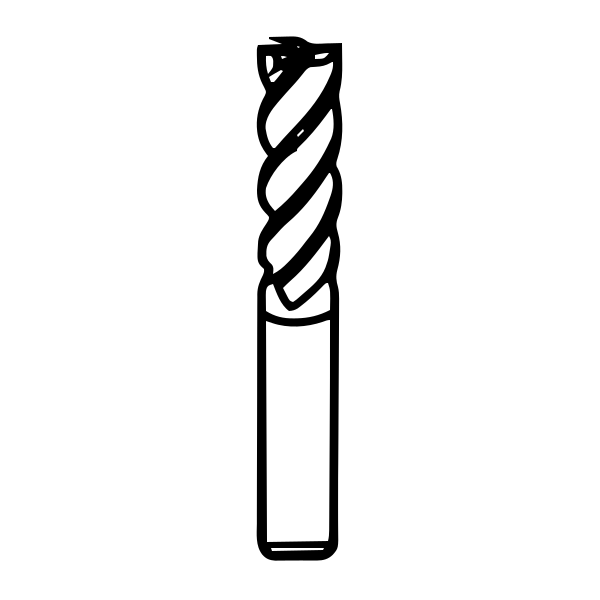
For most CNC aluminum milling, start with an aluminum-specific carbide end mill with sharp edges, polished or low-friction flutes, enough chip space, and the shortest practical stickout. The exact choice depends on the machine, RPM range, holder rigidity, operation, and chip evacuation. A single flute can be useful when chip clearance and high spindle speed matter. A 2 flute is a safe general-purpose choice for slotting and pocketing. A 3 flute is often productive on rigid CNC machines because it balances chip space with feed capability. A pcd end mill belongs in more specialized high-volume or abrasive nonferrous work, not as the default answer for every aluminum job.
Quick answer: what end mill should you use for aluminum?
If you need a quick starting point, choose by operation and machine type.
| Application | Good starting choice | Why |
|---|---|---|
| General CNC aluminum pocketing | 2 flute or 3 flute carbide end mill for aluminum | Good chip clearance with enough cutting edges for productivity. |
| Deep slotting | 2 flute aluminum end mill, or single flute where RPM and chip clearance support it | More flute space helps chips escape. |
| High-speed router aluminum cutting | Single flute or 2 flute aluminum cutter | Helps maintain chip load at high RPM and evacuate chips. |
| Rigid VMC roughing | 3 flute aluminum-specific carbide end mill | More feed capacity while keeping chip space. |
| Finishing walls/floors | Sharp 2 flute or 3 flute, often polished or coated | Clean edge and stable setup matter more than flute count alone. |
| High-volume abrasive nonferrous work | PCD tooling when justified | Long life and finish consistency can offset cost. |
This table is a starting point, not a substitute for the setup. Aluminum is soft compared with steel, but it is not always easy to machine cleanly. Its chips can be large, sticky, and fast-moving. If those chips cannot leave the cut, they weld to the edge, scratch the finish, pack in the flute, or break the tool.
Why aluminum needs a different cutter choice
The right end mill for aluminum is less about maximum hardness and more about chip control. A cutter that works well in steel may have too many flutes, too little chip space, or an edge/coating combination that encourages aluminum to stick.
Aluminum makes large, sticky chips
Aluminum usually allows higher cutting speeds than steel, but the chips are larger for a given operation and can be gummy depending on alloy and condition. Soft or wrought aluminum can smear. Cast aluminum may include abrasive silicon. Thin walls can vibrate. Welded chips can damage the finish faster than the tool looks visibly worn.
That is why chip space is central. The flute must give the chip room to curl and leave. If chips stay packed in the cut, they get recut. Recut chips increase heat, scratch the surface, and make the cutter sound worse even if the programmed feed and speed look reasonable.
Chip evacuation matters as much as hardness
A very strong cutter with poor chip evacuation can fail quickly in aluminum. More flutes increase cutting edges and core strength, but they reduce flute valley space. That tradeoff is useful in harder materials where chips are smaller and speeds are lower. In aluminum, especially slotting, the extra flutes can become a problem if chips cannot escape.
Coolant, mist, air blast, toolpath, depth of cut, and radial engagement all affect evacuation. The cutter choice is only one part of the chip-control system.
Rubbing can create built-up edge and poor finish
Built-up edge happens when aluminum sticks to the cutting edge. Once that material builds up, the edge stops cutting cleanly. The finish becomes torn or smeared, dimensions drift, and heat rises. Rubbing makes the problem worse because the tool is in contact without taking a proper chip.
The cure is usually not one magic coating. It is a combination: sharp geometry, enough chip load, enough chip clearance, proper lubrication or air/coolant, stable holding, and a toolpath that does not trap chips.
Choose the right flute count
Flute count and helix angle are often the first geometry decisions because it changes chip space, feed capability, tool strength, and finish behavior. For aluminum, fewer flutes are often better than a general steel-focused cutter, but the answer still depends on the operation.
Single flute for maximum chip clearance
A single flute gives the largest chip space. It is common in router-style aluminum cutting, high-RPM machines, and applications where chip evacuation is the main limit. Because there is only one cutting edge, the programmed feed must be high enough to maintain chip load. If the feed is too low at high RPM, the tool rubs.
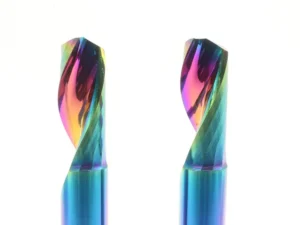
A Single-flute aluminium milling cutter can be a strong choice when the machine has high spindle speed but limited rigidity or when chips need maximum room to escape. It is not automatically better on a rigid VMC where a 2 flute or 3 flute tool can remove material more efficiently.
2 flute for general aluminum slotting and pocketing
A 2 flute aluminum end mill is a common general-purpose choice. It gives more chip clearance than a 3 flute or 4 flute while still offering two cutting edges. That makes it useful for slots, pockets, lighter machines, and operations where chip packing is a concern.
For many shops, a sharp 2 flute carbide tool with polished flutes is the safer first choice when the job is unknown. It gives the process more chip space before pushing productivity.
3 flute for productive CNC aluminum roughing and finishing
A 3 flute tool often works well on rigid CNC machines because it increases feed capability while still leaving more chip room than a 4 flute. In aluminum roughing, a 3 flute cutter can be productive when the machine has enough RPM, horsepower, coolant or air blast, and workholding stability.
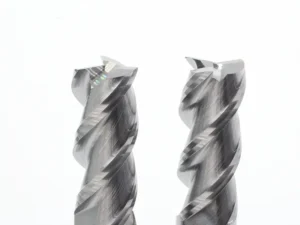
The advantage is balance. You get more edges than a 2 flute, but not so many that chip clearance disappears. That is why many aluminum-specific carbide end mills are 3 flute tools with polished flutes and high helix geometry.
Why 4 flute is not always better in aluminum
More flutes do not automatically mean better finish or faster cutting. A 4 flute tool may work in some aluminum finishing operations when engagement is light and chips clear easily, but it is often a poor first choice for slotting or deep cuts in aluminum. The reduced flute space can trap chips and encourage welding.
If a 4 flute tool is already causing squealing, chip packing, or smeared finish, switching to a 2 flute or 3 flute aluminum-specific cutter is often more useful than simply adjusting RPM.
Tool material and coating choices
Tool material and coating should support the chip behavior of aluminum. The cutter needs a sharp edge, low friction, and enough wear resistance for the application.
| Option | Best use | Caution |
|---|---|---|
| Uncoated polished carbide | General aluminum milling | Needs good chip evacuation and correct chip load. |
| ZrN / TiB2 / DLC-style low-friction coatings | Reduce adhesion and improve chip flow | Coating choice still depends on alloy, coolant, and tool geometry. |
| HSS | Low-speed or flexible special cases | Less rigid and less wear-resistant than carbide in most CNC production. |
| PCD | High-volume nonferrous or abrasive aluminum work | Expensive and not needed for most general jobs. |
Carbide end mill as the usual CNC baseline
A carbide end mill is usually the baseline for CNC aluminum machining because carbide offers stiffness, wear resistance, and edge stability at higher speeds. The important qualifier is that it should be geometry made for aluminum, not just any carbide cutter.
Look for sharp cutting edges, polished flutes, generous chip clearance, and a geometry that fits the operation. A carbide tool designed for steel may be strong, but it can have flute space and edge preparation that make aluminum chip evacuation harder.
Polished, ZrN, TiB2, DLC, and uncoated options
Polished flutes help chips slide out instead of sticking. Low-friction coatings such as ZrN, TiB2, or DLC-style coatings are often used for aluminum because they can reduce adhesion. Uncoated polished carbide can also work well, especially when coolant, air blast, chip load, and setup are correct.
Avoid choosing a coating as a substitute for process control. If the tool is rubbing, buried too deep, hanging too far out, or recutting chips, a coating may only delay the failure.
When a PCD end mill makes sense
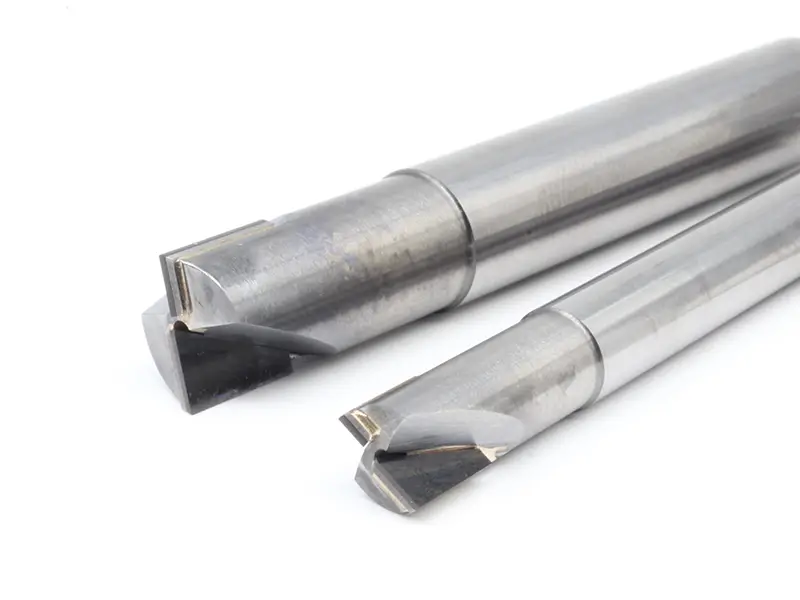
A pcd end mill makes sense when tool life, finish stability, or abrasive nonferrous material justifies the cost. PCD is common in some high-volume aluminum, cast aluminum, composite, and abrasive nonferrous applications. It can hold an edge for a long time and maintain consistent finish in the right job.
For low-volume general aluminum milling, PCD is often overkill. A good aluminum-specific carbide cutter is usually the more practical starting point. Mention PCD when the part volume, material abrasiveness, finish requirement, or tool-life economics support it.
Geometry details that change the result
The same flute count can perform very differently depending on helix angle, edge sharpness, corner geometry, flute length, stickout, holder, and runout.
High helix and sharp cutting edges
Aluminum generally benefits from sharp cutting edges and geometry that shears cleanly. High helix tools can help lift chips and improve finish, especially in side milling and pocketing. The edge should cut rather than push.
Sharpness matters because aluminum can smear if the tool is dull or overly honed. A cutter that is too blunt may survive in harder materials but rub in aluminum.
Corner radius, reach, flute length, and stickout
A corner radius can strengthen the edge and improve finish in some operations, but it must match the part geometry. Flute length should be only as long as the cutting depth requires. Extra flute length and extra overall length reduce rigidity.
Stickout is often the hidden cause of chatter. If the tool extends too far from the holder, the edge deflects. In aluminum, where feeds can be high, a flexible setup can create vibration, poor wall finish, and size error quickly.
Holder rigidity and runout
A good cutter cannot overcome a bad holder. Runout makes one flute cut more than the others, which can create chatter, uneven tool wear, and poor finish. Toolholding is especially important for small cutters, long-reach tools, and high-RPM aluminum work.
Use the shortest practical tool, hold it securely, and check that the holder matches the job. If the cutter keeps chattering even after parameter changes, inspect stickout, runout, holder condition, and workholding before blaming flute count.
Match the cutter to the operation
The “best” aluminum end mill changes with the cut. Slotting, pocketing, finishing, and router-style cutting all stress the tool differently.
Slotting
Slotting traps the cutter between two walls of material. Chips have fewer places to go. This is where chip clearance becomes critical. A 2 flute tool is often a good starting point; a single flute can help on high-RPM routers or less rigid setups; a 3 flute can work when chip evacuation is strong.
Avoid using a general 4 flute cutter for deep slotting unless the engagement is light and chips clear reliably.
Pocketing and adaptive roughing
Pocketing can be easier than slotting if the toolpath keeps radial engagement controlled. A 3 flute aluminum end mill can be productive here on a rigid CNC machine. Adaptive or high-efficiency paths may allow deeper axial engagement with lighter radial engagement, but feeds, chip thinning, and chip evacuation must be calculated as a system.
If the pocket packs chips, add air blast/coolant, reduce engagement, change toolpath, or choose a cutter with more chip space.
Finishing walls and floors
Finishing needs a clean edge, stable holder, controlled stock allowance, and a toolpath that does not force the cutter into a heavy corner. A 2 flute or 3 flute aluminum-specific tool can both work. For wall finish, avoid excessive stickout and check that the tool is not deflecting away during the pass.
For floor finishing, chip recutting can scratch the surface. Clean evacuation and a sharp tool matter more than simply adding flutes.
Router-style aluminum cutting
Routers often have high RPM but less rigidity than a VMC. That changes the cutter choice. A single flute or 2 flute aluminum cutter can help maintain chip load and clear chips at high spindle speed. The challenge is feeding fast enough to cut real chips without overloading the machine.
On routers, air blast, workholding, tool stickout, and conservative stepdown are especially important. A tool that works on a VMC may not behave the same way on a router.
Feeds, speeds, coolant, and chip control
Feeds and speeds for aluminum should start from tool diameter, flute count, cutter geometry, alloy, machine RPM, holder rigidity, and engagement. Do not copy a feed value without knowing those assumptions.
The key is chip load. If chip load is too low, the tool rubs and builds heat. If it is too high, the edge overloads. Aluminum often tolerates high spindle speed, but high RPM without enough feed creates rubbing. A single flute tool at high RPM may need a surprisingly high feed to maintain chip thickness.
Coolant and air blast should remove chips, not merely wet the part. Flood coolant can help with cooling and flushing. Air blast can be effective for chip evacuation, especially in router and dry-style setups. Mist or minimum quantity lubrication may help reduce sticking when appropriate for the shop and material.
Watch the chips and sound. Healthy aluminum milling usually produces formed chips that leave the cut. Dust, smearing, squealing, welded aluminum on the edge, or a hot gummy finish are warning signs.
Troubleshooting chip welding, chatter, and poor finish
When aluminum milling goes wrong, the symptom usually points to a system issue rather than one isolated setting.
| Symptom | Likely causes | Practical fixes |
|---|---|---|
| Aluminum welded to the edge | Rubbing, poor coating/finish, insufficient chip load, poor lubrication | Increase real chip load if safe, use sharper aluminum geometry, improve air/coolant, use polished or low-friction flutes. |
| Chatter | Excess stickout, weak holder, too much engagement, thin wall, wrong toolpath | Shorten tool, improve holding, reduce radial load, adjust feed/RPM, use more stable toolpath. |
| Chips packing in slot | Too many flutes, deep slot, weak chip evacuation | Use fewer flutes, add air/coolant, reduce depth or engagement, change toolpath. |
| Poor wall finish | Deflection, runout, dull edge, too much stock in finish pass | Check holder/runout, reduce stickout, leave consistent stock, use sharp finishing tool. |
| Tool breaks suddenly | Chip packing, overload, long stickout, wrong feed/speed | Clear chips, reduce engagement, check chip load, use shorter tool. |
| Smeared surface | Rubbing, dull tool, built-up edge | Use sharper tool, increase chip load if safe, improve lubrication and chip evacuation. |
Do not chase every problem with RPM alone. In aluminum, a squeal can mean too much speed for the feed, too little chip load, too much stickout, or too much engagement. Look at the setup and chip formation before making large changes.
Buying checklist for an aluminum end mill
Before buying, answer these questions:
- What aluminum alloy or material condition will be cut?
- Is the job slotting, pocketing, adaptive roughing, finishing, or router-style cutting?
- What spindle RPM range and horsepower are available?
- How rigid are the machine, holder, and workholding?
- How much flute length and stickout are actually needed?
- Will chips be cleared by flood coolant, mist, air blast, or another method?
- Is the goal low cost, high removal rate, surface finish, tool life, or high-volume consistency?
For a general CNC starting point, choose an aluminum-specific 2 flute or 3 flute carbide tool with polished flutes and a sharp edge. For high-RPM router work, consider a single flute. For high-volume abrasive nonferrous work, evaluate whether PCD tooling makes economic sense.
The wrong choice is usually not “carbide vs PCD” in isolation. It is choosing a tool without enough chip space, using too much stickout, feeding too lightly, or failing to remove chips from the cut.
Conclusion
The best end mill for aluminum is the one that matches chip evacuation, flute count, geometry, coating, rigidity, and operation. Start with an aluminum-specific carbide end mill for most CNC work, choose flute count by chip clearance and productivity, and reserve PCD for jobs where volume, abrasiveness, or finish stability justifies it. If you control chip load and chip evacuation, aluminum cuts cleanly. If you ignore them, even an expensive cutter can weld chips, chatter, or leave a poor finish.
FAQ
Is a 2 flute or 3 flute end mill better for aluminum?
A 2 flute is often safer for slotting and general chip clearance. A 3 flute can be more productive on a rigid CNC machine with good chip evacuation. The operation and setup decide which is better.
Can I use a 4 flute end mill on aluminum?
Sometimes, especially for light finishing with good chip evacuation. It is usually not the best first choice for deep slotting or heavy aluminum roughing because chip space is limited.
Why do chips weld to my aluminum end mill?
Common causes include rubbing, low chip load, poor chip evacuation, dull or unsuitable geometry, lack of lubrication, and excessive heat. A sharper aluminum-specific tool and better chip control usually help.
Is a carbide end mill good for aluminum?
Yes. A carbide end mill is the normal baseline for CNC aluminum milling, but it should have aluminum-suitable geometry, sharp edges, and enough flute space.
When should I use a PCD end mill for aluminum?
Use PCD when long tool life, abrasive nonferrous material, high-volume production, or consistent finish justifies the higher tool cost. It is not necessary for most general aluminum milling.
Is a single flute end mill only for routers?
No, but it is especially common on high-RPM routers because it provides maximum chip clearance and helps maintain chip load. On rigid CNC mills, 2 flute and 3 flute tools are often more productive.
What coating is best for aluminum end mills?
Polished uncoated carbide, ZrN, TiB2, and DLC-style low-friction coatings can all work. The right choice depends on alloy, coolant, operation, and tool geometry. Coating does not replace proper chip load and evacuation.
How short should the end mill be?
Use the shortest flute length and stickout that can reach the feature. Extra length reduces rigidity and can cause chatter, deflection, and poor finish.