Skip to content
End Mill Flute Count: How to Choose 2, 3, 4, or More Flutes
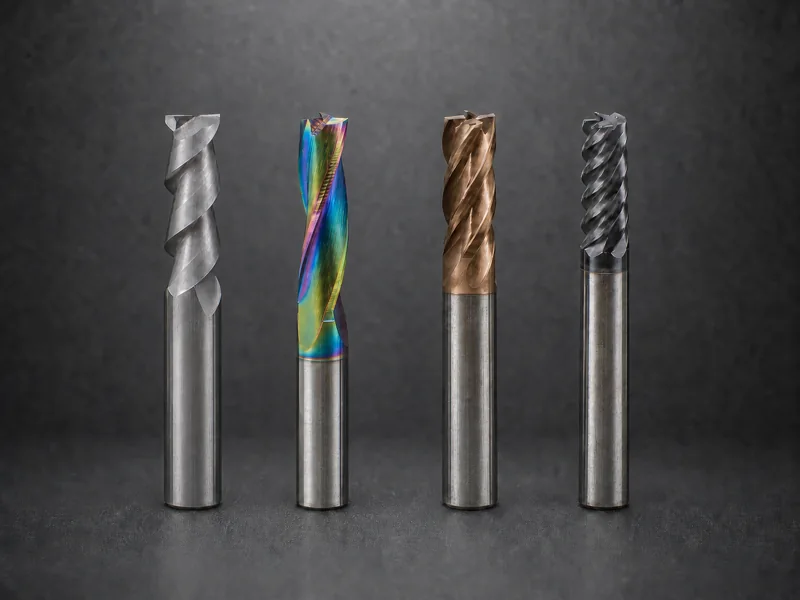
Choose end mill flute count from the chip volume and engagement before you choose from tradition. Fewer flutes leave larger valleys for chip evacuation. More flutes usually allow a larger core and put more cutting edges into each revolution, but each flute gets less chip space. That is why two or three flutes often suit heavy-chip non-ferrous work, four flutes are a common ferrous starting point, and five or more can excel at low-radial-engagement or finishing work—when the machine and evacuation system can support them.
The numbers are families, not laws. A modern aluminum-specific five-flute tool and a general-purpose five-flute steel tool may share a count while differing in helix, core, coating, flute form and intended engagement.
The governing tradeoff: chip space versus core
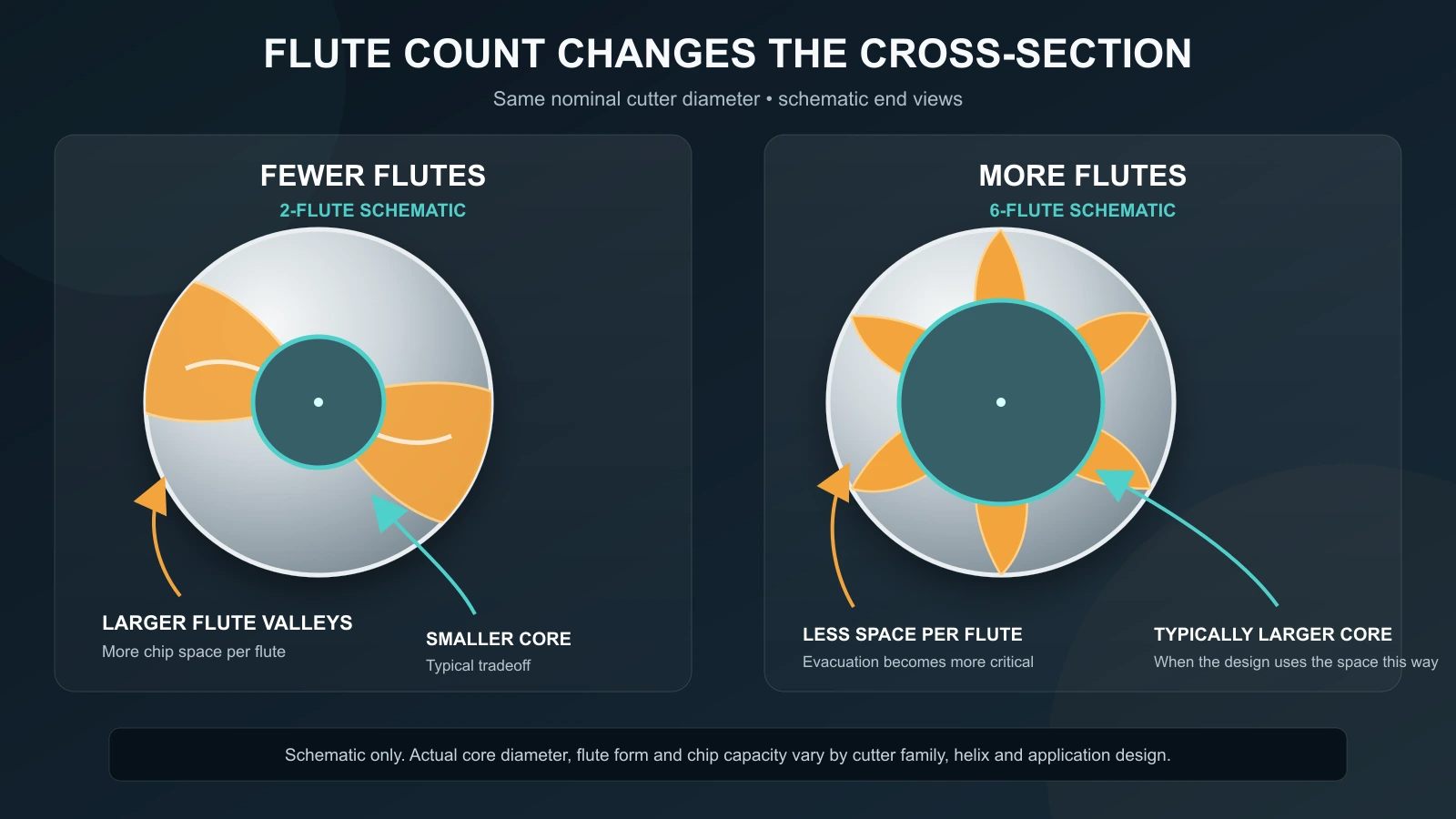
Flutes are the helical valleys and cutting edges that form and carry chips. At a given tool diameter, adding flutes normally uses circumference and cross-section that might otherwise create a deeper flute valley. The usual result is:
- fewer flutes: more space for each chip, a smaller core and fewer tooth engagements per revolution;
- more flutes: less space per chip, a larger core and more tooth engagements per revolution.
Larger flute valleys help when the operation produces thick or bulky chips, when the cutter is deeply engaged, or when coolant and air have difficulty clearing the cut. A larger core can improve tool strength and deflection resistance, especially in harder materials or long-reach conditions. More edges can also support higher table feed at the same feed per tooth, but only if power, control, chip flow and the exact tool data allow it.
Flute count therefore changes several things at once. It is not merely a productivity number.
What 2, 3, 4, and 5-plus flutes are good at
Two flutes: maximum chip room
2-flute end mills devote a large share of the tool cross-section to flute valleys. They are a natural starting point for slotting, plunging-capable operations and soft or gummy materials that generate large chips.
The traditional two-flute aluminum rule comes from this chip-space requirement, not from aluminum chemistry alone. In a full slot, both sides of the cutter engage and chips have limited escape paths. Open valleys and strong air or coolant delivery can matter more than adding another edge.
The tradeoff is fewer cutting edges and, in many designs, a smaller core than a comparable higher-flute tool. That may limit table feed, stiffness or finish productivity in lighter-engagement work.
Three flutes: non-ferrous balance
3-flute end mills often bridge the gap between two-flute chip space and four-flute tooth frequency. They are common in aluminum side milling and can also work in slotting when the specific geometry leaves enough flute volume.
The third edge can raise potential table feed for a fixed feed per tooth and RPM, while a material-specific three-flute design can preserve more chip room than a general-purpose four-flute tool. Do not assume every three-flute cutter is aluminum-specific. Check helix, polish, coating, center-cutting geometry and the supplier’s engagement limits.
Three flutes are especially useful when a two-flute tool evacuates reliably but the process needs more tooth frequency, and when a four-flute tool packs chips or demands more machine feed than the control can deliver cleanly.
Four flutes: strength and general ferrous work
4-flute end mills are a familiar starting point for steels and many general side-milling operations. Compared with a lower-flute tool of similar design, the larger core and additional edges can support strength, wear distribution and productive feed in materials that form smaller chips at their intended cutting conditions.
Four flutes do not automatically mean “for steel,” and they do not automatically fail in aluminum. The relevant question is whether the flute valleys, geometry and evacuation match the chip volume. A four-flute aluminum tool designed for low radial engagement is a different proposition from a general-purpose four-flute cutter pushed through a full-width slot.
For finishing, the extra edges can improve tooth frequency and allow a productive feed while each edge removes a small amount of material. The setup must still control runout; otherwise one flute may do more work and the theoretical edge count will not be realized evenly.
Five or more: productivity under controlled engagement
High-flute-count tools use many edges and a strong core, but offer less flute space per edge. They make the most sense when radial engagement and chip thickness are controlled, chips are small enough to clear, and the machine can execute the required feed.
High-efficiency side milling, finishing and harder-material applications can fit this pattern. So can specialized high-flute aluminum tools, which is why “high flute count equals steel only” is outdated. The design must be evaluated as a complete tool.
More flutes can become counterproductive in a slot, a heavy-width roughing cut or any operation where chips pack faster than they leave. Once chips recut or weld, added tooth frequency no longer means added productivity.
Let the operation override the material rule
Start with engagement.
Full slotting is the most demanding case for chip room. Prefer a tool whose flute volume and center-cutting capability are explicitly intended for the operation. Reducing flute count is often the first direction to investigate.
Chip evacuation must be checked along the entire slot, not only at entry. Deep walls can trap chips that cleared easily in a shallow test, and recut chips occupy the same limited valleys as newly formed material.
Heavy roughing also creates large chip volume. A lower flute count can be useful even in steel if the alternative packs chips. Roughing geometry, chip breakers and coolant delivery may matter as much as the count.
Low-radial-engagement side milling changes the balance. Thin chips and an open side can leave room for more flutes, allowing greater tooth frequency and a stronger core. Do not copy the feed from a lower-flute tool; use the exact tool’s engagement and chip-load guidance.
Here, chip evacuation may be less restrictive because the cut is open on one side, but it is not automatic. Long flutes, deep pockets and weak air or coolant delivery can still return chips to the engagement zone.
Finishing removes less stock, so chip space is less likely to dominate. A higher flute count may improve productivity and surface quality, but runout, edge condition and machine feed resolution remain limiting factors.
Where the old 2-for-aluminum, 4-for-steel rule breaks
The old rule remains a useful memory aid because it reflects typical chip size and strength needs. It fails when treated as a specification.
Toolmakers now change helix, core profile, flute form, edge preparation, coating and chip-gullet shape for narrow applications. A high-flute aluminum cutter can work at controlled radial engagement because it is designed around that chip flow. A low-flute steel rougher can be appropriate when deep valleys and chip breakers are needed for heavy removal.
Production economics also matter. A shop making a few parts may value a versatile three- or four-flute tool. A high-volume job may justify a specialized cutter matched to one bore, wall or facing pass. An accepted production case for cast aluminum illustrates the real question: the shop was not merely choosing “three versus five”; it was balancing multiple operations, length of cut, holder length, finish and cycle time.
Choose in six steps
- Define the operation and engagement. Record slotting, roughing, side milling or finishing, plus radial and axial engagement.
- Estimate chip-space demand. Consider material ductility, chip size, flute length, pocket depth and how chips will leave. If evacuation is the dominant risk, move toward fewer or more open flutes.
- Set the strength requirement. Consider material hardness, tool diameter, stickout, holder rigidity and interrupted loading. If deflection or edge strength dominates and chip space is available, investigate more flutes or a stronger core.
- Check the actual cutter family. Use the solid carbide end mill page to compare families. Then verify flute geometry, stock and application fit in the exact product data.
- Match the machine. Confirm spindle speed, available feed, acceleration, power, coolant or air delivery and control behavior. A high-flute tool is not productive if the machine cannot reach the calculated table feed or evacuate its chips.
- Run a controlled proof cut. Use the tool-specific starting data, observe chip formation, load, sound, heat and finish, and change one variable at a time.
Recalculate feed when flute count changes
Table feed is related to feed per tooth, flute count and RPM:
Table feed = feed per tooth × effective flute count × RPM
If a two-flute and four-flute tool run at the same RPM and target feed per tooth, the four-flute calculation calls for twice the table feed. Keeping table feed unchanged would halve feed per tooth. That can move the edge toward rubbing rather than delivering a conservative version of the same cut.
The relationship does not authorize doubling feed blindly. The target feed per tooth, usable tooth count, engagement and speed must come from the exact tool and operation. The machine must also be able to execute the command.
Read the symptoms of a poor flute-count choice
Chip packing, recutting, welded material or rising heat suggest insufficient flute space, poor evacuation or excessive engagement. Investigate a more open tool, better chip delivery/removal or a lighter engagement before changing everything else.
Rubbing, polished edges or heat with very small chips can mean feed per tooth is too low, including after a flute-count change made without recalculating table feed.
Chatter or wall error can point to insufficient core strength, excessive stickout, unstable workholding or an engagement that excites the setup. More flutes may help only if they change the relevant stiffness/load condition without creating chip packing.
A finish that does not improve with more flutes may expose runout or one-edge loading. Measure the tool and holder system rather than assuming the nominal flute count is sharing the cut evenly.
Machine feed saturation can make a high-flute tool miss its intended chip load. If the control cannot deliver the required table feed, choose a compatible tool/parameter set rather than running the many-flute cutter underfed.
Record the qualified choice
Record the tool ID, flute count, diameter, flute length, geometry, coating, material, operation, engagement, RPM, feed per tooth, table feed, coolant/air method and proof-cut result. That record is more useful than “use three flutes for aluminum” because it preserves the conditions that made the selection work.